
The Agneepath Scheme is a new way to join the Indian Armed Forces. Launched by the government in 2022, it allows young people to serve as soldiers for a short period of four years. These soldiers are called “Agniveers.” The aim is to make the army younger and fitter. While some people worry about job security after four years, the government promises a good financial package to help them start a new life. The following essays are written for students from Class 1 to Class 12.
Essay on Agneepath Scheme in 100 Words
The Agneepath Scheme is a recruitment plan for the Indian Army, Navy, and Air Force. It was started by the Government of India in June 2022. Under this scheme, young people between 17.5 and 21 years old can join the forces. They will serve for four years. These soldiers are known as Agniveers.
After four years, only 25% of them will stay in the army permanently. The other 75% will leave. When they leave, they get a good amount of money called the “Seva Nidhi” package. This scheme helps the army stay young and energetic.

Essay on Agneepath Scheme in 150 Words
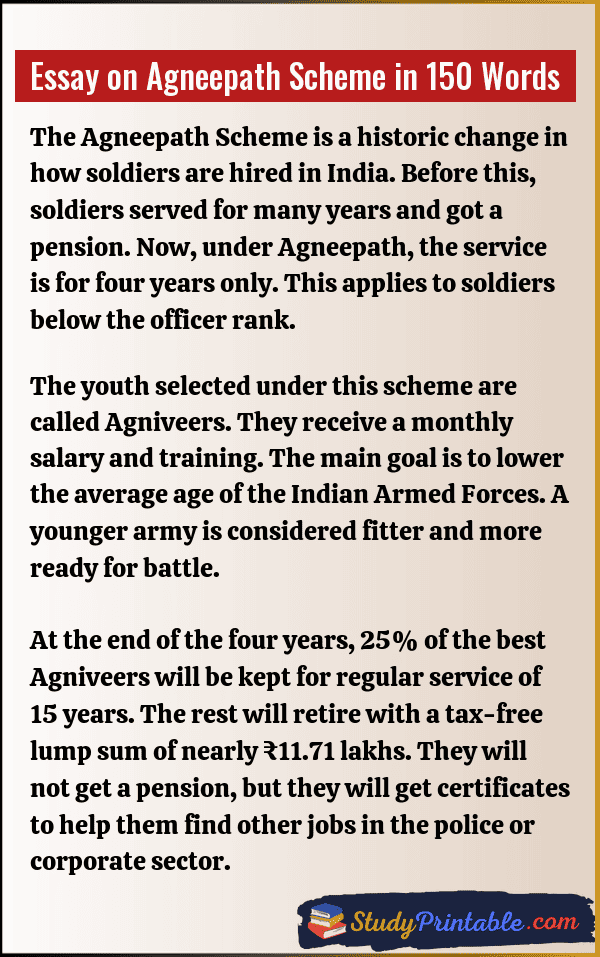
The Agneepath Scheme is a historic change in how soldiers are hired in India. Before this, soldiers served for many years and got a pension. Now, under Agneepath, the service is for four years only. This applies to soldiers below the officer rank.
The youth selected under this scheme are called Agniveers. They receive a monthly salary and training. The main goal is to lower the average age of the Indian Armed Forces. A younger army is considered fitter and more ready for battle.
At the end of the four years, 25% of the best Agniveers will be kept for regular service of 15 years. The rest will retire with a tax-free lump sum of nearly ₹11.71 lakhs. They will not get a pension, but they will get certificates to help them find other jobs in the police or corporate sector.
Essay on Agneepath Scheme in 200 Words
The Agneepath Scheme was introduced to modernize the Indian military. Launched in 2022, it allows patriotic youth to don the uniform for a short tenure. The scheme is open for the Army, Navy, and Air Force. Candidates must be between 17.5 and 21 years of age to apply.
The government believes that modern warfare needs tech-savvy and young soldiers. By hiring Agniveers for four years, the military ensures a constant flow of fresh talent. During these four years, they get a good salary and risk allowances.
One of the biggest points of discussion is the “Seva Nidhi” package. Agniveers contribute 30% of their salary, and the government adds an equal amount. After four years, this total amount is given to the soldier with interest. This money can be used to start a business or for higher education.
Although there were protests initially about the lack of pension and job security, the government has announced reservations for Agniveers in paramilitary forces like CRPF and Assam Rifles. This ensures that their service to the nation opens new doors for their future.

Essay on Agneepath Scheme in 250 Words
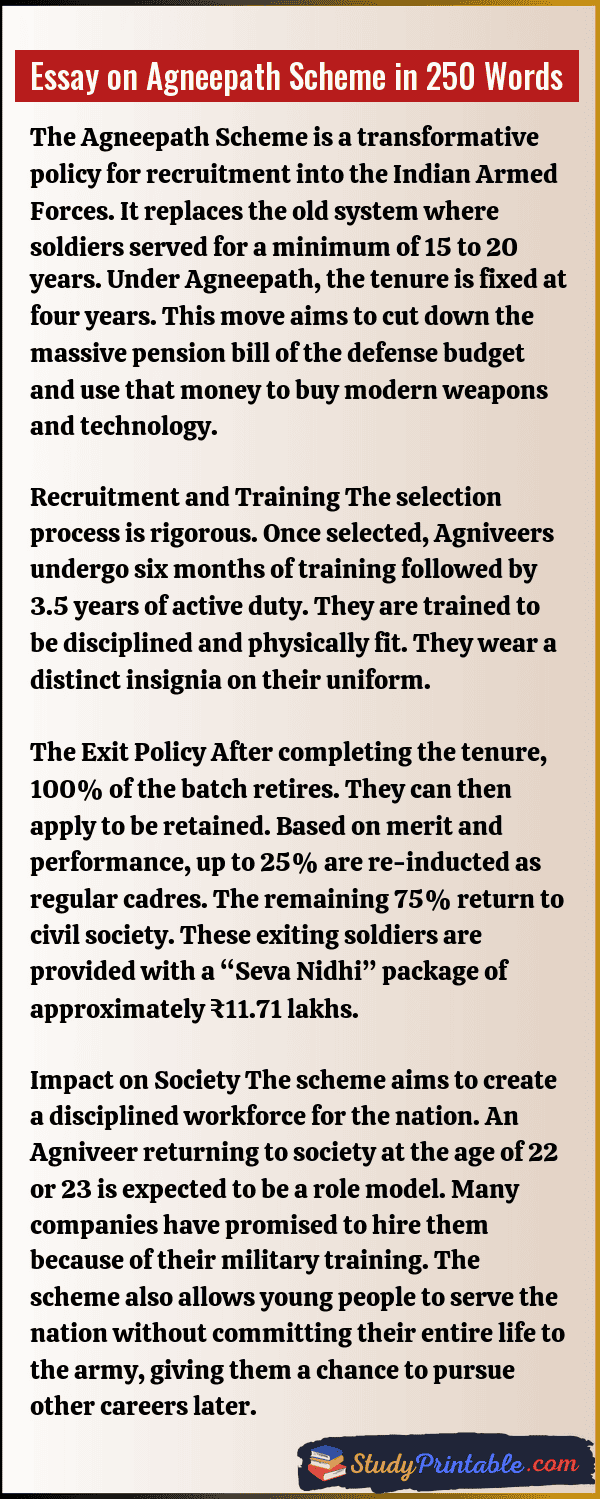
The Agneepath Scheme is a transformative policy for recruitment into the Indian Armed Forces. It replaces the old system where soldiers served for a minimum of 15 to 20 years. Under Agneepath, the tenure is fixed at four years. This move aims to cut down the massive pension bill of the defense budget and use that money to buy modern weapons and technology.
Recruitment and Training
The selection process is rigorous. Once selected, Agniveers undergo six months of training followed by 3.5 years of active duty. They are trained to be disciplined and physically fit. They wear a distinct insignia on their uniform.
The Exit Policy
After completing the tenure, 100% of the batch retires. They can then apply to be retained. Based on merit and performance, up to 25% are re-inducted as regular cadres. The remaining 75% return to civil society. These exiting soldiers are provided with a “Seva Nidhi” package of approximately ₹11.71 lakhs.
Impact on Society
The scheme aims to create a disciplined workforce for the nation. An Agniveer returning to society at the age of 22 or 23 is expected to be a role model. Many companies have promised to hire them because of their military training. The scheme also allows young people to serve the nation without committing their entire life to the army, giving them a chance to pursue other careers later.
Essay on Agneepath Scheme in 300 Words
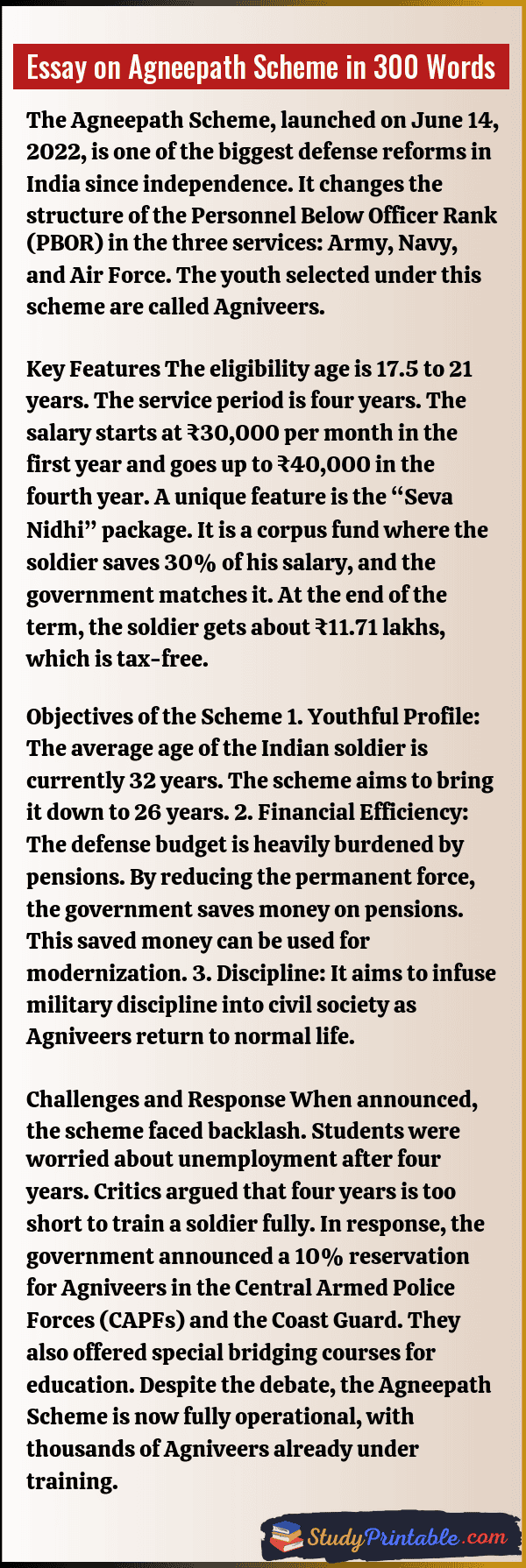
The Agneepath Scheme, launched on June 14, 2022, is one of the biggest defense reforms in India since independence. It changes the structure of the Personnel Below Officer Rank (PBOR) in the three services: Army, Navy, and Air Force. The youth selected under this scheme are called Agniveers.
Key Features
The eligibility age is 17.5 to 21 years. The service period is four years. The salary starts at ₹30,000 per month in the first year and goes up to ₹40,000 in the fourth year. A unique feature is the “Seva Nidhi” package. It is a corpus fund where the soldier saves 30% of his salary, and the government matches it. At the end of the term, the soldier gets about ₹11.71 lakhs, which is tax-free.
Objectives of the Scheme
1. Youthful Profile: The average age of the Indian soldier is currently 32 years. The scheme aims to bring it down to 26 years.
2. Financial Efficiency: The defense budget is heavily burdened by pensions. By reducing the permanent force, the government saves money on pensions. This saved money can be used for modernization.
3. Discipline: It aims to infuse military discipline into civil society as Agniveers return to normal life.
Challenges and Response
When announced, the scheme faced backlash. Students were worried about unemployment after four years. Critics argued that four years is too short to train a soldier fully. In response, the government announced a 10% reservation for Agniveers in the Central Armed Police Forces (CAPFs) and the Coast Guard. They also offered special bridging courses for education. Despite the debate, the Agneepath Scheme is now fully operational, with thousands of Agniveers already under training.
Essay on Agneepath Scheme in 500 Words
The Agneepath Scheme is a radical recruitment policy introduced by the Government of India to recruit soldiers into the three services of the armed forces. Approved by the Union Cabinet in June 2022, the scheme allows Indian youth to serve in the armed forces for a period of four years. The personnel recruited under this scheme are known as Agniveers. This policy is a departure from the traditional recruitment method where soldiers served for long tenures leading to a lifetime pension.
Structure of the Scheme
Under the Agneepath Scheme, candidates between the ages of 17.5 and 21 years can apply. The recruitment is conducted through an online centralized system for all three services, followed by specialized rallies and campus interviews. The training period lasts for about six months, followed by deployment.
Upon completion of four years, all Agniveers will be discharged. However, the armed forces will offer an opportunity to apply for enrollment in the regular cadre. Based on organizational requirements and performance, up to 25% of each batch will be enrolled in the regular cadre for a further period of 15 years. The remaining 75% will leave the service with a financial package.
Financial Benefits: Seva Nidhi
The financial model of the scheme is attractive for young recruits.
* Monthly Package: In the first year, an Agniveer gets ₹30,000 per month. By the fourth year, this rises to ₹40,000.
* Allowances: Risk and hardship allowances are applicable as per the posting.
* Seva Nidhi: This is the exit package. Every month, 30% of the salary is deducted for this fund, and the government contributes an equal amount. At the end of four years, the accumulated amount, along with interest, comes to approximately ₹11.71 Lakhs. This amount is tax-free.
* Insurance: Agniveers are provided with a non-contributory life insurance cover of ₹48 Lakhs during their service.
Why Was it Introduced?
The primary reason is to lower the age profile of the armed forces. A younger army is seen as more agile and better suited for modern technological warfare. Secondly, the pension bill of the defense ministry has been ballooning, leaving less money for buying new equipment like drones, missiles, and jets. The Agneepath scheme helps balance this expenditure.
Concerns and Way Forward
The scheme faced initial protests due to the lack of job security and pension. Critics feared that releasing thousands of weapon-trained youth into society without jobs could be dangerous. Addressing these fears, the Ministry of Home Affairs announced a 10% reservation for Agniveers in forces like the CRPF and CISF. State governments also promised preferences in police recruitment.
Conclusion
The Agneepath Scheme is a bold step towards military modernization. It offers a golden opportunity for youth to serve the nation, earn a good capital sum, and gain discipline. While it has its challenges, the government’s support measures aim to ensure that the future of every Agniveer remains bright even after they hang up their uniform.
Essay on Agneepath Scheme in 1000 Words
The Agneepath Scheme marks a paradigm shift in the recruitment policy of the Indian Armed Forces. Announced on June 14, 2022, by the Ministry of Defence, it is designed to recruit personnel below officer rank (PBOR) into the Army, Navy, and Air Force for a short-term tenure of four years. The selected candidates are titled “Agniveers.” This scheme effectively replaces the legacy recruitment models that had been in place for decades, aiming to create a leaner, younger, and more technically adept military force.
The Context: Why the Change?
For years, defense experts and committees (like the Kargil Review Committee) had recommended reducing the average age of the Indian military. Before Agneepath, the average age was around 32 years. In modern warfare, which relies heavily on technology and agility, a younger profile is preferred.
Furthermore, the financial health of the defense budget was a major concern. A significant portion of the defense budget was being spent on salaries and pensions, leaving limited funds for capital expenditure—the buying of new tanks, fighter jets, ships, and surveillance systems. By moving to a short-service model without a lifetime pension for the majority, the government aims to redirect funds toward modernization.
Key Provisions of the Scheme
Eligibility and Recruitment:
The scheme is open to candidates aged 17.5 to 21 years. Recruitment is merit-based, conducted through rallies and online exams. The medical and physical standards remain as high as they were in the previous system.
Tenure and Retention:
All Agniveers serve for four years. This includes a training period of roughly six months. After four years, 100% of the batch is discharged. They can then volunteer to join the regular cadre. The armed forces will select up to 25% of the batch to continue for another 15 years as permanent soldiers. These 25% will then be eligible for pension and other long-term benefits. The remaining 75% return to civilian life.
The Financial Package:
The Agniveers receive a customized package known as the “Seva Nidhi.”
* Year 1: ₹30,000/month (In-hand: ₹21,000, Contribution to Fund: ₹9,000).
* Year 2: ₹33,000/month.
* Year 3: ₹36,500/month.
* Year 4: ₹40,000/month (In-hand: ₹28,000, Contribution to Fund: ₹12,000).
The government matches the soldier’s contribution to the fund. Upon exit, the soldier receives the total accumulated corpus of approximately ₹11.71 Lakhs. This amount is completely tax-free. Additionally, they get a life insurance cover of ₹48 Lakhs. In case of death during service, the family receives over ₹1 Crore (insurance plus ex-gratia).
Benefits of the Scheme
1. A Younger Force: The scheme is expected to bring the average age of the armed forces down to 26 years. A “Young and Fit” profile is ideal for high-altitude areas and rigorous combat operations.
2. Tech-Savvy Soldiers: The current generation is naturally more comfortable with technology. Inducting them as Agniveers helps the army adapt to drone warfare and cyber systems faster.
3. Nation Building: The scheme produces a disciplined, skilled, and patriotic workforce. When Agniveers enter the corporate or civil world at age 22, they bring military discipline with them, which improves national productivity.
4. Financial Independence for Youth: For a young person from a rural background, exiting with ₹11-12 Lakhs at the age of 21 or 22 is a massive head start. They can fund their own higher education or start a business without taking loans.
Controversies and Concerns
The announcement of the scheme triggered violent protests in several states like Bihar, Uttar Pradesh, and Telangana. The primary anger stemmed from the “uncertainty” of the future.
Job Security: In India, a government job (Sarkari Naukri) is prized for its security and pension. Agneepath removed both for 75% of the recruits. Aspirants feared they would be unemployed at 22.
Operational Effectiveness: Some veterans argued that four years is too short to train a soldier for specialized units like the Armoured Corps or Artillery. They feared it might weaken the “Regimental Honour” system, which is the backbone of the Indian Army’s fighting spirit.
Militarization of Society: Sociologists expressed concern that having thousands of unemployed, weapon-trained youth could lead to law and order problems if they do not find jobs quickly.
Government Mitigations
To address these fears, the government rolled out several support measures:
* Reservations: 10% of vacancies in the Central Armed Police Forces (CRPF, BSF, CISF, etc.) and Assam Rifles are reserved for Agniveers.
* Coast Guard & Defense Civilians: 10% reservation in the Indian Coast Guard and defense civilian posts.
* Education Credits: The Ministry of Education launched a special degree program where Agniveers can earn credits during their service, allowing them to get a Bachelor’s degree upon exit.
* Corporate Support: Major Indian companies like Mahindra, Tata, and Reliance have publicly stated they will prefer hiring Agniveers due to their discipline.
Conclusion
The Agneepath Scheme is a disruptive reform. Like all major changes, it has faced resistance and skepticism. However, the necessity of modernizing the Indian military cannot be ignored. The scheme tries to balance the operational needs of the army with the aspirations of the youth.
If implemented well, Agneepath has the potential to turn the Indian military into a future-ready fighting force while creating a pool of disciplined citizens who contribute to the nation’s economy. The success of the scheme will depend on how well the “exit” phase is managed—specifically, ensuring that the 75% of soldiers who leave are successfully reintegrated into the workforce.
FAQ
Who can apply for the Agneepath Scheme?
Candidates between the ages of 17.5 years and 21 years can apply. They must meet the physical and educational standards set by the Army, Navy, or Air Force.
What is the salary of an Agniveer?
An Agniveer gets ₹30,000 per month in the first year. This increases every year, reaching ₹40,000 per month in the fourth year.
Do Agniveers get a pension?
No, the 75% of Agniveers who leave after four years do not get a pension. However, the 25% who are selected to stay for 15 more years will get a pension when they retire later.
What is Seva Nidhi?
Seva Nidhi is a savings package. Part of the soldier’s salary is saved, and the government adds the same amount. After four years, the soldier gets this total money (about ₹11.71 Lakhs) to start their new life.


