
Dr. APJ Abdul Kalam was a great scientist and a true hero of India. He is known as the “Missile Man” because he built strong missiles for the country. He also served as the 11th President of India. People loved him very much because he was kind and simple. He loved to talk to children and students. His life teaches us that hard work can make dreams come true. He wanted every child to dream big and fly high. The following essays are written for students from Class 1 to Class 12.
Essay on APJ Abdul Kalam in 100 Words
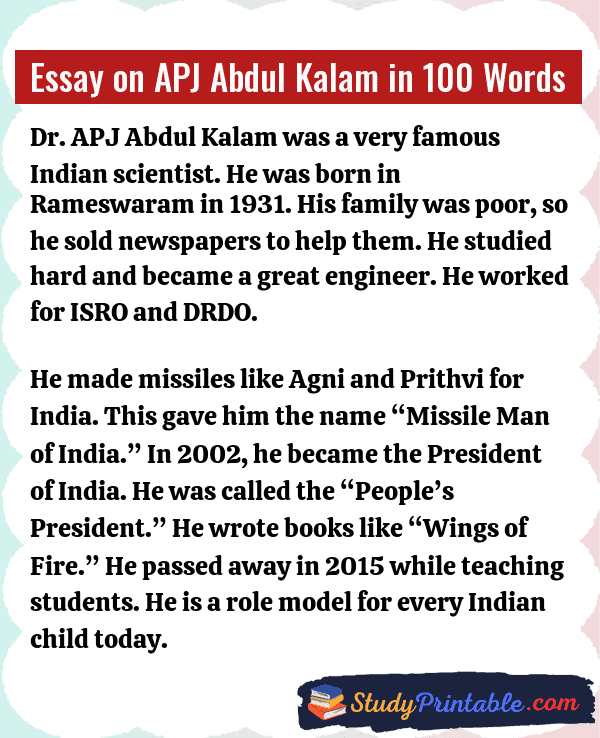
Dr. APJ Abdul Kalam was a very famous Indian scientist. He was born in Rameswaram in 1931. His family was poor, so he sold newspapers to help them. He studied hard and became a great engineer. He worked for ISRO and DRDO.
He made missiles like Agni and Prithvi for India. This gave him the name “Missile Man of India.” In 2002, he became the President of India. He was called the “People’s President.” He wrote books like “Wings of Fire.” He passed away in 2015 while teaching students. He is a role model for every Indian child today.
Essay on APJ Abdul Kalam in 150 Words
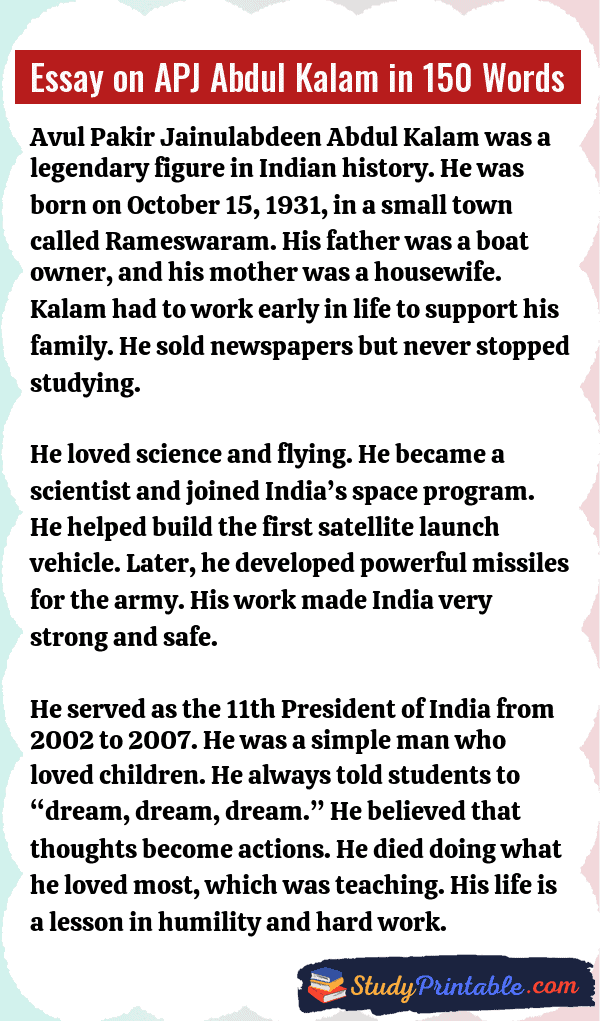
Avul Pakir Jainulabdeen Abdul Kalam was a legendary figure in Indian history. He was born on October 15, 1931, in a small town called Rameswaram. His father was a boat owner, and his mother was a housewife. Kalam had to work early in life to support his family. He sold newspapers but never stopped studying.
He loved science and flying. He became a scientist and joined India’s space program. He helped build the first satellite launch vehicle. Later, he developed powerful missiles for the army. His work made India very strong and safe.
He served as the 11th President of India from 2002 to 2007. He was a simple man who loved children. He always told students to “dream, dream, dream.” He believed that thoughts become actions. He died doing what he loved most, which was teaching. His life is a lesson in humility and hard work.
Essay on APJ Abdul Kalam in 200 Words
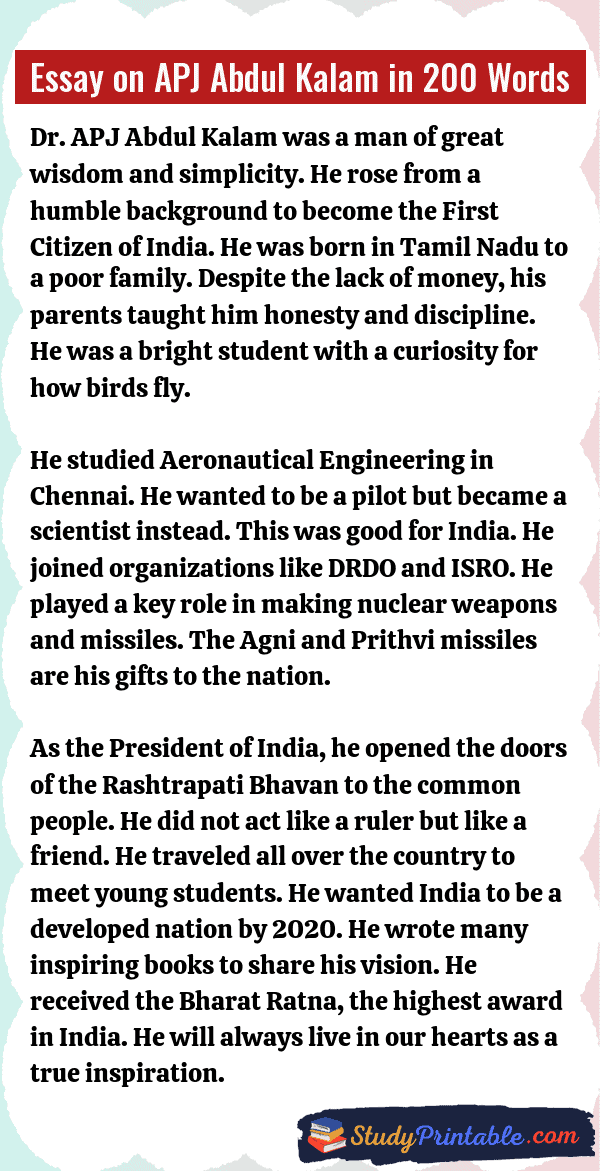
Dr. APJ Abdul Kalam was a man of great wisdom and simplicity. He rose from a humble background to become the First Citizen of India. He was born in Tamil Nadu to a poor family. Despite the lack of money, his parents taught him honesty and discipline. He was a bright student with a curiosity for how birds fly.
He studied Aeronautical Engineering in Chennai. He wanted to be a pilot but became a scientist instead. This was good for India. He joined organizations like DRDO and ISRO. He played a key role in making nuclear weapons and missiles. The Agni and Prithvi missiles are his gifts to the nation.
As the President of India, he opened the doors of the Rashtrapati Bhavan to the common people. He did not act like a ruler but like a friend. He traveled all over the country to meet young students. He wanted India to be a developed nation by 2020. He wrote many inspiring books to share his vision. He received the Bharat Ratna, the highest award in India. He will always live in our hearts as a true inspiration.
Essay on APJ Abdul Kalam in 250 Words
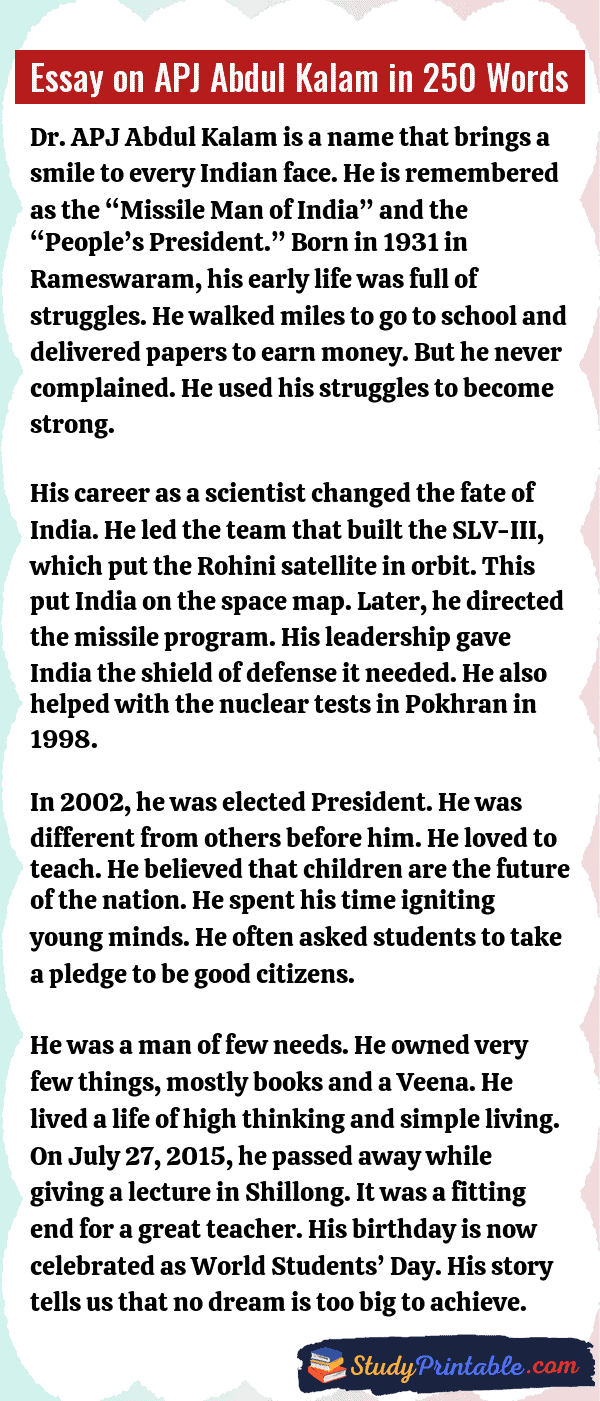
Dr. APJ Abdul Kalam is a name that brings a smile to every Indian face. He is remembered as the “Missile Man of India” and the “People’s President.” Born in 1931 in Rameswaram, his early life was full of struggles. He walked miles to go to school and delivered papers to earn money. But he never complained. He used his struggles to become strong.
His career as a scientist changed the fate of India. He led the team that built the SLV-III, which put the Rohini satellite in orbit. This put India on the space map. Later, he directed the missile program. His leadership gave India the shield of defense it needed. He also helped with the nuclear tests in Pokhran in 1998.
In 2002, he was elected President. He was different from others before him. He loved to teach. He believed that children are the future of the nation. He spent his time igniting young minds. He often asked students to take a pledge to be good citizens.
He was a man of few needs. He owned very few things, mostly books and a Veena. He lived a life of high thinking and simple living. On July 27, 2015, he passed away while giving a lecture in Shillong. It was a fitting end for a great teacher. His birthday is now celebrated as World Students’ Day. His story tells us that no dream is too big to achieve.
Essay on APJ Abdul Kalam in 300 Words
Dr. Avul Pakir Jainulabdeen Abdul Kalam was a visionary who dedicated his entire life to the service of his motherland. He was born into a large family in Rameswaram. His father, Jainulabdeen, was a pious man who owned a boat. His mother, Ashiamma, was a kind soul. Though they were not rich, they gave Kalam a childhood full of love and values.
Kalam was an average student in school but was very hardworking. He had a special love for mathematics and physics. He went on to study aerospace engineering at the Madras Institute of Technology. He missed his dream of becoming a fighter pilot by one rank. But he did not lose hope. He joined the Ministry of Defence as a scientist.
His contribution to India’s space and defense sectors is unmatched. He worked under Vikram Sarabhai, the father of the Indian space program. Kalam was the project director for India’s first indigenous Satellite Launch Vehicle. Later, he moved to the Defence Research and Development Organisation (DRDO). There, he led the Integrated Guided Missile Development Programme. This gave birth to five major missiles: Agni, Prithvi, Akash, Trishul, and Nag.
As the 11th President of India, he touched the hearts of millions. He had a unique connection with the youth. He received thousands of emails from children and tried to reply to many. He wrote best-selling books like “Wings of Fire” and “Ignited Minds.” These books encourage readers to break barriers.
He was honored with the Padma Bhushan, Padma Vibhushan, and the Bharat Ratna. Even after leaving the presidency, he continued to teach. He died of a cardiac arrest while addressing students at IIM Shillong. Dr. Kalam proved that a person is defined by their actions, not their birth. He remains an eternal beacon of hope for India.
Essay on APJ Abdul Kalam in 500 Words
Dr. APJ Abdul Kalam was not just a name; he was a movement of inspiration. He was a scientist, a writer, a teacher, and a leader who lived for his country. Born on October 15, 1931, in the island town of Rameswaram, Tamil Nadu, his journey is a fairy tale of hard work. He came from a humble background where resources were scarce. His father was a boatman who ferried pilgrims. To help his father, young Kalam collected tamarind seeds and sold newspapers. These early hardships taught him the value of labor and humility.
Education was his ladder to the sky. He was a curious child who asked many questions. After finishing school, he joined St. Joseph’s College in Tiruchirappalli for a degree in Physics. Later, his passion for flying took him to the Madras Institute of Technology to study aeronautical engineering. He famously said that he had to sell his sister’s jewelry to pay his fees. This sacrifice fueled his determination to succeed.
Kalam started his career designing a small hovercraft. He soon joined the Indian Space Research Organisation (ISRO). Here, he found his true calling. He played a pivotal role in the launch of the SLV-III, India’s first satellite launch vehicle. This success made him a known face in the scientific community. But his biggest work was yet to come. He transferred to DRDO to lead the missile program. Under his guidance, India developed the Agni and Prithvi missiles. These missiles made India a powerful nation that could defend itself. He also played a key administrative role in the Pokhran-II nuclear tests, establishing India as a nuclear state.
In 2002, the nation chose him as its 11th President. He entered the Rashtrapati Bhavan with two suitcases and a heart full of dreams. He transformed the presidency. He interacted with people from all walks of life. He was particularly fond of children. He believed that a developed India required the energy of its youth. He set a goal for India to become a developed nation by the year 2020. This vision was called “Vision 2020.”
Dr. Kalam was a man of diverse talents. He played the Veena and wrote poetry in Tamil. He was a spiritual person who respected all religions. He never married and dedicated every second of his life to the nation. He wrote many books to share his experiences. His autobiography, “Wings of Fire,” has inspired millions to overcome difficulties.
He left the world on July 27, 2015. He collapsed while delivering a lecture at IIM Shillong. It was a sudden but peaceful end for a man who always wanted to be remembered as a teacher. His funeral in Rameswaram was attended by thousands. Today, his grave is a memorial where people come to pay respect. Dr. Kalam showed us that true greatness lies in simplicity and service.
Essay on APJ Abdul Kalam in 1000 Words
Dr. Avul Pakir Jainulabdeen Abdul Kalam, popularly known as APJ Abdul Kalam, was a rare gem of India. He was a scientist who became a statesman, but at his core, he remained a teacher. His life story is a testament to the power of perseverance. From delivering newspapers in the small lanes of Rameswaram to occupying the highest office in the land, his journey is nothing short of miraculous. He is revered not just for his scientific achievements but for his humble personality and his undying love for the nation.
Early Life and Struggle
Kalam was born on October 15, 1931, into a Tamil Muslim family in Rameswaram. His father, Jainulabdeen, was an Imam and a boat owner. His mother, Ashiamma, was a devoted housewife. The family was not wealthy. In fact, during his childhood, the family lost most of its fortune. Kalam faced poverty at a young age. He would get up early to pick up newspaper bundles from the train station and distribute them. This job gave him his first earnings and a sense of pride.
Despite the lack of money, his home was rich in values. His father taught him that true wealth is the wealth of the spirit. He learned to respect all religions as Rameswaram was a place where Hindus and Muslims lived in harmony. His science teacher, Sivasubramania Iyer, played a big role in breaking social barriers for him. He invited Kalam to his house for a meal, defying strict caste rules. These incidents shaped Kalam’s worldview.
Education and Dreams
Kalam was an average student academically but possessed a bright mind. He spent hours studying. After school, he went to St. Joseph’s College to study Physics. However, he soon realized that physics was not his only passion. He dreamed of flying. He moved to Madras to study Aeronautical Engineering at MIT.
During his final project at MIT, the dean threatened to revoke his scholarship if he did not finish a complex design in three days. Kalam worked day and night, skipping meals and sleep. He finished the project on time, impressing the dean. This incident showed his ability to work under immense pressure. He graduated in 1958 with high hopes of joining the Air Force. He was ranked ninth, but there were only eight slots. He was heartbroken but decided to serve science instead.
The Scientist and The Missile Man
He began his career at the Defence Research and Development Organisation (DRDO). He designed a small helicopter for the army. Later, he moved to the Indian Space Research Organisation (ISRO). This was the turning point in his life. He worked as the Project Director for the SLV-III. In 1980, the rocket successfully deployed the Rohini satellite. Kalam was overjoyed. It was the first time India had launched a satellite on its own.
In the 1980s, he returned to DRDO with a bigger mission. He launched the Integrated Guided Missile Development Programme (IGMDP). He led a team of brilliant scientists to build missiles. This program produced Prithvi (surface-to-surface), Agni (long-range), Akash, Trishul, and Nag. The success of Agni was a global event. It proved that India had the technology to defend itself against any threat. For this massive contribution, the nation called him the “Missile Man of India.”
The People’s President
In 2002, the ruling party and the opposition agreed to nominate him for President. He won easily. As President, he chose to be accessible. He ignored strict protocols that kept people away. He invited school children, farmers, and scientists to the Rashtrapati Bhavan. He famously refused to sit on a larger chair at events, insisting on an equal seat.
He used his position to speak about “Vision 2020.” He wanted India to transform from a developing nation to a developed one. He focused on three key areas: education, infrastructure, and technology. He traveled to remote villages and top universities, delivering the same message of hope. He received two suitcases of personal items when he moved in, and he left with the same two suitcases. He donated his salary to charity.
Philosophy and Writings
Dr. Kalam was a prolific writer. His autobiography, “Wings of Fire,” is one of the most read books in India. It tells the story of his life simply and honestly. In “Ignited Minds,” he argues that India’s greatest resource is its youth. In “India 2020,” he lays out a blueprint for the country’s future.
His philosophy was simple. He believed that you have to dream before your dreams can come true. He said, “Dream is not that which you see while sleeping, it is something that does not let you sleep.” He encouraged students to ask questions and never accept failure. For him, FAIL meant “First Attempt In Learning.”
Final Moments and Legacy
After his term ended in 2007, he returned to teaching. He became a visiting professor at IIM Shillong, IIM Ahmedabad, and IIM Indore. He loved being among students. On July 27, 2015, he was in Shillong to give a lecture on “Creating a Livable Planet Earth.” Five minutes into the lecture, he collapsed. He died of a sudden cardiac arrest.
His death triggered a wave of grief across the nation. The government declared a seven-day mourning period. He was laid to rest in his hometown of Rameswaram with full state honors. A memorial was built there to honor him.
Conclusion
Dr. APJ Abdul Kalam was a true patriot. He did not seek power or money. He sought knowledge and the welfare of his people. He showed that a boy from a small island could reach the stars. He bridged the gap between science and spirituality. He proved that kindness is a strength, not a weakness. His legacy is not just in the missiles he built but in the millions of minds he ignited. He will forever remain the heartbeat of a rising India.
This video is relevant because it is an audio summary of the chapter “My Childhood” from Kalam’s autobiography, helping students understand his early life.
FAQ
Who was APJ Abdul Kalam?
APJ Abdul Kalam was a great Indian scientist and the 11th President of India. He is famous for making missiles and is known as the “Missile Man of India.” He was also a writer and a teacher.
Why is he called the Missile Man?
He is called the Missile Man because he led the development of important missiles for India. He helped make missiles like Agni and Prithvi. These missiles made India’s defense very strong.
When was he the President of India?
He was the President of India from the year 2002 to 2007. During this time, he was known as the “People’s President” because he was very friendly and met many common people.
What books did he write?
He wrote many famous books. The most famous one is his autobiography called “Wings of Fire.” He also wrote “Ignited Minds,” “India 2020,” and “My Journey.” These books inspire young people.


