
Autumn is the season that comes between summer and winter. It is often called “fall” because the leaves fall from the trees during this time. The air starts to get cooler, and the days become shorter. It is a time when nature changes its colors to gold, orange, and red. Farmers harvest their crops, and animals prepare for the cold winter ahead. It is a beautiful and peaceful time of the year. The following essays are written for students from Class 1 to Class 12.
Essay on Autumn Season in 100 Words
Autumn is a very colorful season. It comes after the hot summer. During this time, the weather becomes pleasant. It is neither too hot nor too cold. The leaves on the trees turn yellow, brown, and red. Soon, they dry up and fall to the ground. That is why it is also called fall.
Birds start flying to warmer places. Squirrels gather nuts to eat in winter. People wear light jackets and sweaters. Many festivals happen in autumn. It is the time for harvesting crops like corn and pumpkins. Autumn is a season of change and beauty.
Essay on Autumn Season in 150 Words
Autumn is one of the four main seasons. It acts as a bridge between the blazing heat of summer and the freezing cold of winter. In many parts of the world, autumn creates a stunning view. The green leaves of summer turn into bright shades of orange, gold, and red. Walking in a park feels like walking on a crunchy carpet of leaves.
The temperature drops, and the air feels crisp. People enjoy hot drinks like tea and cocoa. It is the perfect weather for outdoor picnics. This season is also very important for farmers. It is the harvest season. They cut crops and store food for the coming months.
Days get shorter in autumn, and nights get longer. It is nature’s way of telling us to slow down. The beauty of autumn brings peace to the mind. It is truly the golden season of the year.
Essay on Autumn Season in 200 Words
Autumn is known as the “season of mists and mellow fruitfulness.” It creates a magical atmosphere all around. The scorching sun of summer is gone. A cool breeze starts to blow. The sky looks clear and blue, often filled with white, fluffy clouds.
The most distinctive feature of autumn is the shedding of leaves. Trees prepare for winter by dropping their leaves to save energy. Before they fall, they put on a spectacular show of colors. Forests look like paintings made of gold and fire.
For animals, autumn is a busy time. Bears eat a lot to get fat for hibernation. Birds migrate thousands of miles to find warmth. For humans, it is a time of celebration. Many festivals like Halloween and Thanksgiving are celebrated in the West. In India, festivals like Durga Puja and Diwali often fall during this period.
The markets are full of fresh fruits and vegetables. Apples, pears, and pumpkins are everywhere. The weather is healthy and refreshing. It is the best time to travel and explore nature. Autumn teaches us that change can be beautiful. It reminds us that letting go of the old is necessary to make way for the new.
Essay on Autumn Season in 250 Words
Autumn is a season that brings relief from the humidity and heat of the rainy and summer seasons. It usually spans from September to November in the Northern Hemisphere. It is a season characterized by a distinct change in the environment.
The transformation of trees is the highlight of autumn. Chlorophyll, which makes leaves green, disappears. This reveals other colors like yellow and red. The sight of leaves falling gently from trees is mesmerizing. Children love to play in piles of dry leaves.
This season is also known as the harvest season. In the past, the survival of people depended on a good autumn harvest. Even today, it is a time of plenty. Fields are golden with ripe wheat and corn. Farmers work hard to gather the yield.
The weather in autumn is very balanced. It is perfect for wearing comfortable clothes. You do not need heavy coats yet, just a cozy sweater. The nights are cool and starry. The moon often looks bigger and brighter, known as the “Harvest Moon.”
However, autumn also has a mood of sadness for some. It signals the end of the lively summer. The trees become bare, looking like skeletons. But this is just a cycle. The trees are resting to bloom again in spring.
Autumn is a time for family and gratitude. It is a time to sit by the fire and tell stories. It is a season that warms the heart even as the air gets cold.
Essay on Autumn Season in 300 Words
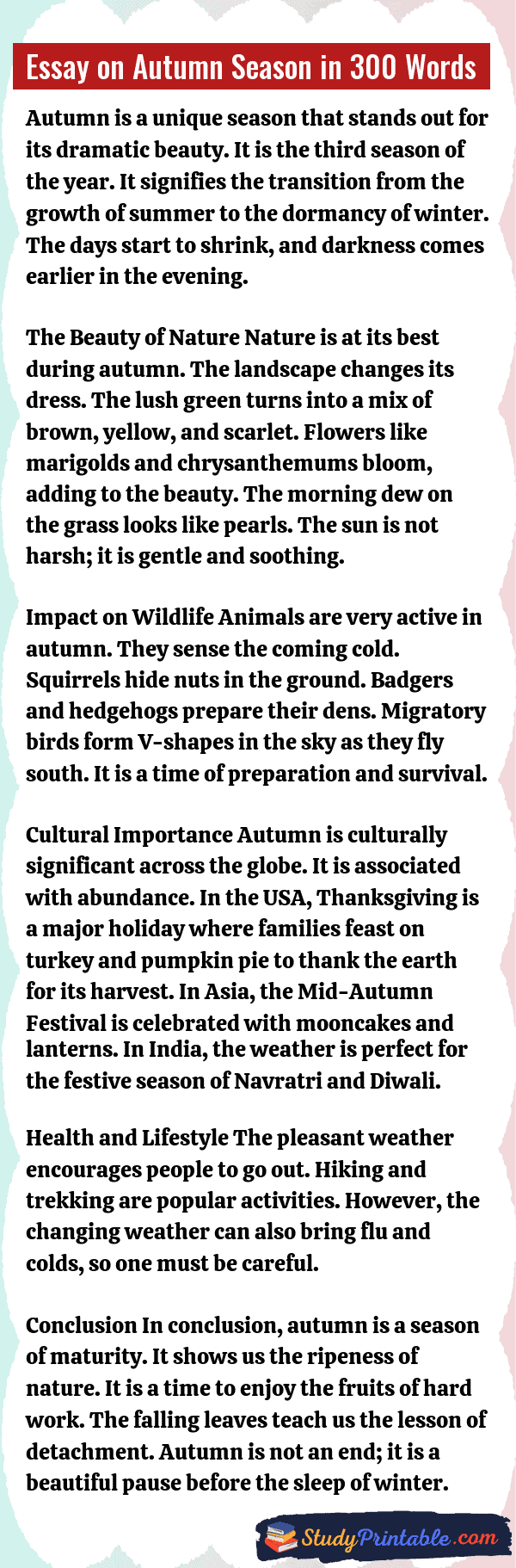
Autumn is a unique season that stands out for its dramatic beauty. It is the third season of the year. It signifies the transition from the growth of summer to the dormancy of winter. The days start to shrink, and darkness comes earlier in the evening.
The Beauty of Nature
Nature is at its best during autumn. The landscape changes its dress. The lush green turns into a mix of brown, yellow, and scarlet. Flowers like marigolds and chrysanthemums bloom, adding to the beauty. The morning dew on the grass looks like pearls. The sun is not harsh; it is gentle and soothing.
Impact on Wildlife
Animals are very active in autumn. They sense the coming cold. Squirrels hide nuts in the ground. Badgers and hedgehogs prepare their dens. Migratory birds form V-shapes in the sky as they fly south. It is a time of preparation and survival.
Cultural Importance
Autumn is culturally significant across the globe. It is associated with abundance. In the USA, Thanksgiving is a major holiday where families feast on turkey and pumpkin pie to thank the earth for its harvest. In Asia, the Mid-Autumn Festival is celebrated with mooncakes and lanterns. In India, the weather is perfect for the festive season of Navratri and Diwali.
Health and Lifestyle
The pleasant weather encourages people to go out. Hiking and trekking are popular activities. However, the changing weather can also bring flu and colds, so one must be careful.
Conclusion
In conclusion, autumn is a season of maturity. It shows us the ripeness of nature. It is a time to enjoy the fruits of hard work. The falling leaves teach us the lesson of detachment. Autumn is not an end; it is a beautiful pause before the sleep of winter.
Essay on Autumn Season in 500 Words
Autumn, frequently referred to as fall in North America, is one of the four temperate seasons. It marks the transition from summer to winter. In the Northern Hemisphere, it generally begins in late September and ends in late December. It is a season of profound changes in the natural world, affecting plants, animals, and human life alike.
The Science of Colors
The most striking feature of autumn is the changing color of the foliage. During spring and summer, leaves are green because of a pigment called chlorophyll. This pigment absorbs sunlight to make food for the tree. As days get shorter in autumn, there is less sunlight. The trees stop making food and chlorophyll breaks down. The green color fades, and other pigments like carotene (orange) and anthocyanin (red) become visible. This chemical process creates the breathtaking landscapes we associate with fall.
The Harvest Season
Since ancient times, autumn has been the most critical time for survival. It is the time of harvest. Crops that were planted in spring and grew all summer are finally ready. Farmers rush to collect grains, fruits, and vegetables before the frost arrives. A good autumn harvest meant the community would have enough food to survive the harsh winter. Even today, we see this connection in our festivals. Thanksgiving, Succoth, and Pongal are all harvest-related celebrations that happen around this time or celebrate the harvest spirit.
Animal Behavior
Wildlife undergoes a massive shift in behavior. It is a race against time. Mammals like bears and groundhogs eat excessive amounts of food to build up body fat. This fat keeps them alive while they hibernate in winter. Insects die off or go dormant. Birds are perhaps the most noticeable. Many species, like geese and swallows, migrate to warmer climates. They travel thousands of miles to escape the freezing temperatures.
Atmosphere and Mood
There is a distinct “feel” to autumn. The air loses its humidity and becomes crisp and dry. The sky is often a brilliant, deep blue. Mornings are misty and cool, while afternoons are pleasantly warm. This weather is ideal for human health. It is neither too sweaty nor too freezing. People enjoy outdoor activities like camping and bonfires.
However, autumn also carries a sense of melancholy. It represents the end of the life cycle for many plants. Poets often use autumn as a metaphor for old age or the decline of life. But it is a graceful decline. The falling leaves do not just die; they decompose and enrich the soil. This provides nutrients for the new plants that will grow in spring.
Conclusion
Autumn is a season of balance. It balances the day and night during the equinox. It balances the heat and the cold. It is a time of reflection and gratitude. As we watch the leaves fall, we are reminded that nature moves in cycles. Autumn is the earth’s way of resting, a colorful finale before the quiet of winter. It is a season that fills the eyes with beauty and the heart with peace.
Essay on Autumn Season in 1000 Words
The Earth revolves around the sun, and its tilted axis gives us the rhythm of the seasons. Among the four seasons—spring, summer, autumn, and winter—autumn holds a special place in the hearts of poets, artists, and nature lovers. It is the transition period between the vibrant life of summer and the dormant silence of winter. While spring is the season of birth and summer is the season of growth, autumn is the season of maturity and harvest. It is a time when nature puts on its most spectacular display of colors, a final burst of beauty before the white blanket of winter covers the land.
The Timing and Astronomy
In the Northern Hemisphere, autumn officially begins with the autumnal equinox, which usually falls on September 22 or 23. On this day, the sun shines directly on the equator, and day and night are of almost equal length. After this date, the days get shorter and the nights get longer. The sun rises later and sets earlier, reducing the amount of daylight and warmth the earth receives. This decrease in light and temperature triggers the changes we see in the environment.
The Phenomenon of Falling Leaves
The word “fall” is used interchangeably with autumn, especially in American English, and it describes the season’s most defining event: the falling of leaves. Deciduous trees—trees that lose their leaves—undergo a complex chemical process.
Leaves are the food factories of a tree. They contain chlorophyll, which gives them their green color. In autumn, the tree senses the shorter days and cooler temperatures. It knows that it cannot maintain its leaves in the winter because the water in the delicate leaf cells would freeze. To protect itself, the tree slowly cuts off the supply of water and nutrients to the leaves.
As the chlorophyll disappears, the green fades away. This unmasks the other colors that were hidden underneath. We see brilliant yellows from xanthophylls, oranges from carotenoids, and deep reds and purples from anthocyanins. The result is a landscape that looks like it is on fire with color. Eventually, the stem of the leaf weakens, and it flutters to the ground. These fallen leaves are not waste; they form a protective layer over the soil and eventually decay to become fertilizer.
The Season of Harvest
Historically, autumn was the most stressful and important time of the year. It was the harvest season. In an agricultural society, the success of the autumn harvest determined whether a family would live or starve during the winter.
Farmers work long hours to bring in crops like wheat, barley, corn, apples, pumpkins, and grapes. The connection to food is strong in autumn. We see it in the abundance of fresh produce in the markets. Root vegetables like carrots and potatoes are dug up. Orchards are full of ripe fruit.
This abundance is celebrated in almost every culture. In North America, Thanksgiving brings families together to share a large meal, centering on the harvest foods of turkey, squash, and cranberries. In the UK, Harvest Festivals are held in churches and schools. In China and Vietnam, the Mid-Autumn Festival celebrates the harvest and the full moon. These festivals are a way for humans to express gratitude to nature for its bounty.
Wildlife and Preparation
For the animal kingdom, autumn is not a time for relaxation; it is a time of frantic preparation. The instinct to survive winter drives animal behavior.
Migration: Look up at the sky in autumn, and you will often see birds flying in V-formations. Geese, swallows, and monarchs butterflies travel thousands of miles to warmer regions near the equator. They leave before the food runs out and the water freezes.
Hibernation: Animals that do not migrate, like bears, chipmunks, and bats, prepare to sleep through the winter. They enter a state called hibernation. In autumn, they enter a phase of hyperphagia, which means overeating. They eat constantly to build up a thick layer of fat. This fat will fuel their bodies while they sleep for months without eating.
Hoarding: Other animals, like squirrels and jays, spend autumn gathering food. They hide nuts and seeds in the ground or in tree hollows. They are creating a pantry that they can visit when the ground is covered in snow.
Weather and Human Health
Autumn weather is often described as “crisp.” The humidity of summer vanishes. The air becomes cleaner and fresher. For many people, this is the most comfortable time of the year. It is perfect for outdoor exercises like running and hiking without the risk of heatstroke.
However, the shifting season also brings challenges. The drop in temperature can weaken the immune system, making people susceptible to the flu and common colds. The reduction in sunlight can also affect mental health, leading to a condition known as Seasonal Affective Disorder (SAD), where people feel sad or low energy. It is important to stay active and get sunlight during these months.
Symbolism in Literature and Art
Artists and writers have always been drawn to autumn. It is a season of duality. On one hand, it is beautiful and abundant. On the other hand, it represents decline and decay.
In literature, autumn often symbolizes maturity and wisdom. Just as a tree bears fruit in autumn, a person gains wisdom in the later years of their life. It is also a symbol of letting go. The trees do not fight to keep their leaves; they release them gracefully. This teaches us the lesson of acceptance.
Painters love the autumn palette. The warm earth tones—ochre, amber, sienna, and gold—create a cozy and nostalgic feeling. It evokes a sense of comfort, of sitting by a fire with a warm drink while the wind howls outside.
Conclusion
Autumn is a spectacular bridge between the extremes of the year. It is a season that engages all our senses—the sight of red leaves, the sound of crunching footsteps, the smell of rain on dry earth, the taste of apple pie, and the feeling of a cool breeze. It reminds us that change is the only constant in life. It teaches us to prepare for the future while enjoying the present. Autumn is nature’s way of showing us how beautiful it is to let things go.
FAQ
Why do leaves change color in autumn?
Leaves change color because trees stop making chlorophyll, the green pigment. As the green fades, other colors like yellow and orange, which were hiding underneath, become visible.
What is the autumnal equinox?
The autumnal equinox is the day when autumn officially begins. On this day, the day and night are of equal length. It usually happens around September 22 or 23.
What do animals do in autumn?
Animals prepare for winter in autumn. Some birds fly to warmer places (migration). Some animals like bears eat a lot to store fat for sleeping (hibernation). Others like squirrels collect nuts to eat later.
Why is autumn called “fall”?
It is called “fall” mainly in North America because it is the season when leaves fall from the trees. It is a simple way to describe what happens in nature during this time.


