
Plastic has become a very common part of our lives, but it is also a big enemy of our planet. From candy wrappers to shopping bags, plastic is everywhere. The problem is that it does not rot or go away like leaves or paper. It stays on the earth for hundreds of years, making the land and water dirty. It hurts animals who eat it by mistake. To save the Earth, we must stop using plastic and switch to eco-friendly options. The following essays are written for students from Class 1 to Class 12.
Essay on Avoid Plastic in 100 Words
Plastic is a harmful material for nature. We use plastic bags, bottles, and toys every day. But when we throw them away, they do not disappear. They stay in the soil and make it dirty. Animals like cows and dogs often eat plastic bags with food. This makes them very sick and can even kill them.
Burning plastic is also bad because it produces black smoke that hurts our lungs. We should stop using plastic bags. Instead, we should use cloth or paper bags. If we want a clean and green earth, we must say no to plastic.
Essay on Avoid Plastic in 150 Words
Plastic pollution is a serious problem today. “Avoid Plastic” should be our motto. Plastic is cheap and easy to use, so people use it a lot. However, it is non-biodegradable. This means it cannot be broken down by bacteria in the soil. It remains on the earth for hundreds of years.
When plastic is thrown into rivers or oceans, it kills sea creatures. Turtles often mistake plastic bags for jellyfish and eat them. This blocks their stomach. On land, plastic blocks drains and causes floods during rain.
We can help by making small changes. We should carry our own water bottles instead of buying plastic ones. We should refuse plastic straws at restaurants. Using jute or cotton bags for shopping is a great habit. Avoiding plastic is the best way to show we love our planet.
Essay on Avoid Plastic in 200 Words
Plastic was invented to make life easy, but it has now become a curse. The slogan “Say No to Plastic” is heard everywhere because the damage is visible. The biggest issue with plastic is its durability. It takes up to 1000 years for a plastic bottle to decompose. Until then, it lies in landfills or floats in the ocean.
The chemicals in plastic are dangerous. When we eat hot food from plastic containers, harmful chemicals can mix with our food. This can cause diseases like cancer in the long run. Burning plastic waste is common in villages, but it releases poisonous gases into the air.
To avoid plastic, we need to find alternatives. Steel, glass, and wood are good options. For example, use a steel lunchbox instead of a plastic one. The government has banned single-use plastics like thin carry bags. We must follow this rule strictly.
Schools should teach students how to make paper bags. Every step counts. If we stop buying plastic, companies will stop making it. Let us pledge to make our homes plastic-free zones.
Essay on Avoid Plastic in 250 Words
The campaign to avoid plastic is gaining momentum globally. Plastic is a synthetic material made from petroleum. It is used to make almost everything, from toothbrushes to cars. While it is useful, the waste it creates is unmanageable. We are drowning in plastic trash.
The impact on marine life is heartbreaking. Millions of tons of plastic enter the oceans every year. Fish eat small pieces of plastic, known as microplastics. When humans eat seafood, this plastic enters our bodies too. So, by polluting the ocean, we are poisoning ourselves.
On land, plastic waste makes the soil infertile. It prevents rainwater from seeping into the ground, lowering the groundwater level. Stray animals are the worst victims. Cows are often seen eating plastic from garbage dumps, which leads to a painful death.
How can we avoid it? The concept of the 3 Rs—Reduce, Reuse, and Recycle—is vital.
Reduce: Buy fewer items with plastic packaging.
Reuse: If you have a plastic bag, use it many times before throwing it.
Recycle: Send old plastic bottles to recycling factories instead of the dustbin.
However, the best solution is “Refuse.” Refuse to take a plastic bag from the shopkeeper. Carry a cloth bag from home. Avoiding plastic is not just a choice; it is a necessity for the survival of future generations.
Essay on Avoid Plastic in 300 Words
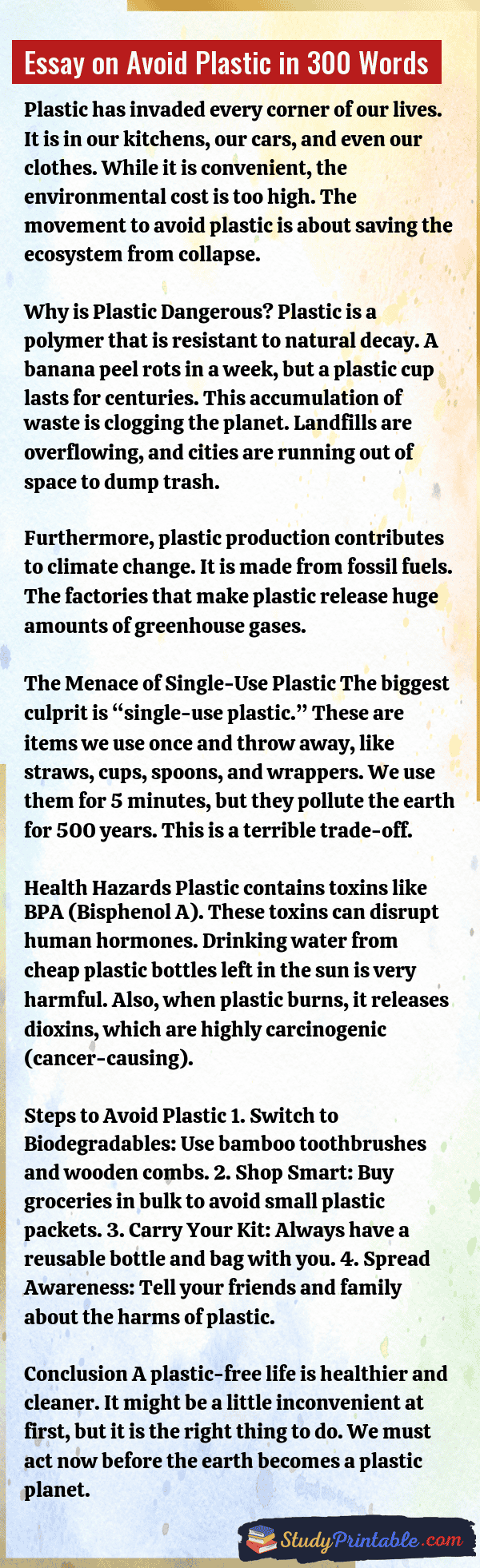
Plastic has invaded every corner of our lives. It is in our kitchens, our cars, and even our clothes. While it is convenient, the environmental cost is too high. The movement to avoid plastic is about saving the ecosystem from collapse.
Why is Plastic Dangerous?
Plastic is a polymer that is resistant to natural decay. A banana peel rots in a week, but a plastic cup lasts for centuries. This accumulation of waste is clogging the planet. Landfills are overflowing, and cities are running out of space to dump trash.
Furthermore, plastic production contributes to climate change. It is made from fossil fuels. The factories that make plastic release huge amounts of greenhouse gases.
The Menace of Single-Use Plastic
The biggest culprit is “single-use plastic.” These are items we use once and throw away, like straws, cups, spoons, and wrappers. We use them for 5 minutes, but they pollute the earth for 500 years. This is a terrible trade-off.
Health Hazards
Plastic contains toxins like BPA (Bisphenol A). These toxins can disrupt human hormones. Drinking water from cheap plastic bottles left in the sun is very harmful. Also, when plastic burns, it releases dioxins, which are highly carcinogenic (cancer-causing).
Steps to Avoid Plastic
1. Switch to Biodegradables: Use bamboo toothbrushes and wooden combs.
2. Shop Smart: Buy groceries in bulk to avoid small plastic packets.
3. Carry Your Kit: Always have a reusable bottle and bag with you.
4. Spread Awareness: Tell your friends and family about the harms of plastic.
Conclusion
A plastic-free life is healthier and cleaner. It might be a little inconvenient at first, but it is the right thing to do. We must act now before the earth becomes a plastic planet.
Essay on Avoid Plastic in 500 Words
Plastic pollution is one of the most pressing environmental issues of our time. The invention of plastic in the early 20th century was hailed as a miracle. It was cheap, lightweight, and durable. However, this “miracle” has turned into a nightmare. Today, we produce about 300 million tons of plastic waste every year. That is nearly equivalent to the weight of the entire human population. To protect our environment, it is imperative that we avoid the use of plastic, especially single-use items.
The Environmental Toll
The primary reason to avoid plastic is its non-biodegradable nature. Nature has a cycle where everything returns to the soil. Plastic breaks this cycle. It does not decompose; it only breaks down into smaller and smaller pieces called microplastics. These microplastics are now found everywhere—from the deepest parts of the ocean to the top of Mount Everest.
Marine life suffers the most. Sea turtles, dolphins, and whales are dying because their stomachs are full of plastic debris. Seabirds feed plastic bits to their chicks, mistaking them for food. It is estimated that by 2050, there will be more plastic in the ocean than fish (by weight).
Impact on Human Health
Plastic is not just an environmental issue; it is a health crisis. Chemicals leached from plastic containers contaminate our food and water. Microplastics have been found in human blood, lungs, and placentas. The long-term effects of this are still being studied, but scientists link it to hormonal imbalances, reproductive issues, and cancer.
The Problem with Recycling
Many people think, “It’s okay to use plastic if I recycle it.” This is a myth. Less than 10% of all plastic ever produced has been recycled. Most of it is either incinerated, which pollutes the air, or dumped in landfills. Plastic degrades in quality each time it is recycled, so it cannot be recycled indefinitely like glass or metal. Therefore, recycling is not the solution; avoidance is.
Practical Ways to Avoid Plastic
Living without plastic requires conscious effort. Here are some actionable steps:
* Kitchen: Replace plastic containers with glass or stainless steel. Use beeswax wraps instead of cling film.
* Shopping: Never leave home without a cloth bag. Buy loose vegetables instead of those wrapped in plastic.
* Personal Care: Use bar soap instead of liquid body wash in plastic bottles. Switch to shampoo bars.
* Dining Out: Carry your own metal straw and cutlery. If ordering takeout, ask the restaurant not to send plastic cutlery.
Conclusion
The convenience of plastic is not worth the destruction of our planet. We need a cultural shift away from the “use and throw” mentality. Governments must ban unnecessary plastics, and corporations must redesign packaging. But ultimately, the power lies with the consumer. Every time we say “no” to plastic, we vote for a cleaner world. Avoiding plastic is a small inconvenience for us, but a giant leap for the Earth.
Essay on Avoid Plastic in 1000 Words
Plastic has become ubiquitous in modern society. It is hard to look around a room and not see something made of plastic. From the keys on a laptop to the fibers in our clothes, plastic is everywhere. Its versatility and low cost have made it the material of choice for industries worldwide. However, this convenience has come at a catastrophic cost to the environment. The accumulation of plastic waste is choking our oceans, poisoning our soil, and harming our health. The call to “Avoid Plastic” is no longer just a suggestion; it is an urgent warning for the survival of our ecosystem.
The History and Rise of Plastic
The first fully synthetic plastic, Bakelite, was invented in 1907. However, the mass production of plastic began in earnest after World War II. It changed the way we live. It made cars lighter, medical devices safer, and food preservation easier. But the culture of disposability that came with it—the idea that we can use something once and throw it away—has created a crisis. We are using a material designed to last forever for products designed to be used for minutes.
The Ecological Disaster
1. Marine Pollution: The oceans are the biggest victims of our plastic addiction. Eight million tons of plastic enter the ocean annually. The “Great Pacific Garbage Patch” is a massive island of floating trash between California and Hawaii. It is three times the size of France. Marine animals get entangled in abandoned fishing nets (ghost nets) or six-pack rings. They suffer a slow and painful death.
2. Soil Degradation: When plastic is dumped in landfills, it releases hazardous chemicals into the soil. These chemicals seep into the groundwater, making it unsafe for drinking. Furthermore, plastic fragments in the soil affect the growth of plants and the health of earthworms, which are essential for agriculture.
3. Threat to Wildlife: On land, animals often forage in garbage dumps. In countries like India, cows are frequently found with kilograms of plastic bags in their stomachs. This blocks their digestive system and leads to starvation and death.
The Hidden Danger: Microplastics
Plastic does not biodegrade; it photodegrades. This means sunlight breaks it into tiny pieces called microplastics (less than 5mm in size). These particles are everywhere. They are in the water we drink, the salt we eat, and the air we breathe.
When fish eat microplastics, the toxins accumulate in their bodies. When larger fish eat smaller fish, the toxins concentrate further. Finally, when humans eat seafood, those toxins enter our bodies. This is known as biomagnification. The long-term health effects include immune system problems and cellular damage.
Why Recycling Is Not Enough
For years, plastic companies have promoted recycling as the solution. However, this is largely a distraction. Recycling plastic is difficult and expensive. There are thousands of different types of plastic, and they cannot be mixed. Food-contaminated plastic often cannot be recycled.
As a result, most “recycled” plastic is actually downcycled into lower-quality products like carpets or park benches, which eventually end up in landfills anyway. We cannot recycle our way out of this mess. The tap must be turned off at the source.
Strategies to Avoid Plastic
Avoiding plastic requires a change in lifestyle and mindset. It involves moving from a linear economy (make-use-dispose) to a circular economy (make-use-reuse).
1. Policy and Bans: Governments play a crucial role. Many countries have banned single-use plastic bags and straws. Extended Producer Responsibility (EPR) laws are being introduced, making companies responsible for the waste their products create. This forces them to design better, plastic-free packaging.
2. Sustainable Alternatives: We need to look back to traditional materials.
* Cloth and Jute: Perfect for shopping bags.
* Glass and Metal: Ideal for food storage.
* Bamboo and Wood: Great for toothbrushes and cutlery.
* Leaves: In many cultures, banana leaves or Sal leaves are used as natural plates.
3. The Zero-Waste Lifestyle: This is a growing movement where individuals strive to create no trash. They buy food in bulk using their own jars, compost their food scraps, and refuse all disposable items. While going zero-waste is hard, everyone can take steps toward “low-waste.”
The Economic Argument
Critics often say that avoiding plastic is too expensive. While plastic-free items might cost more upfront (like a steel bottle vs. a plastic one), they save money in the long run because they are reusable and durable. Moreover, the cost of cleaning up plastic pollution and treating health issues caused by it runs into billions of dollars. Investing in a plastic-free world is economically smart.
Conclusion
The plastic crisis is a reflection of our disconnect from nature. We have prioritized convenience over consequences. But the tide is turning. People are waking up to the reality that there is no “away” when we throw things away. Avoiding plastic is a moral imperative. It is an act of respect for the ocean, the soil, the animals, and our own bodies.
We must challenge the status quo. We must demand plastic-free options from companies. We must teach our children to value sustainability. The journey to a plastic-free world is long, but it begins with the simple decision to say “no” to that plastic bag today.
FAQ
Why is plastic harmful to the environment?
Plastic is harmful because it does not biodegrade. It stays in the environment for hundreds of years, polluting land and water and harming wildlife that mistake it for food.
What are some simple alternatives to plastic bags?
The best alternatives are reusable bags made of cloth, jute, or canvas. You can also use paper bags for dry items.
What is single-use plastic?
Single-use plastics are items intended to be used only once before they are thrown away or recycled. Examples include straws, coffee stirrers, soda bottles, and food packaging.
How long does it take for a plastic bottle to decompose?
It can take roughly 450 years or more for a plastic water bottle to decompose in a landfill.


