
Nepal is a small country with a very big heart and rich history. It is famous for high mountains and beautiful temples. The culture here is a mix of many old traditions that have lived for thousands of years. People of different religions live together in peace and joy. They celebrate many colorful festivals and make amazing art. The old palaces and holy places tell stories of the past. Learning about Nepal helps us see how special our world is. The following essays are written for students from Class 1 to Class 12.
Essay on Cultural Heritage of Nepal in 100 Words
Nepal has a very rich and old culture. It is known as a land of temples and gods. The people follow two main religions, Hinduism and Buddhism. They live together like brothers and sisters. There are many festivals in Nepal. Dashain and Tihar are the biggest ones.
People wear new clothes and eat good food. The art of Nepal is also very famous. You can see beautiful wood carvings on old houses. The temples have roofs that look like gold. Food like Dal Bhat is loved by everyone. Nepal’s culture is full of color and love.
Essay on Cultural Heritage of Nepal in 150 Words
The cultural heritage of Nepal is unique and beautiful. It is a blend of Indian and Tibetan influences. But it has its own special style too. The Kathmandu Valley is the heart of this culture. It has three old cities filled with palaces and shrines. These places are very old and important.
Nepal is the birthplace of Lord Buddha. Lumbini is the place where he was born. Many people visit there to find peace. The architecture of Nepal is amazing. The pagoda style of temples started here. These temples have many roofs on top of each other.
Music and dance are also a big part of life. People dance during festivals to thank the gods. The traditional dress is bright and colorful. Men wear Daura Suruwal and women wear Gunyo Cholo. The culture of Nepal teaches respect and kindness to all guests.
Essay on Cultural Heritage of Nepal in 200 Words
Nepal is a country where culture and nature meet. The cultural heritage of Nepal is very deep and diverse. It includes ancient monuments, languages, and customs. There are more than one hundred ethnic groups in Nepal. Each group has its own language and dress. This makes the country very colorful.
One of the best things about Nepal is the harmony between religions. Hindus and Buddhists often worship at the same places. Swayambhunath Stupa is a great example. It is a holy place for both groups. The temples in Nepal are works of art. The wood and stone carvings tell stories of gods and heroes.
UNESCO has listed many sites in Nepal as World Heritage Sites. These include the Durbar Squares of Kathmandu, Patan, and Bhaktapur. These squares have old palaces where kings used to live. They are open museums of history.
Food is also part of the heritage. Momos are a favorite snack. Festivals happen all year round. Holi is the festival of colors. Teej is a festival for women. These celebrations bring families together. Nepal preserves its past while moving towards the future. It is a treasure of the world.
Essay on Cultural Heritage of Nepal in 250 Words
The cultural heritage of Nepal is a source of pride for its people. It is centuries old and still very much alive. The culture is shaped by the Himalayas and the deep valleys. Religion plays a central role in daily life. You can hear bells ringing in temples every morning. People start their day with prayer.
Nepal has seven World Heritage Sites in the Kathmandu Valley alone. Pashupatinath is a very holy temple for Hindus. Boudhanath is a huge stupa for Buddhists. These sites show the skill of Nepali artists. The Newar people of Kathmandu are famous for their art. They make beautiful statues from metal and stone.
The festivals of Nepal are full of joy. During Dashain, people fly kites and receive blessings from elders. During Tihar, they light oil lamps and worship animals like dogs and cows. This shows love for all living beings.
Traditional music instruments like the Sarangi and Madal are very popular. Folk songs tell stories of village life. The mountains also shape the culture. The Sherpa people live near Mount Everest. They have a rich culture of mountain climbing and Buddhism.
Nepal is also known for its living goddess, the Kumari. She is a young girl worshipped as a deity. This is a tradition found only in Nepal. The cultural heritage of Nepal is a beautiful mix of myth, art, and faith. It teaches the world about peace.
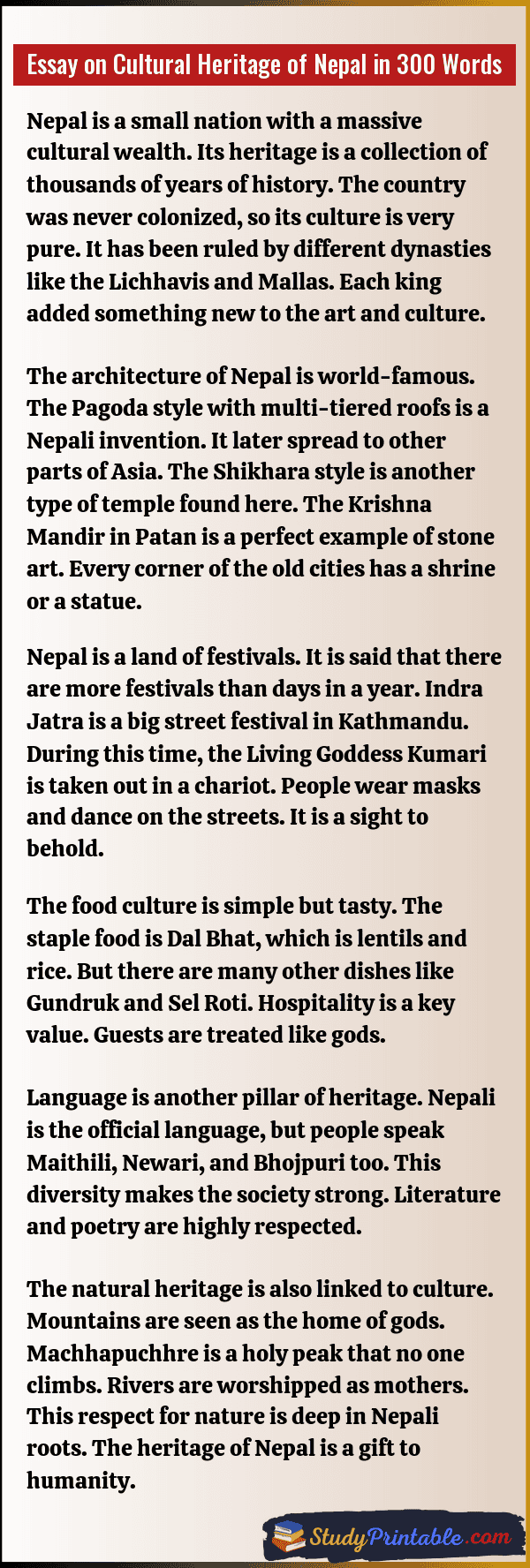
Essay on Cultural Heritage of Nepal in 300 Words
Nepal is a small nation with a massive cultural wealth. Its heritage is a collection of thousands of years of history. The country was never colonized, so its culture is very pure. It has been ruled by different dynasties like the Lichhavis and Mallas. Each king added something new to the art and culture.
The architecture of Nepal is world-famous. The Pagoda style with multi-tiered roofs is a Nepali invention. It later spread to other parts of Asia. The Shikhara style is another type of temple found here. The Krishna Mandir in Patan is a perfect example of stone art. Every corner of the old cities has a shrine or a statue.
Nepal is a land of festivals. It is said that there are more festivals than days in a year. Indra Jatra is a big street festival in Kathmandu. During this time, the Living Goddess Kumari is taken out in a chariot. People wear masks and dance on the streets. It is a sight to behold.
The food culture is simple but tasty. The staple food is Dal Bhat, which is lentils and rice. But there are many other dishes like Gundruk and Sel Roti. Hospitality is a key value. Guests are treated like gods.
Language is another pillar of heritage. Nepali is the official language, but people speak Maithili, Newari, and Bhojpuri too. This diversity makes the society strong. Literature and poetry are highly respected.
The natural heritage is also linked to culture. Mountains are seen as the home of gods. Machhapuchhre is a holy peak that no one climbs. Rivers are worshipped as mothers. This respect for nature is deep in Nepali roots. The heritage of Nepal is a gift to humanity.
Essay on Cultural Heritage of Nepal in 500 Words
Nepal stands tall as a country rich in cultural heritage. It is a land where ancient traditions walk hand in hand with modern life. The heritage of Nepal is not just in museums; it is lived by the people every day. From the snow-capped Himalayas in the north to the flat plains in the south, the culture changes every few miles. Yet, there is a strong thread of unity that binds everyone together.
Religious Harmony
The most striking feature of Nepal is religious peace. Hinduism and Buddhism are the two major religions. They have existed side by side for ages. Many deities are worshipped by both Hindus and Buddhists. For example, the temple of Muktinath is holy for both. Buddha was born in Nepal, and his teachings of peace are deeply rooted here. This tolerance is a lesson for the whole world.
Art and Architecture
The art of Nepal is breathtaking. The Kathmandu Valley is often called an open-air museum. The Malla kings were great patrons of art. They built the famous Durbar Squares in Kathmandu, Bhaktapur, and Patan. These squares are filled with palaces, courtyards, and temples. The intricate wood carvings on windows and doors are unique. The stone sculptures of gods look almost real. The Thangka paintings are another treasure. These are detailed religious paintings on cotton or silk.
Living Traditions
Nepal has traditions that are found nowhere else. The tradition of the Kumari is one such wonder. A young girl is chosen as the living incarnation of the Goddess Taleju. She lives in a palace and protects the city. Another unique culture is that of the Tharu people in the south and the Sherpas in the north. The Sherpas are famous for their strength and mountain skills.
Festivals and Celebrations
Festivals are the soul of Nepal. Dashain is the longest festival. It celebrates the victory of good over evil. Tihar is the festival of lights. It is like Diwali but also includes worship of crows, dogs, and oxen. This shows how nature is respected. Holi is played with water and colors. Bisket Jatra involves pulling huge chariots. Each festival brings communities together to dance, sing, and feast.
Language and Literature
Nepal is a garden of languages. While Nepali is the common tongue, there are over 120 other languages spoken. This makes the literature very rich. Poets like Bhanubhakta Acharya are heroes because they unified the people with words.
Conclusion
The cultural heritage of Nepal is a vibrant tapestry. It is made of myths, mountains, and music. It is a heritage of kindness and bravery. The Gurkha soldiers are famous for their bravery, while the monks are known for peace. Preserving this heritage is vital. It gives Nepal its identity and charm. It welcomes every visitor with an open heart and a warm “Namaste.”
Essay on Cultural Heritage of Nepal in 1000 Words
Nepal is a sovereign country located in the lap of the Himalayas. Though small in size, it is a giant in terms of cultural heritage. It is a melting pot of diverse ethnic groups, religions, languages, and traditions. The cultural heritage of Nepal is not just a relic of the past; it is the heartbeat of the present. It influences how people live, eat, worship, and interact. This heritage has been shaped over thousands of years by sages, kings, artists, and common people. It draws millions of tourists to the country, who come not just for the mountains, but for the magic of its culture.
Historical Background
The history of Nepal is the foundation of its culture. The Kathmandu Valley has been inhabited for at least 2,000 years. Early dynasties like the Kirats and Lichhavis laid the groundwork. The Lichhavi period is often called the Golden Age of Nepali art. Later, the Malla dynasty ruled the valley. They were great lovers of beauty. They built the magnificent temples and palaces that we see today. The Shah dynasty later unified the small kingdoms into modern Nepal. This unification brought different cultures together under one flag.
Architectural Marvels
Nepali architecture is distinct and influential. There are two main styles that dominate the skyline. The first is the Pagoda style. This features multi-tiered roofs with wide eaves supported by carved wooden struts. The Pashupatinath Temple and Nyatapola Temple are prime examples. The Nyatapola in Bhaktapur is five stories high and has survived many earthquakes.
The second style is the Shikhara style. These temples look like a mountain peak. They are usually made of stone. The Krishna Mandir in Patan is a masterpiece of this style. It has complex stone carvings telling stories from the Mahabharata.
Stupas are another key feature. These are dome-shaped Buddhist shrines. Boudhanath and Swayambhunath are massive stupas with the eyes of Buddha painted on them. These eyes look in all four directions, symbolizing wisdom. The vibe around a stupa is peaceful, with prayer flags fluttering in the wind.
UNESCO World Heritage Sites
Nepal is home to several UNESCO World Heritage Sites. The Kathmandu Valley alone has seven groups of monuments. These include the three Durbar Squares, two Hindu temples, and two Buddhist stupas. Outside the valley, Lumbini is a World Heritage Site. It is the birthplace of Lord Buddha. It has the Maya Devi temple and the Ashoka Pillar. It is a pilgrimage site for Buddhists worldwide. Chitwan National Park and Sagarmatha National Park are natural heritage sites, but they are deeply linked to the local culture of the Tharu and Sherpa people.
Festivals and Customs
Nepal is often called the land of non-stop festivals. Every month brings a new celebration. These festivals are mostly religious but are celebrated by everyone.
Dashain: This is the biggest Hindu festival. It lasts for 15 days. Families reunite, and elders put ‘Tika’ (a mix of yogurt and red powder) on the foreheads of the young. It honors Goddess Durga.
Tihar: This is the festival of lights. Houses are decorated with oil lamps and marigold flowers. It is unique because animals are worshipped. There is a day for crows, a day for dogs, a day for cows, and a day for oxen. The final day is Bhai Tika, which celebrates the bond between brothers and sisters.
Maha Shivaratri: This is the night of Lord Shiva. Thousands of sadhus (holy men) gather at Pashupatinath. They light bonfires and meditate.
Lhosar: This is the New Year for the Sherpa, Tamang, and Gurung communities. They wear traditional costumes and dance to folk music.
Art and Craft
Nepali craftsmanship is renowned globally. The metal workers of Patan create exquisite statues of gods using the lost-wax technique. The wood carvers of Bhaktapur can turn a piece of timber into a story. The ‘Jhya’ or traditional window is a symbol of Newari art. Thangka painting is a spiritual art form. It requires great patience and skill. These paintings serve as meditation tools. Pottery is another ancient craft. In Bhaktapur, you can see huge squares filled with clay pots drying in the sun.
Food and Dress
Nepali cuisine is simple, healthy, and delicious. Dal Bhat Tarkari (lentil soup, rice, and vegetable curry) is the national meal. It is eaten twice a day. Momos (steamed dumplings) are the most popular snack. They can be found on every street corner. In the mountains, people eat Dhindo (a mash of millet or corn).
Clothing varies by region. In the hills, men wear Daura Suruwal and a Dhaka Topi (cap). Women wear saris or Gunyo Cholo. In the Terai plains, the dress is similar to India. In the mountains, thick woollen clothes called Bakhu are worn to keep warm.
Music and Dance
Music is the soul of Nepali culture. The ‘Panche Baja’ is a set of five traditional instruments played during weddings. The Sarangi is a string instrument that sounds like a human voice. Folk dances are performed in groups. The Lakhey dance is a famous mask dance performed in Kathmandu. It is energetic and wards off evil spirits.
Conclusion
The cultural heritage of Nepal is a living testament to human creativity and spirituality. It is a heritage that promotes peace, tolerance, and respect for nature. Despite modernization, the people of Nepal hold on to their roots. They are proud of their identity. However, this heritage faces threats from pollution and urbanization. It is the duty of the young generation to protect these treasures. By preserving its culture, Nepal preserves its soul. It remains a mystical land that invites the world to come and experience its wonder.
FAQ
What are the two main religions in Nepal?
The two main religions in Nepal are Hinduism and Buddhism. Most people follow Hinduism, but Buddhism is also very strong. Both religions live together in peace and share many temples.
What is the most famous food in Nepal?
The most famous food is Dal Bhat. It is a meal of rice and lentil soup with vegetables. Another very popular food is Momo, which is a type of steamed dumpling filled with meat or veggies.
What is the Kumari?
The Kumari is a Living Goddess. She is a young girl chosen to represent a powerful deity. She lives in a temple palace in Kathmandu and people visit her to get blessings.
Why is Lumbini important?
Lumbini is important because it is the birthplace of Lord Buddha. Buddha is the founder of Buddhism. People from all over the world come to Lumbini to pray and see the place where he was born.
