
Fuel subsidy removal is a very big change for a country. It happens when the government stops paying part of the cost for petrol or gas. This makes fuel cost more money for everyone. But it saves the country a lot of cash. This cash can be used to build schools and hospitals. It is a hard choice that affects how families spend money. It changes the price of food and bus rides. Understanding this helps us know how the country grows. The following essays are written for students from Class 1 to Class 12.
Essay on Fuel Subsidy Removal in 100 Words
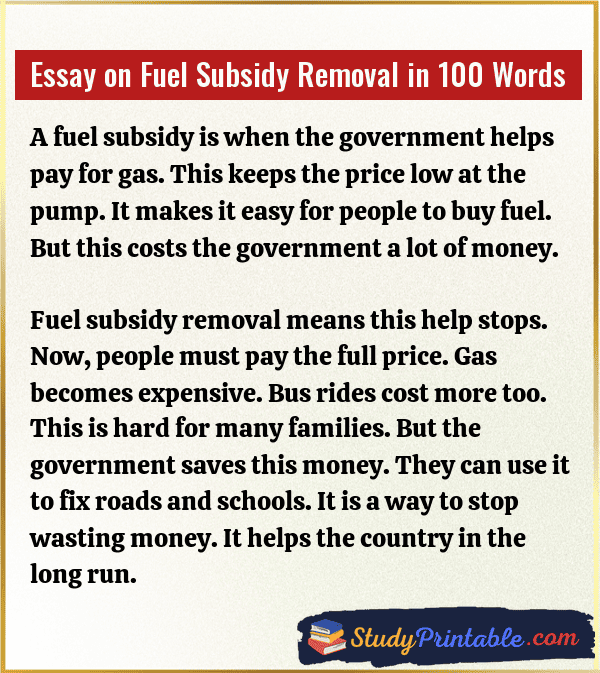
A fuel subsidy is when the government helps pay for gas. This keeps the price low at the pump. It makes it easy for people to buy fuel. But this costs the government a lot of money.
Fuel subsidy removal means this help stops. Now, people must pay the full price. Gas becomes expensive. Bus rides cost more too. This is hard for many families. But the government saves this money. They can use it to fix roads and schools. It is a way to stop wasting money. It helps the country in the long run.
Essay on Fuel Subsidy Removal in 150 Words
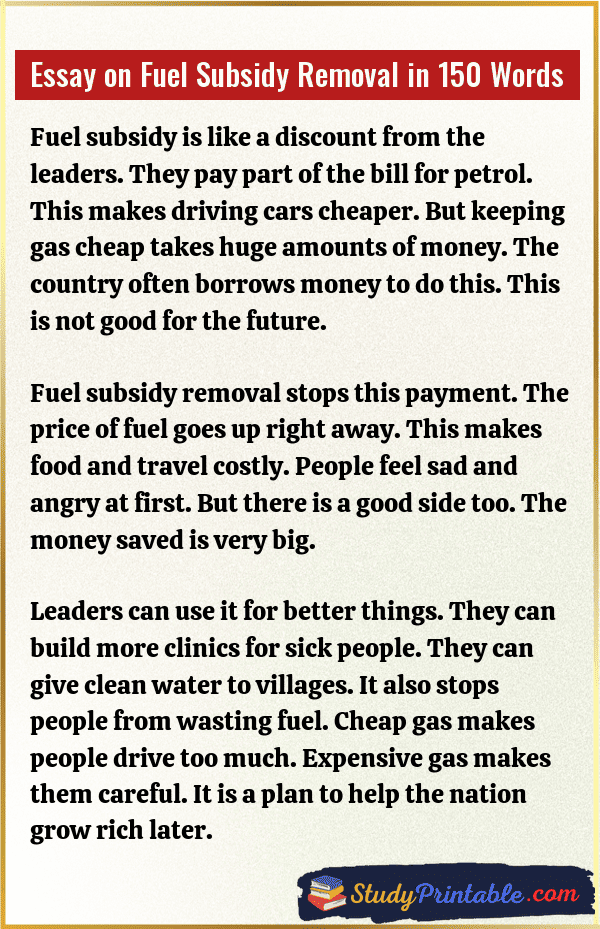
Fuel subsidy is like a discount from the leaders. They pay part of the bill for petrol. This makes driving cars cheaper. But keeping gas cheap takes huge amounts of money. The country often borrows money to do this. This is not good for the future.
Fuel subsidy removal stops this payment. The price of fuel goes up right away. This makes food and travel costly. People feel sad and angry at first. But there is a good side too. The money saved is very big.
Leaders can use it for better things. They can build more clinics for sick people. They can give clean water to villages. It also stops people from wasting fuel. Cheap gas makes people drive too much. Expensive gas makes them careful. It is a plan to help the nation grow rich later.
Essay on Fuel Subsidy Removal in 200 Words
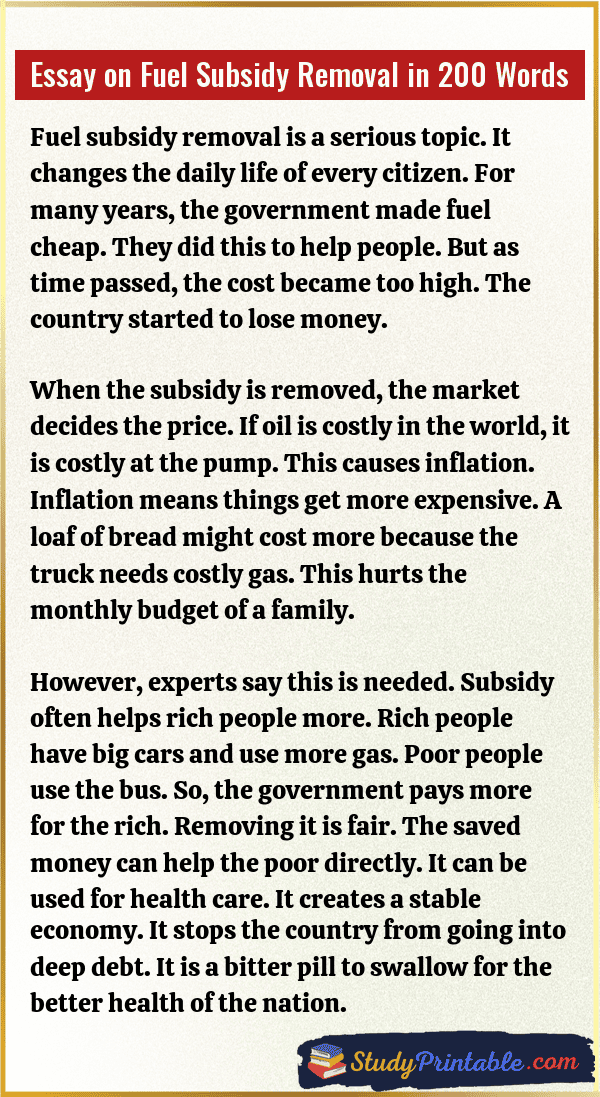
Fuel subsidy removal is a serious topic. It changes the daily life of every citizen. For many years, the government made fuel cheap. They did this to help people. But as time passed, the cost became too high. The country started to lose money.
When the subsidy is removed, the market decides the price. If oil is costly in the world, it is costly at the pump. This causes inflation. Inflation means things get more expensive. A loaf of bread might cost more because the truck needs costly gas. This hurts the monthly budget of a family.
However, experts say this is needed. Subsidy often helps rich people more. Rich people have big cars and use more gas. Poor people use the bus. So, the government pays more for the rich. Removing it is fair. The saved money can help the poor directly. It can be used for health care. It creates a stable economy. It stops the country from going into deep debt. It is a bitter pill to swallow for the better health of the nation.
Essay on Fuel Subsidy Removal in 250 Words
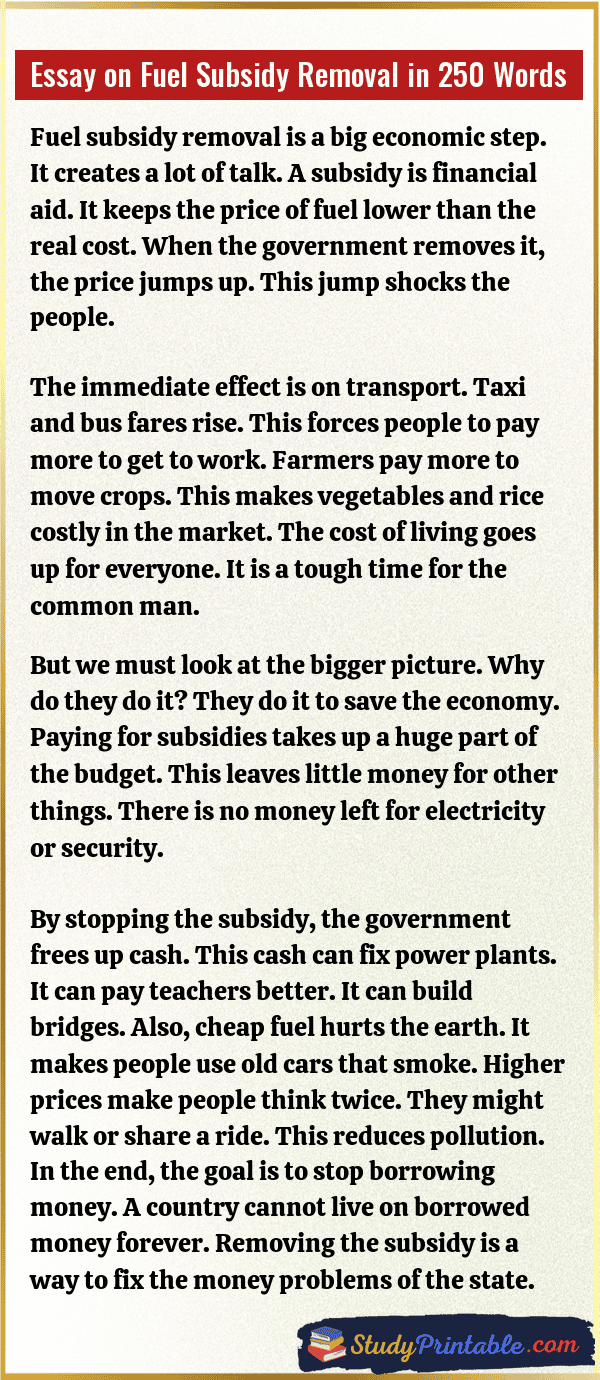
Fuel subsidy removal is a big economic step. It creates a lot of talk. A subsidy is financial aid. It keeps the price of fuel lower than the real cost. When the government removes it, the price jumps up. This jump shocks the people.
The immediate effect is on transport. Taxi and bus fares rise. This forces people to pay more to get to work. Farmers pay more to move crops. This makes vegetables and rice costly in the market. The cost of living goes up for everyone. It is a tough time for the common man.
But we must look at the bigger picture. Why do they do it? They do it to save the economy. Paying for subsidies takes up a huge part of the budget. This leaves little money for other things. There is no money left for electricity or security.
By stopping the subsidy, the government frees up cash. This cash can fix power plants. It can pay teachers better. It can build bridges. Also, cheap fuel hurts the earth. It makes people use old cars that smoke. Higher prices make people think twice. They might walk or share a ride. This reduces pollution. In the end, the goal is to stop borrowing money. A country cannot live on borrowed money forever. Removing the subsidy is a way to fix the money problems of the state.
Essay on Fuel Subsidy Removal in 300 Words
Fuel subsidy removal is a policy change. It means the government stops controlling petrol prices. Before, the state paid the difference to keep prices low. Now, the buyer pays the full market rate. This decision has both bad and good sides.
The bad side is the pain it causes. Suddenly, filling a tank costs a lot. For a daily worker, this is very hard. Transport is vital for everything. When transport gets costly, everything gets costly. School buses charge more. Food trucks charge more. It creates a wave of high prices. This is called inflation. People have less money to save. It can lead to protests and anger.
But the good side is also real. Keeping fuel cheap is a heavy burden. It eats up billions of dollars. This money belongs to the people. It should be used to improve their lives. Instead, it is burned in car engines. Also, cheap fuel encourages smuggling. People buy cheap gas and sell it to other countries. This is theft.
Removing the subsidy stops this theft. It ensures the money stays in the country. It allows the government to invest in real growth. They can build clinics in rural areas. They can improve the police force. They can help farmers with better seeds.
It also helps the environment. When gas is the real price, people use less. They might use solar power instead. This cleans the air. The transition is painful, but the destination is good. It is like fixing a leaking roof. It costs money and effort now, but it keeps the house dry later. It makes the country independent and strong. It forces the leaders to be responsible with money.
Essay on Fuel Subsidy Removal in 500 Words
Fuel subsidy removal is a topic that touches every home. To understand it, we must know what a subsidy is. A subsidy is when the government pays part of the cost for something. For fuel, they pay oil companies to sell gas at a low price. This makes life easy for car owners. But this ease comes at a huge price for the nation.
The main reason for removal is the cost. The government spends a large part of its budget on this. This money comes from taxes or loans. When the country spends so much on cheap gas, it has no money for other needs. Schools do not have books. Hospitals do not have medicine. Roads are full of holes. The country stays poor while gas stays cheap. This is not a good trade.
Another reason is fairness. Studies show that subsidies help the rich more than the poor. A rich person with two big cars uses much more gas than a poor person on a bus. So, the government ends up paying more money to the rich. This is not fair. Removing the subsidy levels the field. The money saved can be used for welfare programs that help the poor directly.
The impact of removal is felt instantly. The price of petrol and diesel shoots up. This affects every sector. Transporters increase their rates. This increases the cost of goods. Food prices rise because it costs more to bring them to the market. Small businesses suffer because their generators cost more to run. The purchasing power of the people drops. Life becomes harder for a while.
However, this hardship is meant to be short. The long-term benefits are many. It reduces the budget deficit. A deficit is when a country spends more than it earns. Removing the subsidy fixes this hole in the pocket. It improves the value of the local money. It attracts investors from other countries. They see that the government is serious about the economy.
It also stops cross-border smuggling. In many places, cheap fuel is taken to neighboring countries and sold for a profit. This is a huge loss. When prices are the same everywhere, this crime stops.
The environment also benefits. Cheap fossil fuels cause high pollution. When prices reflect the true cost, people look for green alternatives. They might use electric cars or public transport. This reduces carbon emissions.
To make this work, the government must be honest. They must show where the saved money goes. They must improve public transport. They must provide support to the poorest people. If managed well, fuel subsidy removal can be the start of a new era. It can turn a country from a debtor to a builder. It is a tough choice, but often the right choice for a better tomorrow.
Essay on Fuel Subsidy Removal in 1000 Words
Fuel subsidy removal is one of the most debated economic policies in the world today. It refers to the decision by a government to stop paying a portion of the cost of fuel. For decades, many countries have kept fuel prices artificially low. They did this to help their citizens and businesses. However, economic realities have forced many nations to rethink this strategy. The removal of this financial support is a major shift that affects every part of society.
What is a Fuel Subsidy?
A fuel subsidy is a form of government support. It keeps the price of petrol, diesel, or kerosene lower than the market rate. For example, if the real cost of a liter of petrol is one dollar, the government might sell it for fifty cents. The government pays the other fifty cents to the supplier. This makes fuel affordable for everyone. It is seen as a benefit of being a citizen.
The Burden on the Economy
While cheap fuel is nice, the cost to the state is massive. In some countries, the subsidy bill is larger than the budget for education and health combined. This creates a huge financial hole. The government has to borrow money to keep prices low. This increases the national debt.
When a country is in debt, it spends a lot of money just paying interest. It cannot save for the future. The economy becomes weak. It becomes vulnerable to shocks in the global market. If the price of oil goes up globally, the subsidy bill gets even bigger. It becomes a trap.
Why Remove the Subsidy?
The primary reason is to save the economy from collapse. By removing the subsidy, the government frees up billions of dollars. This is not just about saving money; it is about redirecting it.
First, infrastructure needs money. The saved funds can be used to build modern railways and airports. It can fix broken roads that damage cars. Second, social services need help. The money can go into schools. It can hire better teachers and buy computers. It can improve health clinics in villages. Third, debt reduction is vital. Stopping the subsidy helps balance the budget. It reduces the need to borrow. This makes the local currency stronger.
The Issue of Fairness
There is also a strong argument about fairness. Who benefits the most from cheap fuel? It is usually the wealthy. Rich people own big cars and generators. They consume hundreds of liters a month. Poor people might only use public transport. Therefore, the subsidy system acts like a gift to the rich funded by the public purse. Removing it stops this inequality.
The Immediate Impact on the People
The days following the removal are usually very hard. The price of fuel can double or triple overnight. This sends a shock through the system.
Transportation is hit first. Commuting becomes expensive. Bus and taxi drivers raise their fares to cover their costs. For a worker on a minimum wage, this is a crisis. Inflation follows quickly. Fuel is an input for almost every business. Factories need it for power. Trucks need it for delivery. When fuel costs rise, the price of everything rises. Bread, milk, and clothes become costlier.
Small businesses also suffer. Many small shops rely on petrol generators because the main power grid is unreliable. High fuel costs eat into their profits. Some may have to close down or fire staff.
Smuggling and Corruption
Subsidy regimes are often corrupt. They create a black market. In many cases, fuel meant for the local people is smuggled into neighboring countries where prices are higher. Smugglers make huge profits while the government bleeds money. Removing the subsidy kills this illegal business instantly. It ensures that the country’s resources are used within its borders.
Environmental Considerations
Cheap fuel encourages waste. When gas is cheap, people do not worry about burning it. They drive inefficient cars. They take unnecessary trips. This leads to high pollution and traffic jams.
When fuel is priced correctly, people become efficient. They plan their trips. They carpool. Businesses look for energy-saving machines. There is also a push toward green energy. People might install solar panels instead of using diesel generators. This helps in the fight against climate change.
Managing the Transition
The transition period is critical. The government cannot just remove the subsidy and walk away. They must provide a safety net. This is often called “palliative measures.”
Public transport needs investment. The state should invest in cheap mass transit. More buses and trains can help people move without feeling the pinch of fuel costs. Direct cash transfers can also help. The government can give cash directly to the poorest families. This helps them buy food and pay bills. Also, wage increases might be needed. Salaries for low-income workers may need to be adjusted to match the new cost of living.
Global Examples
Many countries have gone through this. Some did it well, and others failed. Countries that explained the plan clearly to the people succeeded. They showed where the money was going. Countries that did it suddenly without support faced riots and strikes. Trust between the leaders and the people is the key.
Conclusion
In conclusion, fuel subsidy removal is a painful but necessary surgery. It hurts at first, but it cures the sickness of the economy. It stops the waste of national wealth. It ends the funding of the rich at the expense of the poor. It opens the door for real development.
However, it must be done with a human face. The leaders must feel the pain of the people. They must ensure that the gains from this policy are seen by everyone. If the money saved is used to build a better nation with good schools, hospitals, and roads, then the sacrifice is worth it. It is a step from a wasteful past to a sustainable future.
FAQ
What is a fuel subsidy?
A fuel subsidy is when the government pays part of the cost of fuel. This makes it cheaper for you to buy. It is like a discount paid for by the country.
Why do governments remove the subsidy?
Governments remove it to save money. Subsidies cost billions of dollars. This money can be used better. It can fix schools, roads, and hospitals instead of just burning it in cars.
Does subsidy removal hurt the poor?
Yes, at first it hurts because prices go up. Bus rides and food become costly. But later, it can help the poor if the saved money is used to help them directly.
What happens to the saved money?
The saved money stays with the government. They should use it to build things the country needs. They can improve electricity, health care, and education for everyone.


