
Fundamental rights are very special rules that protect every person. They are written in the Constitution, which is the big book of laws. These rights make sure that everyone is free and safe. They allow people to speak, pray, and live without fear. They treat everyone as equals, no matter who they are. Without these rights, life would be unfair and hard. They are the heart of a free country. The following essays are written for students from Class 1 to Class 12.
Essay on Fundamental Rights in 100 Words
Fundamental rights are the basic rights of every citizen. The Constitution gives these rights to us. They protect us from harm and unfair treatment. The first right is the Right to Equality. This means everyone is the same in the eyes of the law.
Rich or poor, all are equal. Another right is the Right to Freedom. We can speak what we think. We can travel anywhere we want. These rights help us live a good life. If anyone stops us from using them, we can go to court. We must value these rights every single day.
Essay on Fundamental Rights in 150 Words
Fundamental rights are the most important human rights. They are essential for the growth of a person. In a democracy, these rights are like a shield. They protect the people from the power of the government. There are usually six main fundamental rights.
The Right to Equality ensures no one is left out. It stops discrimination based on religion or caste. The Right to Freedom gives us the power of speech. We can form groups and move freely. The Right against Exploitation stops people from forcing others to work. It protects children from child labor.
There is also the right to choose any religion. We can pray to any god we like. These rights are not just words. They are promises made by the nation. They allow every child to dream big. They make sure that dignity is kept safe for all citizens.
Essay on Fundamental Rights in 200 Words
Fundamental rights are the basic conditions needed for a happy life. They are given to every citizen by the Constitution. These rights are vital because they allow us to develop our personality. Without them, we would be like birds in a cage. The Constitution guarantees that the state cannot take these rights away.
One major right is the Right to Freedom of Religion. This means a person can follow any faith. They can visit a temple, a church, or a mosque. The government treats all religions the same way. Another key right is Cultural and Educational Rights. This helps groups of people keep their language and culture alive.
It also gives everyone the right to go to school. Education is the key to a bright future. If a person feels their rights are hurt, they have a remedy. This is the Right to Constitutional Remedies. It means they can go to the Supreme Court for justice. The court acts as the guardian of these rights. These rules make a country a true democracy. They ensure that power is not misused. They build a society based on trust and fairness.
Essay on Fundamental Rights in 250 Words
Fundamental rights are the cornerstone of a free society. They are the basic liberties that belong to every human being from birth. The Constitution lists these rights to ensure peace and order. They are called “fundamental” because they are essential for our existence. They are also protected by the highest court in the land.
The Right to Equality is the first pillar. It means the law is supreme. No person is above the law. It removes untouchability and titles. It opens doors for jobs to everyone equally. The Right to Freedom is the second pillar. It includes freedom of speech, expression, and assembly. This allows ideas to flow freely.
However, these freedoms have some limits. We cannot use our rights to hurt others or the country. We must be responsible. The Right against Exploitation is very important for the poor. It bans human trafficking and forced labor. It ensures that no one is treated like a slave.
For children, it bans working in dangerous factories. This allows kids to go to school instead of work. The Right to Constitutional Remedies is the soul of the list. It gives power to the common man. If the government acts wrongly, the citizen can fight back legally.
These rights create a balance. They give power to the people while keeping order. They are the greatest gift of the Constitution. We must respect the rights of others to keep our own rights safe.
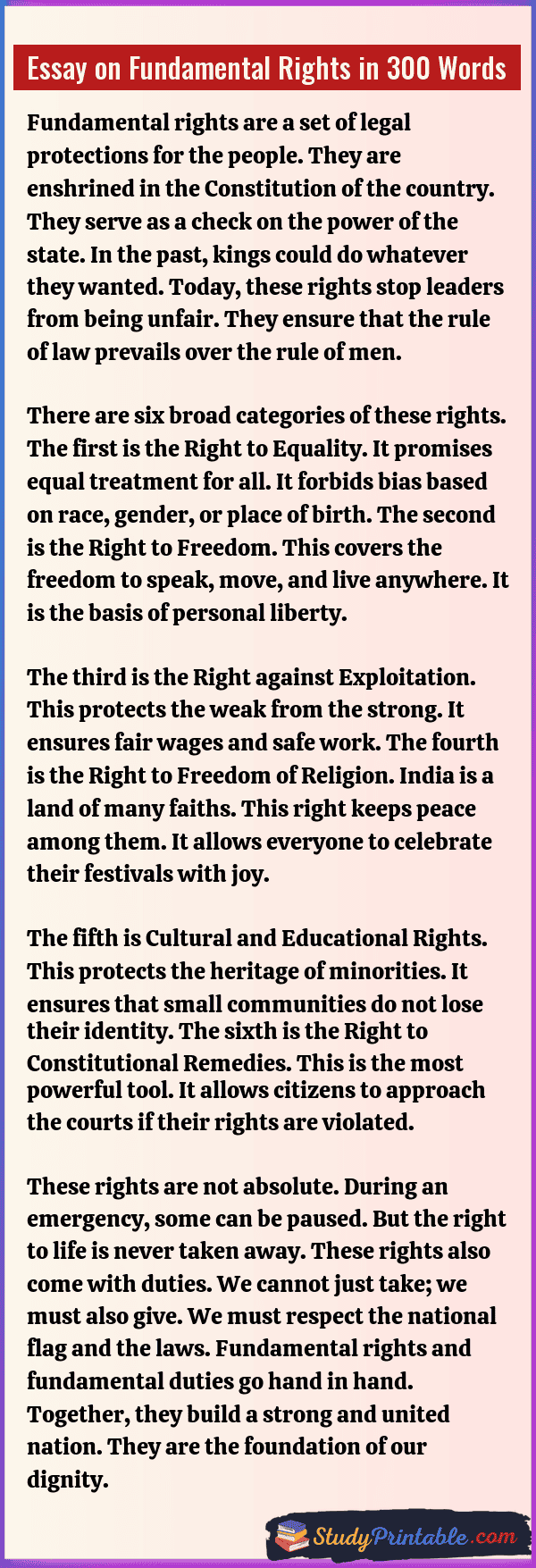
Essay on Fundamental Rights in 300 Words
Fundamental rights are a set of legal protections for the people. They are enshrined in the Constitution of the country. They serve as a check on the power of the state. In the past, kings could do whatever they wanted. Today, these rights stop leaders from being unfair. They ensure that the rule of law prevails over the rule of men.
There are six broad categories of these rights. The first is the Right to Equality. It promises equal treatment for all. It forbids bias based on race, gender, or place of birth. The second is the Right to Freedom. This covers the freedom to speak, move, and live anywhere. It is the basis of personal liberty.
The third is the Right against Exploitation. This protects the weak from the strong. It ensures fair wages and safe work. The fourth is the Right to Freedom of Religion. India is a land of many faiths. This right keeps peace among them. It allows everyone to celebrate their festivals with joy.
The fifth is Cultural and Educational Rights. This protects the heritage of minorities. It ensures that small communities do not lose their identity. The sixth is the Right to Constitutional Remedies. This is the most powerful tool. It allows citizens to approach the courts if their rights are violated.
These rights are not absolute. During an emergency, some can be paused. But the right to life is never taken away. These rights also come with duties. We cannot just take; we must also give. We must respect the national flag and the laws. Fundamental rights and fundamental duties go hand in hand. Together, they build a strong and united nation. They are the foundation of our dignity.
Essay on Fundamental Rights in 500 Words
Fundamental rights are the basic human rights that every citizen enjoys. They are the bedrock of a democratic nation. These rights are written in the Constitution to protect the people. They act as a guarantee against harsh rule. They ensure that every individual can live with dignity and self-respect. Without these rights, true freedom is not possible.
The Constitution of India, for example, provides six fundamental rights. These are very detailed and cover all aspects of life.
1. Right to Equality: This is the foundation of democracy. It means that the state cannot discriminate against any citizen. Religion, race, caste, sex, or place of birth do not matter. The law applies to everyone in the same way. It also abolishes the practice of untouchability. This was a great step to fix social evils. It also ensures equal opportunity in public jobs.
2. Right to Freedom: Freedom is the essence of life. This right gives citizens the freedom of speech and expression. People can share their views without fear. It also allows peaceful assembly without arms. Citizens can form unions and associations. They can move freely throughout the territory of the country. They can reside and settle in any part of the land.
3. Right against Exploitation: In many places, poor people are misused. This right stops that. It prohibits human trafficking and forced labor. It acts as a shield for women and children. It strictly bans the employment of children below the age of 14 in factories. This ensures that childhood is protected.
4. Right to Freedom of Religion: This allows every person to follow their conscience. They can profess, practice, and propagate any religion. The state does not have a religion of its own. This is called secularism. It ensures that all religions are treated with equal respect.
5. Cultural and Educational Rights: Diversity is a strength. This right protects the culture, language, and script of minorities. It allows them to establish their own educational institutions. This helps them preserve their unique heritage.
6. Right to Constitutional Remedies: Dr. B.R. Ambedkar called this the “heart and soul” of the Constitution. If any of the above rights are violated, a person can go to court. The Supreme Court has the power to issue orders to restore these rights. This makes the rights real and effective.
However, rights are not unlimited. The government can impose reasonable restrictions. For example, freedom of speech does not mean we can incite violence. We must use our rights responsibly.
These rights are essential for the holistic growth of an individual. They cover mental, physical, and spiritual growth. They create an environment of security. They give a voice to the voiceless. Fundamental rights are the promise of a better life for all. They are the light that guides the nation toward justice.
Essay on Fundamental Rights in 1000 Words
Fundamental rights are the primary rights of the citizens of a country. They are a charter of rights contained in the Constitution. These rights are justiciable. This means that if they are violated, a person can approach a court of law. They are called “fundamental” for two reasons. First, they are mentioned in the fundamental law of the land. Second, they are very essential for the development of the personality of every individual. They ensure civil liberties such that all people can live in peace and harmony. They are the very pillars of human rights and democracy.
Why Do We Need Fundamental Rights?
The history of the world shows that power can be misused. Kings and dictators often treated people badly. They took away land, freedom, and even lives. To stop this, modern nations wrote constitutions. They included a list of rights that the government cannot touch.
These rights protect the minority from the majority. They ensure that the weakest person has the same voice as the strongest. They promote the ideal of political democracy. They prevent the establishment of despotic rule. In short, they protect the liberties and freedoms of the people against the invasion by the state.
The Six Fundamental Rights
In many democratic constitutions, like India’s, there are six main groups of rights.
1. Right to Equality: Equality is the first condition for justice. This right ensures that the state treats everyone equally. It prohibits discrimination on grounds of religion, race, caste, sex, or place of birth. It also says that there shall be equality of opportunity in matters of public employment. The practice of untouchability is made a crime. The state cannot give special titles like “Sir” or “Lord” to anyone. This creates a society where merit counts, not birth.
2. Right to Freedom: This is a cluster of rights. It includes the freedom of speech and expression. This allows a free press and open debate. It includes the freedom to assemble peacefully. It includes the freedom to form associations or unions. It gives the right to move freely across the country. It gives the right to live anywhere. It also gives the right to practice any profession. However, these freedoms are not absolute. The government can limit them for the safety of the country.
3. Right against Exploitation: This right upholds the dignity of the individual. It bans “begar” or forced work without pay. It bans the buying and selling of human beings. Most importantly, it bans child labor in hazardous places. Factories and mines cannot hire children. This right aims to end the slavery and abuse that existed in the past.
4. Right to Freedom of Religion: In a secular country, religion is a personal matter. This right gives every person the freedom of conscience. They can pray to any god or no god. They can manage their own religious affairs. No one can be forced to pay taxes for the promotion of any religion. Religious instruction cannot be forced in schools run by the state. This keeps religion and politics separate.
5. Cultural and Educational Rights: A country often has many different groups. Some speak different languages or have different cultures. This right protects the interests of these minorities. Any section of citizens has the right to conserve their language or script. No citizen can be denied admission to state schools based on religion or language. Minorities can set up their own schools and colleges. This helps diversity to flourish.
6. Right to Constitutional Remedies: A right is useless if it cannot be enforced. This right provides the enforcement. It allows a citizen to move the Supreme Court if their rights are hurt. The court can issue special orders called writs. These writs can order the government to do something or stop doing something. This right makes the Supreme Court the defender of all other rights.
Suspension of Rights
There are times when the nation is in danger. During a war or armed rebellion, the President can declare an emergency. During this time, some fundamental rights can be suspended. For example, the freedom of speech might be curbed to keep secrets safe. However, the right to life and personal liberty cannot be suspended even during an emergency. This is a vital safeguard.
Fundamental Rights vs. Human Rights
People often confuse these two terms. Human rights are universal. They belong to all humans everywhere. Fundamental rights are specific. They are the human rights that are written in a specific country’s constitution. They have the force of legal protection within that country. While human rights are a moral claim, fundamental rights are a legal claim.
The Importance of Duties
Rights and duties are two sides of the same coin. We cannot have one without the other. If I have the right to speak, I have the duty to listen. If I have the right to use the road, I have the duty to follow traffic rules. The Constitution often lists Fundamental Duties as well. These include respecting the flag, protecting nature, and promoting harmony. A responsible citizen focuses on duties just as much as rights.
Conclusion
In conclusion, fundamental rights are the backbone of a civilized society. They create an environment where the mind is without fear. They allow talent to grow and human spirit to soar. They ensure that the government remains a servant of the people, not a master. But we must remember that freedom comes with responsibility. We must use our rights to build a better nation. We must protect the rights of others with the same zeal as we protect our own. This mutual respect is the true essence of liberty.
FAQ
What are fundamental rights?
Fundamental rights are the basic rights given to all people. They are written in the Constitution. They include rights like freedom of speech and equality. They keep us safe and free.
How many fundamental rights are there?
There are usually six main fundamental rights in democratic countries like India. These cover equality, freedom, religion, and safety from exploitation. They cover all parts of a person’s life.
Can the government take away my rights?
No, the government cannot take away your rights in normal times. If they try, you can go to court. However, during a big emergency like a war, some rights might be paused for a short time.
Why is the right to equality important?
The right to equality is important because it makes everyone the same. It stops unfair treatment based on skin color or money. It gives everyone a fair chance to succeed in life.
