
Helping each other is a beautiful act. It brings people closer together. When a person helps another, the world becomes a better place. It solves big problems quickly. Kindness spreads happiness. It turns strangers into friends. A helping hand is a symbol of hope. This habit builds a strong society. These essays are written for students in classes 1 to 12.
Essay on Helping Each Other in 100 Words
Helping is sharing a load. It is a very kind act. Humans live in groups. No one can do everything alone. Sometimes, a task is too hard. A friend can make it easy. Helping can be small. It can be sharing a pencil.
It can be lifting a heavy bag. Helping builds trust. It makes the bond stronger between friends. When people help, they feel good inside. It brings a smile to faces. Society grows when people care. A helping hand is a symbol of love. It turns a bad day into a good one. Kindness is key.
Essay on Helping Each Other in 150 Words
Helping is the core of humanity. It brings peace to the heart. It can happen at home or school. At home, children can clean up toys. This helps the parents. At school, a student can explain a lesson. This helps a classmate. Doing good deeds creates joy.
It does not cost money. A kind word is free. Listening to a sad friend is help. It heals their pain. Teamwork is also helping. In sports, players help each other to win. Animals help each other too. Birds warn others of danger. Ants work together.
Humans should learn from them. A selfish person is lonely. A helpful person is loved. Helping creates a circle of love. If everyone helps one person, the whole world changes. It is a simple magic. It makes life sweet and easy for everyone.
Essay on Helping Each Other in 200 Words
Helping each other creates a strong community. It is the glue that holds society together. Life has many ups and downs. During hard times, support is vital. A sick neighbor needs food. A lost stranger needs directions. Providing this is a duty. Empathy is the root of helping.
It means feeling the pain of others. When a person feels empathy, they act. They do not wait to be asked. True help is selfless. It does not ask for a reward. The act itself is the prize.
Schools teach children to share. This is the first step. Sharing lunch is a sweet gesture. Donating old clothes is noble. It gives warmth to the poor. Nature also teaches this lesson. Trees give shade to all. Rivers give water to all. They do not choose.
Helping reduces stress. It creates a sense of belonging. It removes anger and hate. A world without help is cold. A world with help is warm. Everyone should try to help one person daily. It builds a happy future.
Essay on Helping Each Other in 250 Words
Helping is a universal language. It is understood by all. It breaks barriers of race and religion. When a disaster strikes, people unite. They send food and money. They send doctors. This shows the power of unity. Helping is not just for big events. It is for daily life.
An old person may struggle to cross the road. Holding their hand is a big help. A blind person may need guidance. Being their eyes is a gift. These small acts add up. They create a culture of kindness. Helping has a ripple effect.
One good deed inspires another. If a man helps a boy, the boy learns. Later, the boy helps someone else. The chain continues. This spreads positivity everywhere. It fights the darkness of selfishness. Volunteers are great examples. They give their time for free.
They clean beaches. They teach poor kids. They visit hospitals. They find joy in service. They know the secret of life. The secret is giving. Helping also improves health. It lowers blood pressure. It creates happy hormones. So, helping is good for the helper too.
It is a win-win situation. No one has ever become poor by giving. It only makes the soul rich. Everyone has something to give. It can be time, skill, or love. Sharing these makes the world bright.
Essay on Helping Each Other in 300 Words
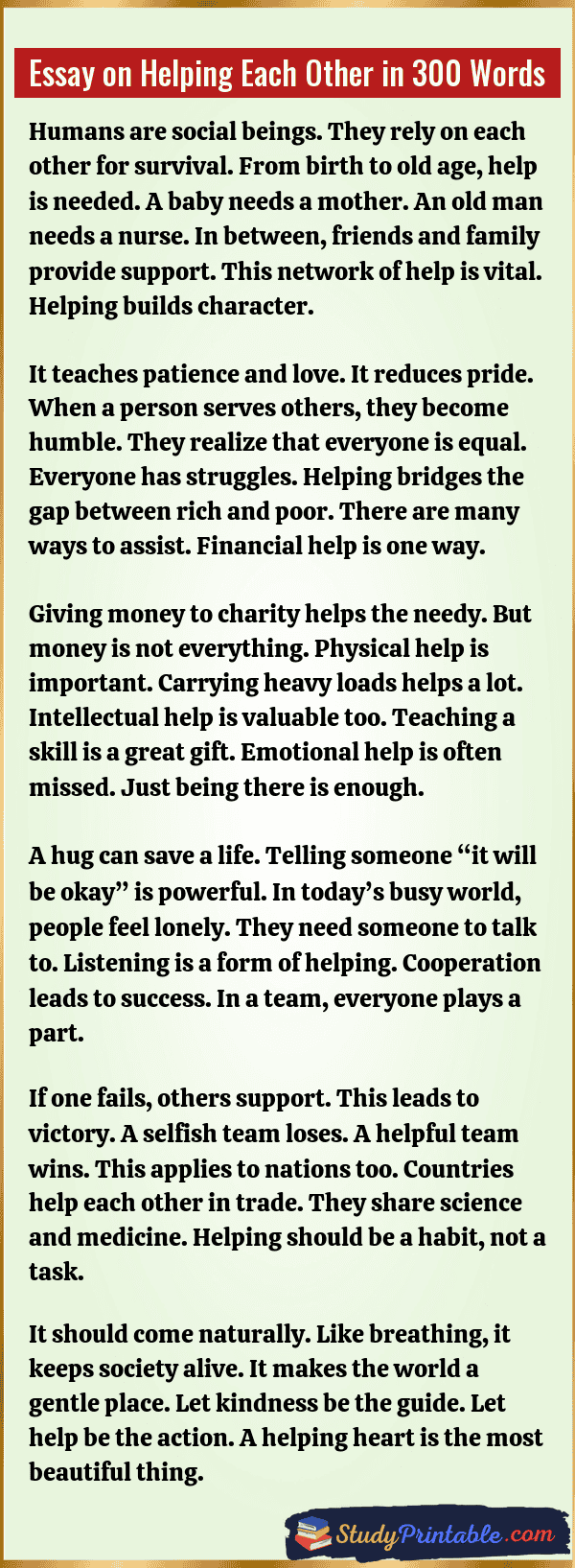
Humans are social beings. They rely on each other for survival. From birth to old age, help is needed. A baby needs a mother. An old man needs a nurse. In between, friends and family provide support. This network of help is vital. Helping builds character.
It teaches patience and love. It reduces pride. When a person serves others, they become humble. They realize that everyone is equal. Everyone has struggles. Helping bridges the gap between rich and poor. There are many ways to assist. Financial help is one way.
Giving money to charity helps the needy. But money is not everything. Physical help is important. Carrying heavy loads helps a lot. Intellectual help is valuable too. Teaching a skill is a great gift. Emotional help is often missed. Just being there is enough.
A hug can save a life. Telling someone “it will be okay” is powerful. In today’s busy world, people feel lonely. They need someone to talk to. Listening is a form of helping. Cooperation leads to success. In a team, everyone plays a part.
If one fails, others support. This leads to victory. A selfish team loses. A helpful team wins. This applies to nations too. Countries help each other in trade. They share science and medicine. Helping should be a habit, not a task.
It should come naturally. Like breathing, it keeps society alive. It makes the world a gentle place. Let kindness be the guide. Let help be the action. A helping heart is the most beautiful thing.
Essay on Helping Each Other in 500 Words
Introduction
Helping each other is the foundation of civilization. Since ancient times, humans have lived in tribes. They hunted together. They built homes together. This unity helped them survive wild animals and storms. Today, the world is modern. But the need for help is the same. No man is an island. Everyone needs support to grow and live happily.
Types of Help
Help comes in many forms. It is not just about money.
Physical Help: This involves using the body. Helping a friend move furniture is physical help. Cleaning a park is physical help.
Emotional Help: This involves the heart. Listening to a sad person is emotional help. Giving hope to a failure is vital.
Mental Help: This involves the brain. Teaching a child to read is mental help. Solving a problem for a colleague is useful.
Financial Help: This involves money. Donating to the poor helps them eat. Buying medicine for the sick is a noble use of wealth.
Benefits for Society
A society that helps is a safe society. Crime goes down when people care. If a neighbor watches a house, thieves stay away. If people feed the hungry, theft for food stops. Trust is built. People feel safe walking on streets. They know someone will help if they fall. This creates peace. Festivals become happier. Sorrow becomes lighter. Sharing divides grief and multiplies joy.
Benefits for the Helper
Helping is not a one-way street. The person who helps gets benefits too. It gives a sense of purpose. It boosts self-esteem. Psychologists say helping cures sadness. It releases “feel-good” chemicals in the brain. It reduces stress. A helpful person sleeps better. They have more friends. They are respected in society. Their life feels meaningful.
The Role of Schools
Schools play a big role. They teach values. Group projects teach teamwork. Students learn to share credit. They learn to support weak students. Sports teach reliance. A striker needs a passer to score a goal. These lessons last a lifetime. A child who helps today becomes a good leader tomorrow.
Challenges to Helping
Sometimes, people do not help. They are busy. They are afraid. They think, “It is not my problem.” This is wrong. A problem today for others can be a problem tomorrow for you. Ignoring suffering creates a cold world. Fear must be overcome. Time must be made. Small acts fit in busy schedules. Holding a door open takes one second. But it shows respect.
Conclusion
Helping each other is the law of nature. Even trees help by sharing nutrients through roots. Humans have the power to choose. Choosing to help is choosing love. It solves conflicts. It ends wars. It feeds the hungry. It is the highest duty of mankind. Let every hand be a helping hand.
Essay on Helping Each Other in 1000 Words
Introduction
Helping each other is the golden thread that ties humanity together. It is an action of extending support, care, and resources to someone in need. This simple act has shaped history. It has built cities. It has saved lives. In a world that often feels competitive, helping is a breath of fresh air. It reminds people that they are not alone. It proves that love is stronger than selfishness. From a small child sharing a toy to nations sending aid, helping is the engine of progress.
The Instinct to Help
Is helping natural? Yes, it is. Look at babies. If one baby cries, others look concerned. They try to comfort. This shows that empathy is born in humans. Evolution favored helpers. In the wild, lone humans died. Groups survived. Those who shared food lived longer. Those who protected the sick kept the tribe strong. So, helping is in the DNA. It is a survival skill. Today, the jungle is gone. But the “social jungle” remains. People still need the pack to survive.
Helping in Daily Life
Opportunities to help are everywhere. They are in the small moments.
In the Family: A family works like a machine. Each member is a gear. If parents cook, children can wash dishes. If a sibling is sick, others bring water. This reduces the burden. It makes the home a happy place.
In Public: Public places test kindness. Giving a seat to an elderly person on a bus is respect. Helping a mother carry a stroller up the stairs is kindness.
At Work: The office can be stressful. Helping a new employee learn the ropes is good. Sharing credit for a project builds trust. It creates a positive work culture.
The Power of Volunteering
Volunteering is helping strangers. It is the purest form of service. Millions of people volunteer daily. Some work in animal shelters. They feed lost dogs. Some work in soup kitchens. They feed the homeless.
Red Cross volunteers go to war zones. They risk lives to help. Teachers go to remote villages. They spread knowledge. This work has no salary. The payment is the smile of the receiver. This satisfaction is worth more than gold. It gives the soul a deep rest.
Helping During Disasters
The true spirit of helping shines in dark times. When earthquakes or floods hit, the world unites. Boundaries disappear. Enemies become friends.
During the Tsunami, the world sent billions. During the pandemic, neighbors shopped for the elderly. People made masks at home. They shared oxygen. This showed that humanity is one big family. Disaster reveals the hero in common people. It proves that compassion is alive.
The Ripple Effect
Kindness is contagious. Scientists call this “upstream reciprocity.” When person A helps person B, person B feels happy. Person B is then likely to help Person C. The chain grows.
Imagine a coffee shop. One person pays for the next car. The next driver is surprised. They pay for the next. A chain of giving starts. One act creates a wave. If everyone did one nice thing daily, the world would change instantly. Anger would vanish. Peace would reign.
Barriers to Helping
Why do people hesitate to help?
The Bystander Effect: This is a psychological term. When many people watch an accident, no one acts. Everyone thinks, “Someone else will do it.” This is dangerous. One person must step forward. Then others follow.
Fear of Danger: People fear getting hurt. They fear legal trouble. Good Samaritan laws now protect helpers.
Busyness: “I don’t have time” is a common excuse. But help does not need hours. A smile takes a second. A text takes a minute.
Judgment: People judge the needy. “He is poor because he is lazy.” This thought stops help. Empathy removes judgment.
Teaching the Next Generation
Children must learn to help. They learn by watching. If parents help, kids help. Schools should have “service days.” Students can clean the neighborhood. They can visit orphanages.
Stories of heroes inspire them. They should learn that real power is not controlling others. Real power is lifting others. A helpful child becomes a responsible citizen. They will build a fair society.
Global Cooperation
Nations help each other too. Rich countries help poor ones. They give loans and food. They share technology. When a disease starts in one land, scientists share the cure.
Global warming is a shared threat. Countries must help each other reduce smoke. They must share green tech. No country can fix the climate alone. Cooperation is the only way to save the planet.
The Spiritual View
All religions teach helping. Christianity says, “Love thy neighbor.” Islam teaches “Zakat” or charity. Hinduism believes in “Seva” or service. Buddhism teaches compassion.
They all agree on one thing. Service to man is service to God. When a person helps, they connect with the divine. It reduces the ego. It brings inner peace. It is the path to enlightenment.
Conclusion
Helping each other is not just a nice thing to do. It is a necessary thing. It is the oxygen of society. Without it, the world creates walls. With it, the world builds bridges.
It turns fear into love. It turns scarcity into abundance. Everyone has the power to be a helper. It starts with a choice. Choose to see the need. Choose to extend a hand. The life saved may be your own. In the end, we rise by lifting others.
FAQ
Why is helping important?
Helping builds strong relationships. It creates a happy community. It solves problems faster and makes life easier for everyone.
How can children help others?
Children can help by sharing toys. They can listen to parents. They can be kind to classmates and help keep the school clean.
Does helping make you happy?
Yes, helping releases happy chemicals in the brain. It gives a feeling of pride and purpose. It reduces stress and sadness.
What is the “Ripple Effect” of kindness?
It means one kind act leads to another. When someone is helped, they often want to help someone else. The kindness spreads far.


