
Alexander Pope wrote a very famous poem. It is called “An Essay on Man”. It talks about life and God. The way it rhymes is very special. He used pairs of matching lines. This makes the poem sound smooth. It helps us remember the wise words. The structure is neat and tidy. It shows clear thinking. These essays are written for students in classes 1 to 12.
Essay on Man Rhyme Scheme in 100 Words
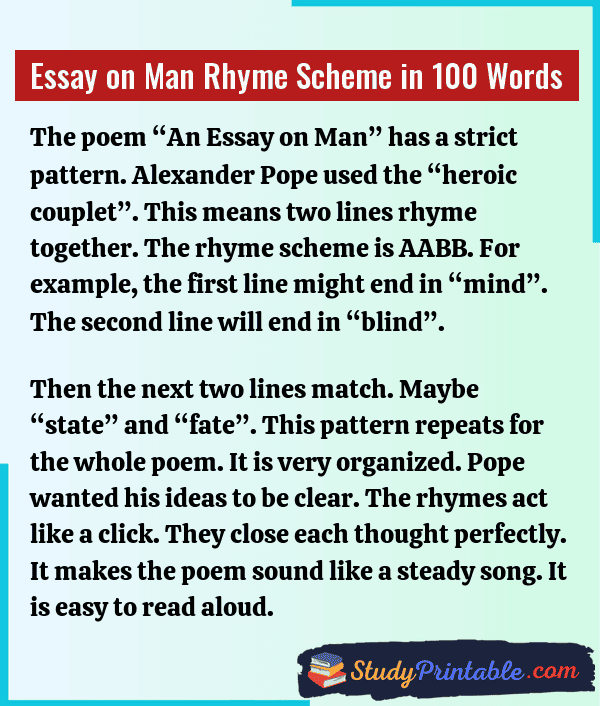
The poem “An Essay on Man” has a strict pattern. Alexander Pope used the “heroic couplet”. This means two lines rhyme together. The rhyme scheme is AABB. For example, the first line might end in “mind”. The second line will end in “blind”.
Then the next two lines match. Maybe “state” and “fate”. This pattern repeats for the whole poem. It is very organized. Pope wanted his ideas to be clear. The rhymes act like a click. They close each thought perfectly. It makes the poem sound like a steady song. It is easy to read aloud.
Essay on Man Rhyme Scheme in 150 Words
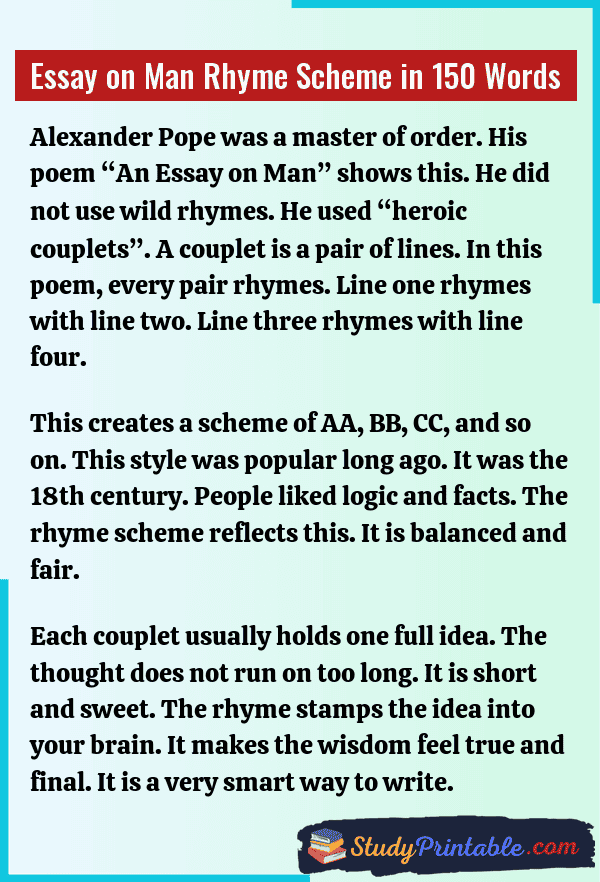
Alexander Pope was a master of order. His poem “An Essay on Man” shows this. He did not use wild rhymes. He used “heroic couplets”. A couplet is a pair of lines. In this poem, every pair rhymes. Line one rhymes with line two. Line three rhymes with line four.
This creates a scheme of AA, BB, CC, and so on. This style was popular long ago. It was the 18th century. People liked logic and facts. The rhyme scheme reflects this. It is balanced and fair.
Each couplet usually holds one full idea. The thought does not run on too long. It is short and sweet. The rhyme stamps the idea into your brain. It makes the wisdom feel true and final. It is a very smart way to write.
Essay on Man Rhyme Scheme in 200 Words
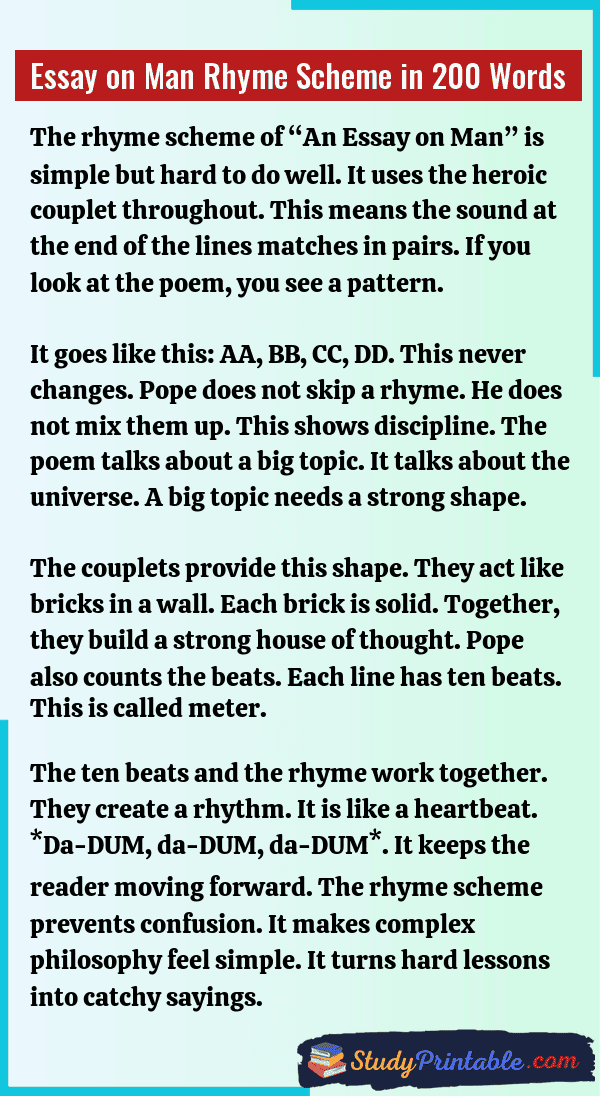
The rhyme scheme of “An Essay on Man” is simple but hard to do well. It uses the heroic couplet throughout. This means the sound at the end of the lines matches in pairs. If you look at the poem, you see a pattern.
It goes like this: AA, BB, CC, DD. This never changes. Pope does not skip a rhyme. He does not mix them up. This shows discipline. The poem talks about a big topic. It talks about the universe. A big topic needs a strong shape.
The couplets provide this shape. They act like bricks in a wall. Each brick is solid. Together, they build a strong house of thought. Pope also counts the beats. Each line has ten beats. This is called meter.
The ten beats and the rhyme work together. They create a rhythm. It is like a heartbeat. Da-DUM, da-DUM, da-DUM. It keeps the reader moving forward. The rhyme scheme prevents confusion. It makes complex philosophy feel simple. It turns hard lessons into catchy sayings.
Essay on Man Rhyme Scheme in 250 Words
“An Essay on Man” is a long philosophical poem. Yet, it is easy to quote. This is because of its rhyme scheme. Alexander Pope chose the heroic couplet. This is a pair of rhyming lines with five strong beats each. The rhyme scheme is AABBCC.
Why did he choose this? He wanted to sound smart and witty. In his time, this was the best style. It is called the Augustan style. It values order over emotion. The rhymes are very exact. He rarely uses “slant rhymes” or sounds that almost match.
He uses “perfect rhymes”. “Hope” rhymes with “scope”. “God” rhymes with “rod”. This makes the poem feel sure of itself. It sounds confident. The couplets are often “closed”. This means the sentence ends at the end of the second line.
You can pause after every pair. This lets the reader think. You read two lines, then you stop and understand. Then you read two more. It breaks the big poem into small bites. This helps in teaching. Students can learn just two lines at a time.
For example, “Hope springs eternal in the human breast; / Man never is, but always to be blest.” The rhyme ties “breast” and “blest” together. It connects the feeling to the blessing. The sound supports the meaning. It is a perfect marriage of form and content.

Essay on Man Rhyme Scheme in 300 Words
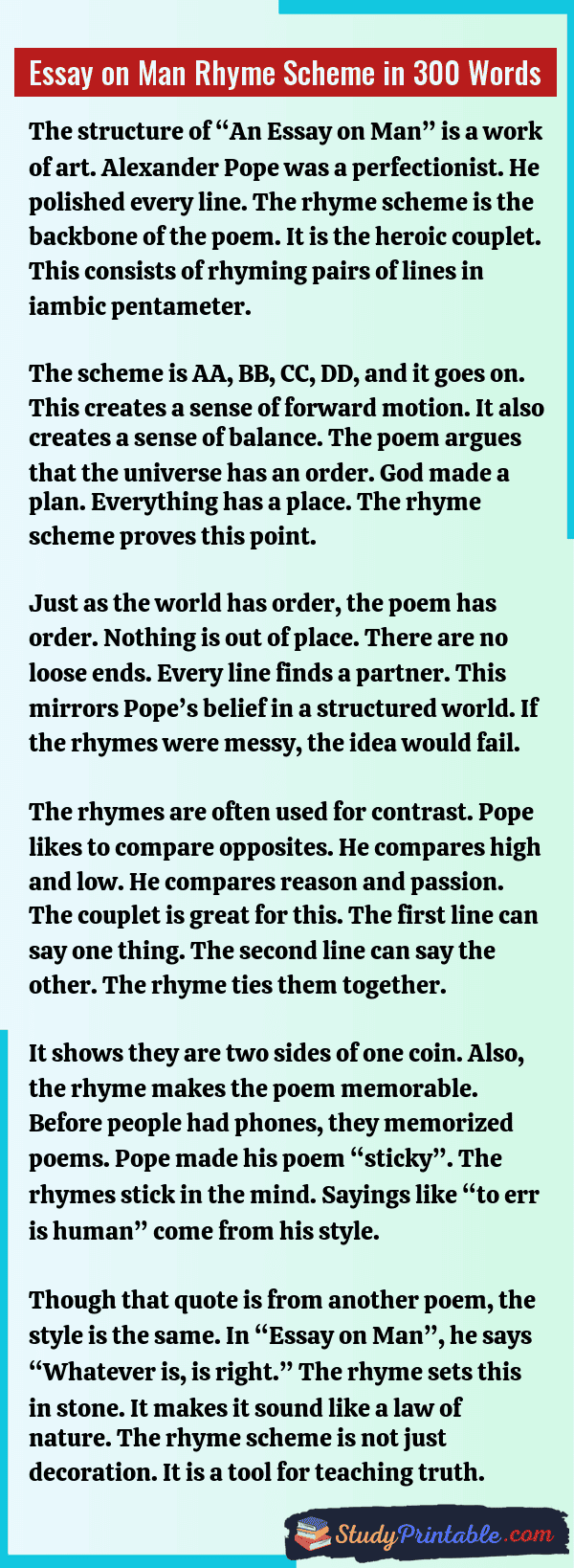
The structure of “An Essay on Man” is a work of art. Alexander Pope was a perfectionist. He polished every line. The rhyme scheme is the backbone of the poem. It is the heroic couplet. This consists of rhyming pairs of lines in iambic pentameter.
The scheme is AA, BB, CC, DD, and it goes on. This creates a sense of forward motion. It also creates a sense of balance. The poem argues that the universe has an order. God made a plan. Everything has a place. The rhyme scheme proves this point.
Just as the world has order, the poem has order. Nothing is out of place. There are no loose ends. Every line finds a partner. This mirrors Pope’s belief in a structured world. If the rhymes were messy, the idea would fail.
The rhymes are often used for contrast. Pope likes to compare opposites. He compares high and low. He compares reason and passion. The couplet is great for this. The first line can say one thing. The second line can say the other. The rhyme ties them together.
It shows they are two sides of one coin. Also, the rhyme makes the poem memorable. Before people had phones, they memorized poems. Pope made his poem “sticky”. The rhymes stick in the mind. Sayings like “to err is human” come from his style.
Though that quote is from another poem, the style is the same. In “Essay on Man”, he says “Whatever is, is right.” The rhyme sets this in stone. It makes it sound like a law of nature. The rhyme scheme is not just decoration. It is a tool for teaching truth.
Essay on Man Rhyme Scheme in 500 Words
Introduction
Alexander Pope wrote “An Essay on Man” in the 1730s. It is a very important poem. It tries to explain the place of humans in the world. It asks why we are here. It asks how we should live. To tell this big story, Pope used a special tool. That tool is the rhyme scheme. He used the heroic couplet. This is a very strict and neat way to write.
What is the Heroic Couplet?
The rhyme scheme of the poem is AABB. This means the lines rhyme in pairs. Line 1 and Line 2 rhyme. Line 3 and Line 4 rhyme. It continues like this until the end.
But it is more than just rhyme. The lines also have a beat. Each line has ten syllables. Five are soft, and five are loud. This is called iambic pentameter. It sounds like a drum. The rhythm is steady.
When you add the rhyme, it becomes a “heroic couplet”. It is called “heroic” because old poems about heroes used it. Pope used it for ideas.
Order and Logic
Pope lived in the Age of Reason. People loved science and logic. They liked things to be tidy. They did not like chaos. The rhyme scheme shows this love for order.
The poem does not ramble. It does not go all over the place. It marches forward in pairs. This makes the poet sound very smart. It sounds like he knows the answers. The rhymes are sharp. They act like the final nail in a board. They hold the thought in place.
The “Closed” Couplet
Most of Pope’s couplets are “closed”. This is a technical term. It means the sentence stops at the end of the rhyme. The thought is complete. You do not need to read the next line to understand the first two.
This makes the poem full of short, wise sayings. You can take two lines out, and they still make sense. This is why Pope is quoted so often. His rhymes made his words portable. You can carry a couplet in your pocket.
Enhancing the Meaning
The rhyme highlights key words. Pope puts the most important words at the end of the line. This is where the rhyme is.
For example, he writes about God. He might rhyme “soul” with “whole”. This connects the human soul to the whole universe. The sound creates a link in meaning. The reader hears the connection.
He also uses rhyme to show balance. He balances man and God. He balances reason and passion. The two lines of the couplet act like a scale. They weigh the two ideas equally.
Conclusion
The rhyme scheme of “An Essay on Man” is perfect for its purpose. It organizes deep thoughts into clear packages. It reflects the order of the universe. It turns philosophy into music. Pope’s skill with the couplet made this poem a classic.
Essay on Man Rhyme Scheme in 1000 Words
Introduction
“An Essay on Man” is a masterpiece by Alexander Pope. It was published between 1733 and 1734. It is not an essay in prose. It is a long poem. Pope wanted to “vindicate the ways of God to man.” This means he wanted to show that God’s plan is good.
To do this, he needed a strong voice. He needed a style that felt authoritative. He chose the heroic couplet. This choice defined the rhyme scheme of the entire work. It is AA, BB, CC, and so on. This structure is crucial to the poem’s success.
The Mechanics of the Rhyme
Let us look closely at the rhyme scheme. The pattern is pairs. Every two lines end with the same sound.
For example:
“Know then thyself, presume not God to scan;
The proper study of mankind is man.”
Here, “scan” rhymes with “man”. This is a full rhyme. It is exact. Pope rarely uses lazy rhymes. He works hard to find the perfect match. This makes the poem satisfying to hear. It feels complete.
The meter helps the rhyme. Pope uses iambic pentameter. This means ten syllables per line. The pattern is unstress-stress. Da-DUM, da-DUM. The last syllable is always stressed. This makes the rhyme word pop out. It lands with a bang.
The Influence of the Era
Pope wrote during the 18th century. This period is called the Neoclassical age. Poets looked back to ancient Rome and Greece. They admired order. They admired control. They disliked wild emotions.
The heroic couplet was the favorite form of this age. It is very controlled. You cannot just write whatever you feel. You have to fit it into the box. You have to make it rhyme.
Pope was the best at this. He used the rhyme scheme to show that reason is king. The neat rhymes suggest that the world is a neat place. If the poem were messy, it would suggest the world is messy. But Pope argues the world is perfect. So, his rhyme scheme must be perfect too.
The Art of Compression
One big effect of this rhyme scheme is compression. This means saying a lot in few words. Pope has to finish his thought in twenty syllables (two lines). He cannot waste words.
He cuts out extra words. He makes the grammar tight. The rhyme forces him to be concise. This makes the poetry very dense. Every word counts.
It is like a diamond. It is small but hard and bright. This compression makes the poem witty. Wit is the ability to say smart things quickly. The rhyme scheme is the engine of his wit.
Comparing Ideas
The couplet structure is great for comparisons. Pope often uses a device called antithesis. This means putting two opposites together.
He might talk about how humans are strong yet weak. He can put “strong” in the first line and “weak” in the second. The rhyme binds them.
It shows the paradox of being human. We are wise, yet we make mistakes. We are born, yet we die. The AABB scheme handles these pairs well. It presents a binary world. Everything has a partner. Everything has a balance.
Sound and Sense
Pope believed that “the sound must seem an echo to the sense.” This means the rhyme should match the meaning.
If he talks about something smooth, the rhyme is soft. If he talks about something harsh, the rhyme is sharp.
In “An Essay on Man”, the rhymes are often firm. They sound like laws. “Right” and “spite”. “Plan” and “man”. These are strong sounds. They give the poem a legal tone. It sounds like a judge speaking. This fits the theme. Pope is judging human nature. He is laying down the laws of life.
Breaking the Boredom
A long poem with AABB rhymes can get boring. It can sound like a nursery rhyme. Pope knew this danger. He used tricks to keep it fresh.
He moves the pause. Usually, the pause is at the end of the line. But Pope moves it to the middle sometimes. This is called a caesura.
He also varies the speed. Some lines are fast. Some are slow. Even though the rhyme is always at the end, the path to get there changes. This keeps the reader awake. It shows his great skill. He follows the rules but is not a slave to them.
Legacy of the Rhyme Scheme
After Pope, this style went out of fashion. The Romantic poets like Wordsworth wanted more freedom. They stopped using the strict couplet. They thought it was too mechanical.
But “An Essay on Man” remains the peak of this style. No one ever did it better. The rhyme scheme allows the poem to be easily memorized. Many people know lines from it without knowing the poem.
When we hear “Fools rush in where angels fear to tread,” we are hearing Pope’s rhythm. (This is from another essay, but the style is identical). The rhyme scheme acts like a preservation tool. It keeps the words safe from time.
Conclusion
The rhyme scheme of “An Essay on Man” is simple AABB. But its effect is huge. It provides order, logic, and beauty. It reflects the mind of Alexander Pope. It reflects the spirit of his age. It turns complex thoughts into clear gems. It proves that strict rules can create great freedom of expression. The poem stands as a monument to the power of the rhyming couplet.
FAQ
What is the rhyme scheme of “An Essay on Man”?
The rhyme scheme is AABB. This means the lines rhyme in pairs. It is written in heroic couplets.
Who wrote “An Essay on Man”?
Alexander Pope wrote this poem. He was a famous English poet in the 18th century.
What is a heroic couplet?
A heroic couplet is a pair of rhyming lines. They are written in a specific rhythm called iambic pentameter.
Why did Pope use this rhyme scheme?
He used it to make his ideas clear and organized. It was also the popular style of his time for serious topics.


