
The Right to Information is a strong law. It gives power to common people. Citizens can ask the government questions. They can ask where money is spent. This stops bad actions. It stops corruption. The government becomes open and fair. Information is power in a democracy. It makes the system work better for everyone. These essays are written for students in classes 1 to 12.
Essay on Right to Information in 100 Words
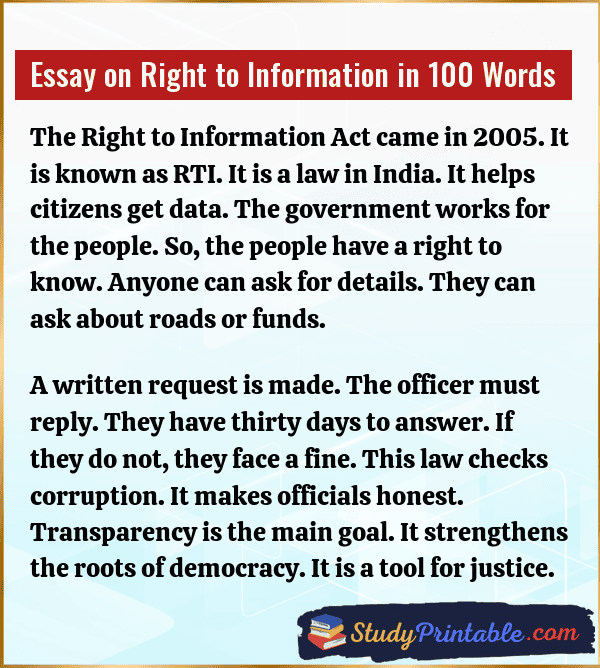
The Right to Information Act came in 2005. It is known as RTI. It is a law in India. It helps citizens get data. The government works for the people. So, the people have a right to know. Anyone can ask for details. They can ask about roads or funds.
A written request is made. The officer must reply. They have thirty days to answer. If they do not, they face a fine. This law checks corruption. It makes officials honest. Transparency is the main goal. It strengthens the roots of democracy. It is a tool for justice.
Essay on Right to Information in 150 Words
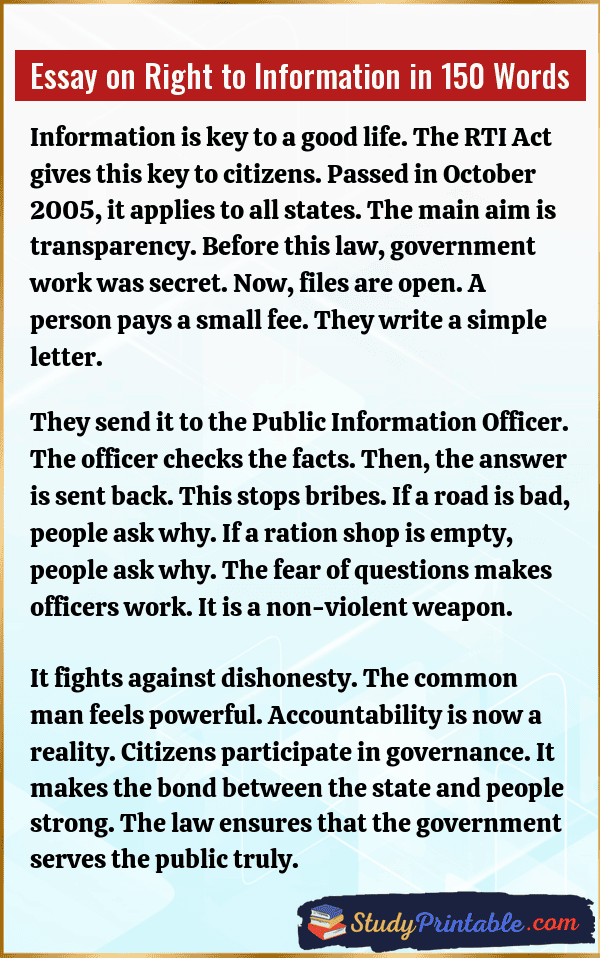
Information is key to a good life. The RTI Act gives this key to citizens. Passed in October 2005, it applies to all states. The main aim is transparency. Before this law, government work was secret. Now, files are open. A person pays a small fee. They write a simple letter.
They send it to the Public Information Officer. The officer checks the facts. Then, the answer is sent back. This stops bribes. If a road is bad, people ask why. If a ration shop is empty, people ask why. The fear of questions makes officers work. It is a non-violent weapon.
It fights against dishonesty. The common man feels powerful. Accountability is now a reality. Citizens participate in governance. It makes the bond between the state and people strong. The law ensures that the government serves the public truly.
Essay on Right to Information in 200 Words
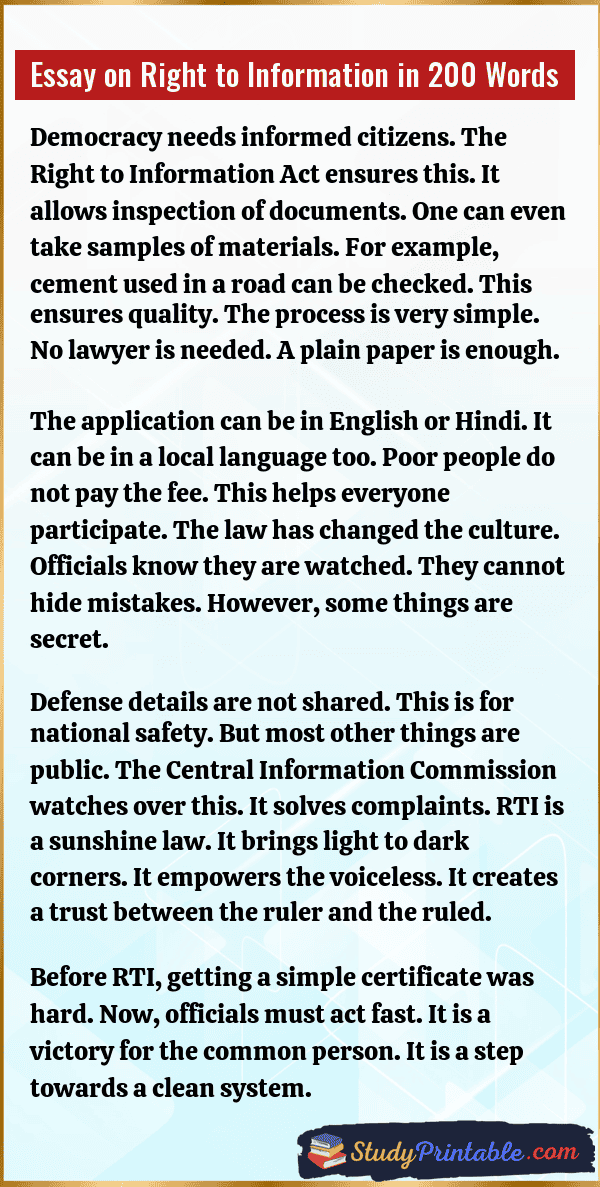
Democracy needs informed citizens. The Right to Information Act ensures this. It allows inspection of documents. One can even take samples of materials. For example, cement used in a road can be checked. This ensures quality. The process is very simple. No lawyer is needed. A plain paper is enough.
The application can be in English or Hindi. It can be in a local language too. Poor people do not pay the fee. This helps everyone participate. The law has changed the culture. Officials know they are watched. They cannot hide mistakes. However, some things are secret.
Defense details are not shared. This is for national safety. But most other things are public. The Central Information Commission watches over this. It solves complaints. RTI is a sunshine law. It brings light to dark corners. It empowers the voiceless. It creates a trust between the ruler and the ruled.
Before RTI, getting a simple certificate was hard. Now, officials must act fast. It is a victory for the common person. It is a step towards a clean system.
Essay on Right to Information in 250 Words
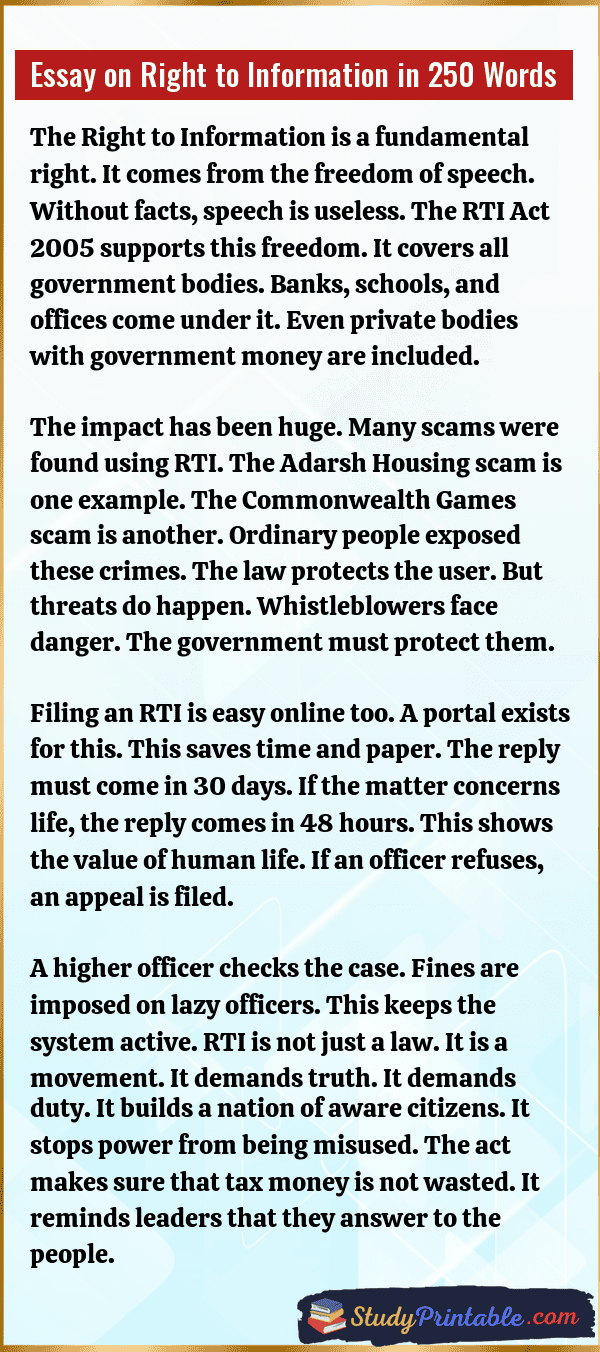
The Right to Information is a fundamental right. It comes from the freedom of speech. Without facts, speech is useless. The RTI Act 2005 supports this freedom. It covers all government bodies. Banks, schools, and offices come under it. Even private bodies with government money are included.
The impact has been huge. Many scams were found using RTI. The Adarsh Housing scam is one example. The Commonwealth Games scam is another. Ordinary people exposed these crimes. The law protects the user. But threats do happen. Whistleblowers face danger. The government must protect them.
Filing an RTI is easy online too. A portal exists for this. This saves time and paper. The reply must come in 30 days. If the matter concerns life, the reply comes in 48 hours. This shows the value of human life. If an officer refuses, an appeal is filed.
A higher officer checks the case. Fines are imposed on lazy officers. This keeps the system active. RTI is not just a law. It is a movement. It demands truth. It demands duty. It builds a nation of aware citizens. It stops power from being misused. The act makes sure that tax money is not wasted. It reminds leaders that they answer to the people.
Essay on Right to Information in 300 Words
The journey of RTI is inspiring. It started in a small village in Rajasthan. A group called MKSS fought for it. Poor farmers wanted to see work records. They shouted a slogan. “Our money, our accounts.” This demand grew loud. Finally, the Parliament passed the law in 2005.
It replaced the old Freedom of Information Act. The new law is stronger. It has teeth. The penalty clause scares bad officials. Every office has a Public Information Officer or PIO. The PIO is the bridge. They take the request. They find the data.
What can be asked? Almost anything. Exam answer sheets can be seen. Passport delays can be questioned. Pension status can be checked. This solves personal problems. It also solves public issues. If a street light is broken, an RTI helps.
But misuse is a problem. Some people file false queries. They try to blackmail officers. This is wrong. The law is for public good. It should be used wisely. Exceptions exist in Section 8. Data that hurts India’s safety is hidden.
Personal privacy is respected. Cabinet papers are secret until the decision is made. Despite limits, RTI is a success. It has deepened democracy. It has shifted power. The master is not the leader. The master is the citizen.
Knowledge is the true currency. RTI distributes this currency to all. It keeps the administration clean and efficient. It encourages people to question authority respectfully. It has made the bureaucracy more responsive. A responsive government creates a happy nation.
Essay on Right to Information in 500 Words
Introduction
The Right to Information (RTI) is a revolutionary Act. It was enacted by the Parliament of India in 2005. It gives citizens the right to access records held by public authorities. It promotes openness. It reduces corruption. It makes the government accountable to the citizens.
Why Was It Needed?
For a long time, the system was opaque. The Official Secrets Act of 1923 hid many things. Officials worked in secrecy. Common people had no voice. Corruption was high. Money for the poor was stolen. There was no way to check. A change was needed. People demanded the right to know. The RTI Act was the answer. It brought sunlight into the system.
How It Works
The process is user-friendly. A citizen writes an application. It is addressed to the Public Information Officer (PIO). A small fee of 10 rupees is paid. The fee is waived for those below the poverty line. The question must be clear. The PIO has 30 days to reply. If the PIO fails, there is a penalty. The penalty is 250 rupees per day. This forces them to act. If the reply is wrong, an appeal is filed. The Information Commission hears the appeal.
What Information is Available?
The scope is vast. Citizens can ask for copies of documents. They can inspect files. They can inspect public works. For example, one can check the quality of a road. They can take samples of material. They can get data in electronic form. Information about government schemes is open. One can ask about ration cards. One can ask about school funds. This helps in daily life. It solves grievances fast.
Exceptions
Not everything is open. Section 8 lists the exemptions. Information affecting sovereignty is secret. Security and strategic interests are protected. Intelligence agencies like IB and RAW are exempt. Personal information with no public interest is also private. The law balances openness with safety.
Impact on Society
RTI has empowered the common man. It has exposed big scams. It helps students get answer sheets. It helps pensioners get money. It forces the administration to be polite. The mindset of ‘ruler and subject’ is changing. Now, the official is a servant of the public.
Challenges
There are hurdles too. Awareness is low in villages. Filing an application can be scary. Activists are sometimes attacked. This violence must stop. Also, record-keeping is poor in offices. Files are often missing. Digitization is needed to fix this. Sometimes, officials give vague answers. This frustrates the applicant.
Conclusion
The RTI Act is a beacon of hope. It is a tool for good governance. It ensures that the tax money is used well. It keeps the democracy alive and healthy. Every citizen should learn to use it correctly.
Essay on Right to Information in 1000 Words
Introduction
The Right to Information (RTI) is one of the most significant laws in India. It marks a shift from secrecy to transparency. In a democracy, the people are the masters. The government uses the people’s money. Therefore, the people have a right to know how it is used. The RTI Act of 2005 grants this legal right. It empowers citizens to question the government. It acts as a watchdog. It ensures that the system works honestly and efficiently. It is often called the ‘Second Independence’ for the citizens.
The Struggle for the Law
The law did not come easily. It was a long battle. It began at the grassroots level. In the 1990s, a movement started in Rajasthan. It was led by the Mazdoor Kisan Shakti Sangathan (MKSS). Aruna Roy was a key leader. Poor villagers worked on government projects. But they were not paid full wages. When they asked for records, they were refused. They organized protests. They held public hearings called ‘Jan Sunwai’. They exposed corruption. This movement spread across India. Civil society and activists joined hands. Finally, the Parliament passed the act in 2005.
Objectives of the Act
The primary goal is transparency. Secrecy breeds corruption. Openness kills corruption. The act aims to contain corruption. It aims to hold the government accountable. It creates an informed citizenry. An informed person makes better choices. The act also aims to reduce the gap between the government and the people. It makes the government sensitive to public needs. It turns the subject into a citizen.
Key Provisions
The act is very comprehensive.
Public Authority: It covers all bodies established by the Constitution. It covers bodies funded by the government. NGOs with government funding are also covered.
Public Information Officer (PIO): Every department must appoint a PIO. They are the face of the act. They receive requests. They provide information.
Time Limit: Speed is crucial. The information must be given within 30 days. If it concerns the life or liberty of a person, the limit is 48 hours.
Fees: The application fee is nominal. It is usually Rs. 10. For people Below Poverty Line (BPL), it is free.
Penalties: If a PIO delays or refuses without cause, they pay a fine. The fine is Rs. 250 per day up to Rs. 25,000. This is deducted from their salary.
The Process of Filing
Filing an RTI is simple. There is no fixed format. One can write on a plain paper. The applicant must write their name and address. They must ask specific questions. They can send it by post or submit it in person. Online filing is available for central ministries. This makes it accessible to youth. The applicant does not need to give a reason. They just need to ask. This provision protects the citizen from harassment.
Exemptions: Section 8
Transparency has limits. Section 8 of the Act lists what cannot be shared.
National Security: Information that hurts the sovereignty of India.
Relations with Foreign States: Diplomatic secrets are safe.
Cabinet Papers: Discussions of ministers are secret until a decision is final.
Personal Privacy: Information that invades privacy is denied. Unless it serves a larger public interest.
Intellectual Property: Trade secrets are protected.
Intelligence and security organizations are mostly exempt. However, if there are allegations of corruption or human rights violation, they must answer.
Role of Information Commissions
The Act set up a two-tier structure. There is the Central Information Commission (CIC) in Delhi. There are State Information Commissions (SIC) in states. They act as the final appellate authority. If a citizen is unhappy with the PIO’s reply, they go to the First Appellate Authority. If still unhappy, they go to the Information Commission. The Commission can order the department to release data. They can impose penalties. They ensure the law is followed.
Impact on Governance
The impact is visible everywhere.
Checking Corruption: Ration dealers now fear RTI. They distribute food grains properly. Road contractors use better materials.
Correcting Grievances: People get tax refunds faster. Passport applications move quickly.
Selection Processes: Interview marks in government jobs are revealed. This ensures fair selection.
Usage of Funds: Village heads disclose how funds are spent. This strengthens the Panchayat system.
RTI has changed the power dynamic. The ‘Mai-Baap’ culture is fading. Officials realize they are answerable.
Success Stories
There are many inspiring stories. In Mumbai, activists used RTI to expose the Adarsh Scam. Politicians took flats meant for war widows. This led to a big investigation. In villages, people used RTI to get wages under MNREGA. Students have used it to get photocopies of answer sheets. This forces examiners to mark correctly. These stories encourage others to use the law.
Challenges and Criticisms
The path is not smooth. There are significant challenges.
Attacks on Activists: This is a sad reality. Many RTI activists have been killed or beaten. The Whistleblowers Protection Act needs to be stronger.
Frivolous Applications: Some people misuse the act. They file hundreds of queries to harass officials. This wastes time.
Pendency: The Information Commissions are overburdened. Thousands of cases are pending. Waiting for a hearing takes years. This defeats the purpose.
Poor Record Management: Government files are often lost or dusty. Finding data takes time. Digital storage is the need of the hour.
Conclusion
The Right to Information Act is a landmark in Indian history. It is a tool for the weak against the strong. It has opened the doors of the government. While there are challenges, the benefits are huge. It has made democracy meaningful. It requires constant vigilance. Citizens must protect this right. The government must strengthen it. A transparent nation is a progressive nation. RTI is the guardian of this progress.
FAQ
What is the RTI Act?
The RTI Act is a law passed in 2005. It allows Indian citizens to ask for information from the government. It aims to stop corruption.
Who can file an RTI?
Any citizen of India can file an RTI. There is no age limit. Even a student can ask questions to the government.
How much does it cost?
The fee is very low. It is usually 10 rupees. For people below the poverty line, there is no fee. They can get information for free.
What is the time limit for a reply?
The government officer must reply within 30 days. If the information is about life and safety, they must reply in 48 hours.


