
Ashfaqulla Khan was a fearless revolutionary and a shining star of the Indian freedom struggle. He is best remembered for his deep friendship with Ram Prasad Bismil and his key role in the Kakori train robbery. A poet at heart and a warrior in spirit, he sacrificed his life for the motherland at the young age of 27. His life stands as a powerful symbol of Hindu-Muslim unity and patriotism. The following essays are written for students from Class 1 to Class 12.
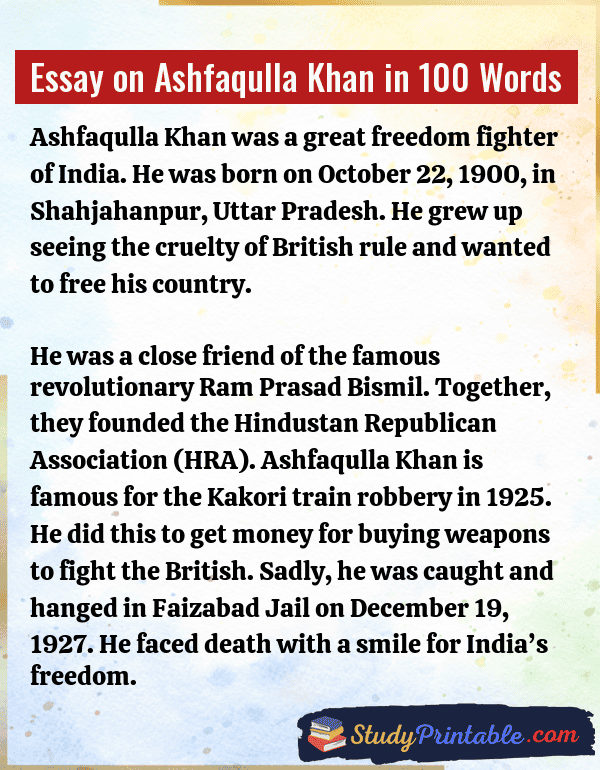
Essay on Ashfaqulla Khan in 100 Words
Ashfaqulla Khan was a great freedom fighter of India. He was born on October 22, 1900, in Shahjahanpur, Uttar Pradesh. He grew up seeing the cruelty of British rule and wanted to free his country.
He was a close friend of the famous revolutionary Ram Prasad Bismil. Together, they founded the Hindustan Republican Association (HRA). Ashfaqulla Khan is famous for the Kakori train robbery in 1925. He did this to get money for buying weapons to fight the British. Sadly, he was caught and hanged in Faizabad Jail on December 19, 1927. He faced death with a smile for India’s freedom.
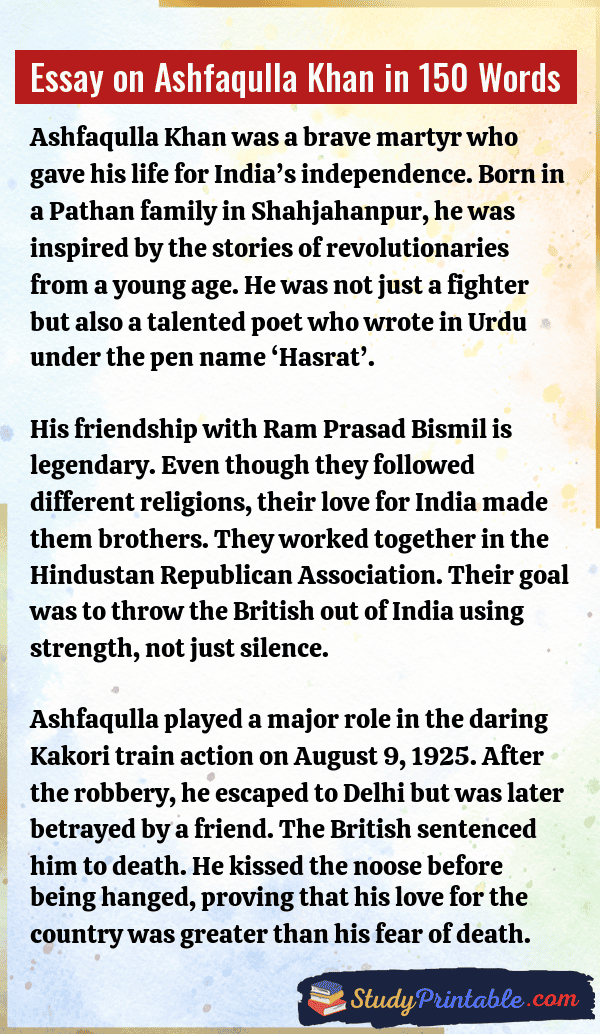
Essay on Ashfaqulla Khan in 150 Words
Ashfaqulla Khan was a brave martyr who gave his life for India’s independence. Born in a Pathan family in Shahjahanpur, he was inspired by the stories of revolutionaries from a young age. He was not just a fighter but also a talented poet who wrote in Urdu under the pen name ‘Hasrat’.
His friendship with Ram Prasad Bismil is legendary. Even though they followed different religions, their love for India made them brothers. They worked together in the Hindustan Republican Association. Their goal was to throw the British out of India using strength, not just silence.
Ashfaqulla played a major role in the daring Kakori train action on August 9, 1925. After the robbery, he escaped to Delhi but was later betrayed by a friend. The British sentenced him to death. He kissed the noose before being hanged, proving that his love for the country was greater than his fear of death.
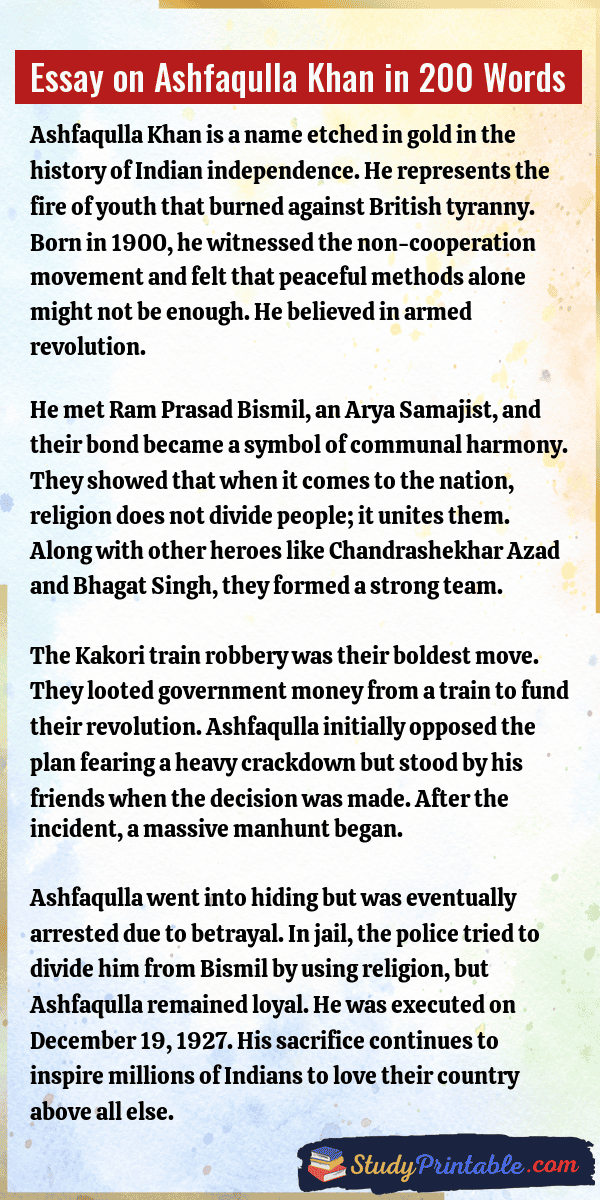
Essay on Ashfaqulla Khan in 200 Words
Ashfaqulla Khan is a name etched in gold in the history of Indian independence. He represents the fire of youth that burned against British tyranny. Born in 1900, he witnessed the non-cooperation movement and felt that peaceful methods alone might not be enough. He believed in armed revolution.
He met Ram Prasad Bismil, an Arya Samajist, and their bond became a symbol of communal harmony. They showed that when it comes to the nation, religion does not divide people; it unites them. Along with other heroes like Chandrashekhar Azad and Bhagat Singh, they formed a strong team.
The Kakori train robbery was their boldest move. They looted government money from a train to fund their revolution. Ashfaqulla initially opposed the plan fearing a heavy crackdown but stood by his friends when the decision was made. After the incident, a massive manhunt began.
Ashfaqulla went into hiding but was eventually arrested due to betrayal. In jail, the police tried to divide him from Bismil by using religion, but Ashfaqulla remained loyal. He was executed on December 19, 1927. His sacrifice continues to inspire millions of Indians to love their country above all else.
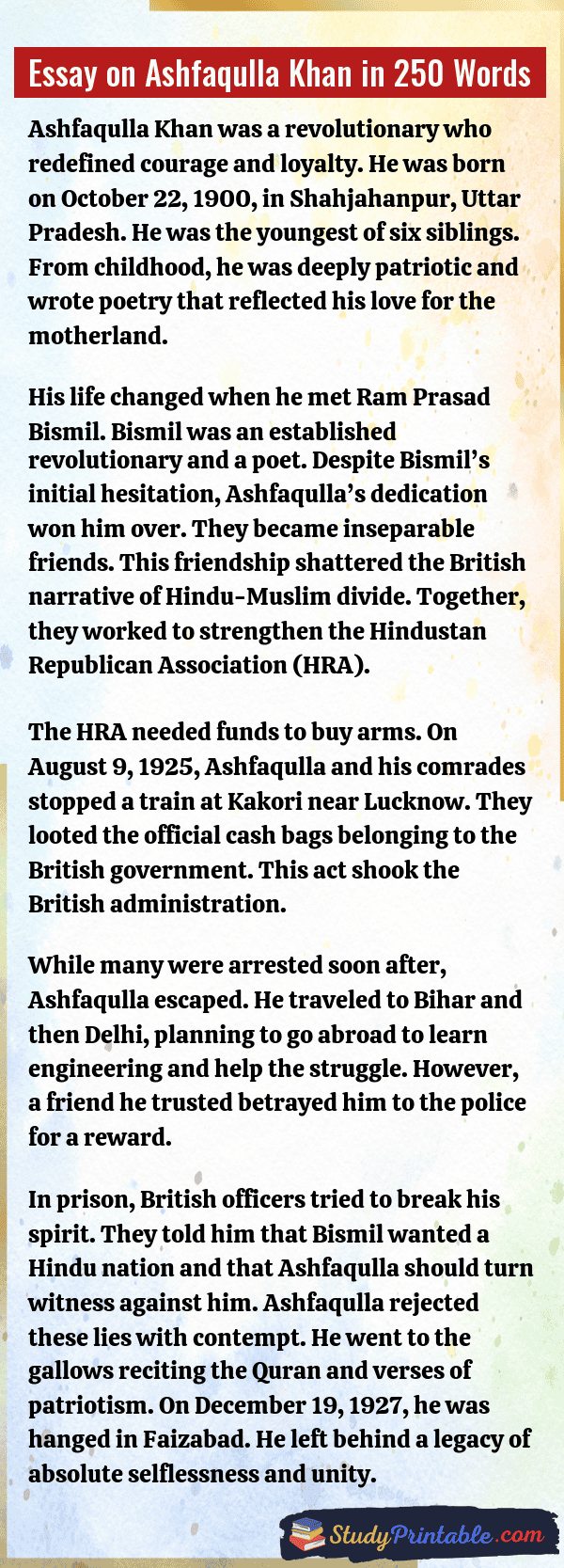
Essay on Ashfaqulla Khan in 250 Words
Ashfaqulla Khan was a revolutionary who redefined courage and loyalty. He was born on October 22, 1900, in Shahjahanpur, Uttar Pradesh. He was the youngest of six siblings. From childhood, he was deeply patriotic and wrote poetry that reflected his love for the motherland.
His life changed when he met Ram Prasad Bismil. Bismil was an established revolutionary and a poet. Despite Bismil’s initial hesitation, Ashfaqulla’s dedication won him over. They became inseparable friends. This friendship shattered the British narrative of Hindu-Muslim divide. Together, they worked to strengthen the Hindustan Republican Association (HRA).
The HRA needed funds to buy arms. On August 9, 1925, Ashfaqulla and his comrades stopped a train at Kakori near Lucknow. They looted the official cash bags belonging to the British government. This act shook the British administration.
While many were arrested soon after, Ashfaqulla escaped. He traveled to Bihar and then Delhi, planning to go abroad to learn engineering and help the struggle. However, a friend he trusted betrayed him to the police for a reward.
In prison, British officers tried to break his spirit. They told him that Bismil wanted a Hindu nation and that Ashfaqulla should turn witness against him. Ashfaqulla rejected these lies with contempt. He went to the gallows reciting the Quran and verses of patriotism. On December 19, 1927, he was hanged in Faizabad. He left behind a legacy of absolute selflessness and unity.
Essay on Ashfaqulla Khan in 300 Words
Ashfaqulla Khan was a prominent figure in the Indian independence movement. He was a man of action, a poet, and a symbol of the composite culture of India. Born into a noble Muslim family in Shahjahanpur, he grew up hearing stories of bravery which fueled his desire to see a free India.
The Revolutionary Path
Disappointed by the withdrawal of the Non-Cooperation Movement in 1922, Ashfaqulla felt that aggressive action was needed. He joined forces with Ram Prasad Bismil to form the Hindustan Republican Association. Their manifesto called for a Federal Republic of the United States of India. They were not just fighting for freedom, but for a system where the poor would not be exploited.
The Kakori Conspiracy
The revolutionaries were short on money. They decided to intercept government funds transported by train. On that fateful day in August 1925, Ashfaqulla Khan, along with Bismil, Chandrashekhar Azad, and others, executed the plan at Kakori. Ashfaqulla was the one who famously broke the safe when others couldn’t.
Betrayal and Martyrdom
After the robbery, Ashfaqulla went underground. He worked in an engineering company in Daltonganj for a while. Later, he moved to Delhi. He planned to leave for Russia but was betrayed by a Pathan friend who informed the police. He was arrested and put on trial.
The trial was a display of his courage. The British tried to use religious differences to turn him against Bismil, but Ashfaqulla famously said that if Bismil was a Hindu fighting for the country, he was a Muslim doing the same. He was sentenced to death. On his last day, he walked to the gallows with a heavy heart only because he could not do more for his country. His martyrdom remains a beacon of light for India’s youth.
Essay on Ashfaqulla Khan in 500 Words
Ashfaqulla Khan stands tall as one of the most inspiring martyrs of the Indian freedom struggle. He was a revolutionary who combined the fire of patriotism with the softness of poetry. Born on October 22, 1900, in Shahjahanpur, Uttar Pradesh, he belonged to a Pathan family known for its military background. However, Ashfaqulla chose a different battle—the battle for India’s liberty.
Friendship with Ram Prasad Bismil
The story of Ashfaqulla Khan is incomplete without mentioning Ram Prasad Bismil. They were two bodies with one soul. Bismil was a devout Hindu who performed puja daily, while Ashfaqulla was a devout Muslim who read the Quran. Yet, their bond was unbreakable. They shared a common enemy—the British Raj—and a common love—India. This friendship was a slap in the face of the colonial “divide and rule” policy. They wrote poetry, planned strategies, and lived and died for the same cause.
The Hindustan Republican Association (HRA)
Ashfaqulla was a key member of the HRA, an organization dedicated to armed revolution. The youth of the HRA believed that the British would not leave India peacefully. They needed weapons to fight back. However, weapons cost money. To fund their activities, the group decided to target government property, leading to the famous Kakori train robbery.
The Kakori Train Action
On August 9, 1925, the number 8 Down Train was stopped near Kakori by the revolutionaries. Ashfaqulla Khan was part of the core team. During the heist, when the safe containing the cash bags wouldn’t open, it was the strong-built Ashfaqulla who hammered it open. They took the money, which was collected from Indians as tax, to use it against the British. The incident created panic in the British administration.
Arrest and Trial
Following the robbery, the police launched a massive crackdown. While Bismil was caught in October, Ashfaqulla managed to escape. He hid in Bihar and worked as a clerk. Later, he went to Delhi to find a way to escape to Afghanistan and then Russia to seek help for the movement. Tragically, a friend he sought shelter with betrayed him to the police for a reward.
In jail, the British Superintendent of Police, Tasadduk Khan, tried to communalize the issue. He told Ashfaqulla that Bismil wanted to establish a Hindu Raj and that Ashfaqulla, being a Muslim, should testify against him to save his own life. Ashfaqulla scolded the officer, stating that he valued his friendship and his country more than his life.
Execution
Ashfaqulla Khan was sentenced to death. On December 19, 1927, he was hanged in Faizabad Jail. Before the execution, he adjusted the noose around his neck himself and said, “My hands are not soiled with the murder of man. The charges against me are false. God will give me justice.” He died with the name of Allah on his lips and the love of India in his heart. His sacrifice teaches us that true patriotism sees no religion.
Essay on Ashfaqulla Khan in 1000 Words
The history of India’s struggle for independence is adorned with the sacrifices of countless young men and women who gave up their today for our tomorrow. Among these luminaries, the name of Ashfaqulla Khan shines with a distinct brilliance. He was not just a freedom fighter; he was a poet, a thinker, and a symbol of India’s syncretic culture. His life serves as a powerful reminder that the love for one’s motherland transcends all barriers of caste, creed, and religion.
Early Life and Background
Ashfaqulla Khan was born on October 22, 1900, in Shahjahanpur, a historic city in Uttar Pradesh. He was the youngest of six children born to Shafiq Ullah Khan and Mazharunissa. His family belonged to the Pathan community and was well-respected. From a very young age, Ashfaqulla was exposed to the stories of the world. He was still in school when the non-cooperation movement started. The enthusiasm of the time gripped him, and he began to dream of a free India.
He was deeply influenced by the bravery of revolutionaries. When the Mainpuri Conspiracy took place, a young student named Ram Prasad Bismil was declared an absconder. Ashfaqulla heard stories about Bismil’s poetry and courage and became desperate to meet him.
The Immortal Friendship
The meeting between Ashfaqulla Khan and Ram Prasad Bismil is one of the most beautiful chapters of Indian history. Bismil was initially reluctant to befriend Ashfaqulla, perhaps due to the strict secrecy maintained by revolutionaries. However, Ashfaqulla’s persistence and his shared passion for Urdu poetry eventually melted the ice.
Once they became friends, they were inseparable. They were a study in contrasts—Bismil was a devout Arya Samajist, and Ashfaqulla was a practicing Muslim. Yet, they shared the same plate, the same dreams, and the same destiny. This bond was crucial in the 1920s when communal tension was being fueled by the British. They proved that for an Indian, the nation comes first. They worked together to revive the revolutionary movement in North India.
The Hindustan Republican Association (HRA)
After Mahatma Gandhi withdrew the Non-Cooperation Movement in 1922 following the Chauri Chaura incident, many youths felt disillusioned. They felt that non-violence alone would not drive the British away. This led to the formation of the Hindustan Republican Association (HRA) in 1924.
Ashfaqulla Khan became a core member of this group. The HRA aimed to organize an armed revolution to end colonial rule and establish a “Federal Republic of the United States of India.” Their ideology was socialist, aiming to end the exploitation of man by man. To achieve this, they needed resources, weapons, and money.
The Kakori Train Action
The revolutionaries decided that instead of stealing from private individuals, they would loot government money—money that essentially belonged to the Indian people but was stolen by the British. On August 9, 1925, the HRA executed its most famous plan: the Kakori Train Robbery.
Ten revolutionaries, including Ashfaqulla Khan, Ram Prasad Bismil, Chandrashekhar Azad, and Rajendra Lahiri, boarded the Number 8 Down Train from Shahjahanpur to Lucknow. As the train approached Kakori, they pulled the chain. In the chaos that followed, they overpowered the guard. The iron safe containing the cash was thrown out.
It is said that the safe was incredibly strong and would not open. Ashfaqulla Khan, who was physically the strongest of the group, took the hammer and, with powerful blows, broke it open. They collected the money and escaped. The incident sent shockwaves through the British Empire. It wasn’t about the money (which was only around 4600 rupees); it was about the challenge to British authority.
Life on the Run and Betrayal
The British unleashed a massive manhunt. Within months, most of the leaders, including Bismil, were arrested. Ashfaqulla Khan, however, managed to evade the police. He went into hiding in the jungles of Bihar and then moved to Daltonganj, where he worked as a clerk in an engineering firm under a fake name.
Realizing that he needed to do more, he decided to travel to Russia to seek support for the Indian movement. He traveled to Delhi to make arrangements. There, he met a Pathan friend from his hometown. Ashfaqulla trusted him, but the friend became greedy for the reward money on Ashfaqulla’s head. He informed the police. On the morning of December 7, 1926, Ashfaqulla Khan was arrested.
Trial and Martyrdom
The trial of the Kakori conspirators was a long legal battle. In jail, the British tried their classic “divide and rule” tactic. A Muslim police officer approached Ashfaqulla. He tried to convince him that the HRA was a Hindu organization aiming for Hindu rule and that Bismil would betray him. He offered Ashfaqulla a pardon if he became an approver (government witness).
Ashfaqulla’s response was legendary. He reportedly said, “Ram Prasad is my brother. If a Hindu can die for the country, a Muslim can do it too.” He refused to betray his comrades.
The court sentenced four of them to death: Ram Prasad Bismil, Ashfaqulla Khan, Rajendra Lahiri, and Roshan Singh. Ashfaqulla was detained in Faizabad Jail. During his final days, he spent his time reading the Quran and writing his diary. His writings from jail are full of longing for his country’s freedom and messages to the youth to remain united.
On December 19, 1927, the day of his execution, Ashfaqulla woke up early, performed his morning prayers, and walked calmly to the gallows. He kissed the rope and declared his innocence before God. He was hanged, becoming one of the first Muslims to be executed in a conspiracy case for India’s freedom.
Legacy
Ashfaqulla Khan’s life is a lesson in integrity. He showed that faith and patriotism are not contradictory. He is remembered as a martyr who smiled at death. His poetry, written under the pen name ‘Hasrat’, continues to move hearts. One of his famous couplets captures his spirit:
“Zindagi baad-e-fana tujhko milegi ‘Hasrat’,
Tera jeena tere marne ki badaulat hoga.”
(You will find life after death, Hasrat; your living shall be because of your dying.)
Today, schools, streets, and memorials across India are named after him. But his true memorial is the free India he died for. He remains an eternal symbol of the sacrifices made by India’s youth to break the chains of slavery.
FAQ
Who was Ashfaqulla Khan?
Ashfaqulla Khan was a brave Indian freedom fighter. He was a member of the Hindustan Republican Association and fought against British rule. He is famous for his role in the Kakori train robbery.
Why is Ashfaqulla Khan famous?
He is famous for sacrificing his life for India at a very young age. He is also known for his deep friendship with Ram Prasad Bismil, which showed great Hindu-Muslim unity.
When and how did he die?
He died on December 19, 1927. He was hanged by the British government in Faizabad Jail for his involvement in the Kakori conspiracy case.
What was the Kakori train robbery?
It was a plan by revolutionaries to loot British government money from a train near Lucknow. They used this money to buy weapons to fight for India’s freedom.


