
Reading is a great habit, no matter how you do it. But today, readers have two big choices: printed books or ebooks. Printed books are the ones made of paper that we can hold and smell. Ebooks are digital files we read on screens like tablets or phones. Both have good points and bad points. Some people love the feel of paper, while others love carrying thousands of books in one small device. Choosing between them depends on what you like best. The following essays are written for students from Class 1 to Class 12.
Essay on Books vs Ebooks in 100 Words
Books and ebooks are two ways to read stories. A printed book is made of paper. It has a nice smell. You can turn the pages with your hands. It does not need a battery. You can read it anywhere, even if there is no electricity.
An ebook is a book on a screen. You read it on a phone or a tablet. It is very light. You can carry many ebooks in your pocket. It is great for travel. However, looking at a screen for too long can hurt your eyes. Both help us learn and grow.
Essay on Books vs Ebooks in 150 Words
The debate between books and ebooks is very popular. Printed books have been around for hundreds of years. People love them because they feel real. Holding a book and turning a page gives a special joy. Also, you can share a physical book with a friend easily. You do not need to worry about charging it.
Ebooks are the modern way to read. They are electronic books. The biggest plus point is convenience. You can buy a book instantly from home. You do not need to go to a shop. They also save space. You do not need big shelves to keep them.
But, ebooks need power. If your battery dies, you cannot read. Also, screens can be bad for sleep. In the end, it does not matter if you read on paper or a screen, as long as you are reading.
Essay on Books vs Ebooks in 200 Words
Books vs Ebooks is a choice between tradition and technology. Traditional books offer a sensory experience. The smell of old paper and the sound of flipping pages are things an ebook cannot give. For students, physical books are often better for studying. It is easier to highlight text and write notes in the margins. Also, reading on paper helps you remember the story better.
On the other hand, ebooks are very practical. They are cheaper than printed books because there is no printing cost. For people with weak eyesight, ebooks are a blessing. You can make the font size big or change the brightness. This is not possible with a paper book.
Environmentally, ebooks save trees because no paper is used. But making the electronic device uses rare minerals, which is also bad for the earth. So, both have an impact. Many people use both. They read physical books at home and ebooks while traveling on a bus or train. It is the best of both worlds.
Essay on Books vs Ebooks in 250 Words
Reading has changed a lot in the last twenty years. The arrival of E-readers like Kindle changed the game. Now we compare printed books with digital ones.
The Case for Printed Books
Printed books are collectible. A bookshelf full of books looks beautiful in a room. They have sentimental value. A book gifted by a parent is a treasure. Also, physical books do not have notifications. When you read on a tablet, a message might pop up and distract you. With a paper book, you focus fully on the story. There is no blue light to strain the eyes.
The Case for Ebooks
Ebooks are champions of portability. A student carrying ten textbooks has a heavy bag. A student with a tablet has a light bag. Ebooks also have built-in tools. If you do not know a word, you can tap it to see the meaning. You can search for a specific chapter instantly. This saves time.
Conclusion
Choosing one is hard. Hardcover books are durable and nostalgic. Digital books are efficient and smart. The choice depends on the situation. If you are going on a long flight, an ebook is better. If you are sitting by a fire on a rainy day, a paper book feels better. The medium changes, but the magic of words stays the same.
Essay on Books vs Ebooks in 300 Words
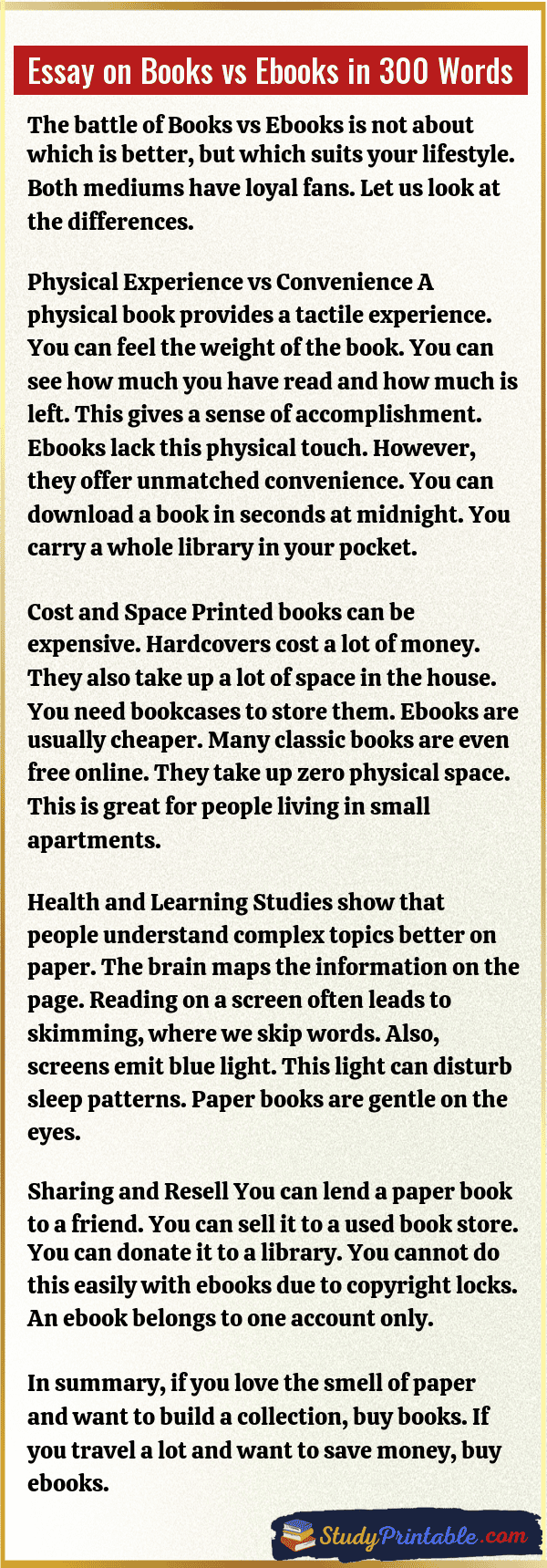
The battle of Books vs Ebooks is not about which is better, but which suits your lifestyle. Both mediums have loyal fans. Let us look at the differences.
Physical Experience vs Convenience
A physical book provides a tactile experience. You can feel the weight of the book. You can see how much you have read and how much is left. This gives a sense of accomplishment. Ebooks lack this physical touch. However, they offer unmatched convenience. You can download a book in seconds at midnight. You carry a whole library in your pocket.
Cost and Space
Printed books can be expensive. Hardcovers cost a lot of money. They also take up a lot of space in the house. You need bookcases to store them. Ebooks are usually cheaper. Many classic books are even free online. They take up zero physical space. This is great for people living in small apartments.
Health and Learning
Studies show that people understand complex topics better on paper. The brain maps the information on the page. Reading on a screen often leads to skimming, where we skip words. Also, screens emit blue light. This light can disturb sleep patterns. Paper books are gentle on the eyes.
Sharing and Resell
You can lend a paper book to a friend. You can sell it to a used book store. You can donate it to a library. You cannot do this easily with ebooks due to copyright locks. An ebook belongs to one account only.
In summary, if you love the smell of paper and want to build a collection, buy books. If you travel a lot and want to save money, buy ebooks.
Essay on Books vs Ebooks in 500 Words
The way we read has evolved. For centuries, ink on paper was the only way to record thoughts. Today, pixels on a screen are just as common. The discussion of “Books vs Ebooks” is a hot topic among readers, students, and publishers. Both formats serve the same purpose—to transfer knowledge and stories—but they do it in very different ways.
The Charm of Printed Books
Printed books have a personality. The cover art, the texture of the pages, and the smell of the ink create a bond with the reader. For many, walking into a bookstore or library is a therapeutic experience. There is a romance in browsing through shelves.
Physical books are also better for focus. In a world full of digital noise, a book is a quiet place. It has no ads, no beeps, and no links. It invites deep reading. Furthermore, printed books do not rely on technology. You don’t need a charger or Wi-Fi. A book dropped on the floor might get a dent, but it will still work. A tablet dropped on the floor might shatter.
The Power of Ebooks
Ebooks represent the future. They are designed for the modern, fast-paced life. An e-reader device is lighter than a single paperback but can hold thousands of titles. This is a game-changer for students who have to carry heavy backpacks.
Ebooks are also accessible. For people with vision problems, ebooks allow text resizing and font changes. Some even have “text-to-speech” features that read the book aloud. This makes reading inclusive. Also, searching is easy. If you want to find a specific quote in a 1000-page book, a digital search finds it in seconds. In a paper book, you might search for hours.
Environmental Impact
This is a tricky comparison. Paper books require cutting trees. The paper industry uses a lot of water and energy. However, paper is biodegradable. Old books can be recycled.
Ebooks save paper, which sounds green. But e-readers are made of plastic, glass, and toxic batteries. Making these devices requires mining rare earth minerals. Also, electronic waste is a huge problem. Disposing of old tablets harms the environment more than disposing of old paper.
Cost Factor
Initially, an e-reader is an expensive investment. You have to buy the device. But over time, it saves money. Ebook versions of novels are almost always cheaper than the print versions. There are no shipping costs. For an avid reader who reads 50 books a year, ebooks are much cheaper.
Conclusion
There is no clear winner. It is a matter of preference. Traditionalists will always prefer the weight of a book in their hands. Tech-savvy readers will prefer the sleekness of a screen. Perhaps the best approach is to embrace both. Use ebooks for convenience and travel, and fill your shelves with the printed books you truly love.
Essay on Books vs Ebooks in 1000 Words
Reading is one of the most enriching activities a human can engage in. It stimulates the mind, reduces stress, and provides knowledge. For a long time, the only medium for reading was the physical book. However, the digital revolution has introduced a new contender: the electronic book, or ebook. This has sparked a global debate: Books vs Ebooks. Which is better? The answer is not simple. It depends on various factors like convenience, cost, retention, and the sensory experience.
The Sensory Experience
The most significant advantage of physical books is the sensory experience they offer. A book is a physical object. It has weight, texture, and a distinct smell. Many readers love the “old book smell,” which is actually the scent of lignin in the paper breaking down. Turning a page is a tactile action that paces the reading. It gives the reader time to process the words.
Visually, a bookshelf is a trophy case of intellectual journeys. Seeing a book on the shelf can bring back memories of where you were when you read it. Ebooks cannot replicate this. An ebook is just a file in a list. It lacks physical presence. You cannot judge an ebook by its cover in the same way, nor can you feel the satisfaction of closing the back cover after finishing a long story.
Convenience and Portability
When it comes to convenience, ebooks are the clear winners. An e-reader like a Kindle or an iPad weighs less than a lunchbox. Yet, it can hold thousands of books. For travelers, this is a miracle. You can go on a month-long vacation with a library in your pocket.
Ebooks are also instantly available. If you hear about a great book from a friend, you can buy and download it immediately. You don’t have to drive to a store or wait for delivery. Ebooks also allow you to read in the dark. With a backlit screen, you can read in bed without turning on a lamp and disturbing your partner.
Learning and Retention
For students, the choice is critical. Studies have shown that reading on paper leads to better comprehension and retention. The brain creates a “mental map” of the physical book. You remember that a certain fact was on the top left of a page halfway through the book. This spatial memory helps in learning.
Screens, on the other hand, encourage “skimming.” When we look at a screen, our eyes tend to jump around, looking for keywords. This makes it harder to focus deeply. Also, digital devices are full of distractions. A notification from social media or an email can break the concentration instantly. A physical book has no such distractions. It demands and keeps your full attention.
Accessibility and Features
Ebooks have features that paper books can only dream of.
Dictionary: In an ebook, if you find a difficult word, you just tap it, and the definition pops up. In a physical book, you have to stop and look it up in a dictionary.
Search: You can search for a character’s name or a specific phrase across the entire book in seconds.
Customization: You can change the font style, increase the text size, and adjust the background color. This is incredibly helpful for people with dyslexia or poor eyesight. Elderly people who struggle with small print in paperbacks find new joy in reading with large-font ebooks.
Cost Comparison
The economics of reading is interesting. Physical books are costly to produce. There is the cost of paper, ink, printing, shipping, and warehousing. This makes the final price high.
Ebooks eliminate these costs. There is no printing or shipping. Therefore, ebooks are generally 20% to 50% cheaper than print books. There is also a vast world of public domain literature. Classics by Shakespeare, Dickens, and Austen are available for free in digital formats. However, the initial cost of the reading device (tablet or e-reader) is high, whereas you can buy a paper book for a few dollars.
Impact on Sleep and Health
Health is a major concern in the digital age. Staring at screens for hours causes “Computer Vision Syndrome.” The symptoms include dry eyes, headaches, and blurred vision. Furthermore, screens emit blue light. This light tricks the brain into thinking it is daytime, suppressing the sleep hormone melatonin. Reading an ebook before bed can make it harder to fall asleep.
Paper books reflect light; they do not emit it. They are restful for the eyes. Reading a physical book is often recommended as a bedtime ritual to help relax the mind.
The Ownership Issue
When you buy a physical book, you own it. You can write in it, lend it to a friend, sell it at a yard sale, or leave it to your children.
When you “buy” an ebook, you are actually just licensing it. You cannot resell it. You cannot easily lend it to a friend. If the company that sold you the ebook goes out of business, you might lose your entire library. This lack of true ownership bothers many readers.
Conclusion
In the battle of Books vs Ebooks, there is no single right answer. It is not a zero-sum game. Physical books offer a deep, tactile, and distraction-free connection to the text. They are better for emotional bonding and deep study. Ebooks offer unmatched utility, speed, and accessibility. They are better for travel, quick reference, and casual reading.
The wise reader does not choose one and hate the other. Instead, they use both tools. They might read a paperback on a sunny Sunday afternoon and an ebook on the crowded subway to work. Ultimately, the medium matters less than the message. Whether on paper or pixel, the act of reading remains a magical door to other worlds.
FAQ
Which is better for eyes, books or ebooks?
Printed books are generally better for your eyes. They do not have a glowing screen. Ebooks can cause eye strain if you read for a long time, especially in the dark.
Are ebooks cheaper than real books?
Yes, usually ebooks are cheaper to buy because there is no paper or shipping cost. However, you need to buy a tablet or reader first, which can be expensive.
Do ebooks save trees?
Yes, ebooks save trees because they do not use paper. But, making the electronic devices uses plastic and metal, which also hurts the environment in different ways.
Can I share my ebooks with friends?
It is difficult to share ebooks. Most are locked to your account. You cannot just hand it to a friend like a physical book. Some apps allow temporary lending, but it is not easy.


