
Hazrat Ayesha (RA) was a very special woman in the history of Islam. She was the beloved wife of the Holy Prophet Muhammad (PBUH) and the daughter of his closest friend, Hazrat Abu Bakr (RA). She is known for her great intelligence and sharp memory. She learned a lot from the Prophet and taught many people about Islam after him. She is called the “Mother of the Believers.” Her life is a shining example of knowledge, simplicity, and kindness. The following essays are written for students from Class 1 to Class 12.
Essay on Hazrat Ayesha in 100 Words
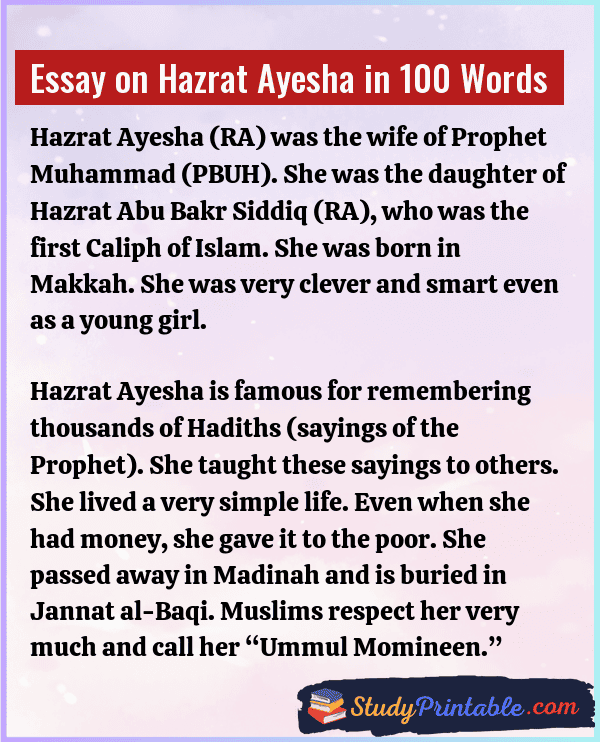
Hazrat Ayesha (RA) was the wife of Prophet Muhammad (PBUH). She was the daughter of Hazrat Abu Bakr Siddiq (RA), who was the first Caliph of Islam. She was born in Makkah. She was very clever and smart even as a young girl.
Hazrat Ayesha is famous for remembering thousands of Hadiths (sayings of the Prophet). She taught these sayings to others. She lived a very simple life. Even when she had money, she gave it to the poor. She passed away in Madinah and is buried in Jannat al-Baqi. Muslims respect her very much and call her “Ummul Momineen.”
Essay on Hazrat Ayesha in 150 Words
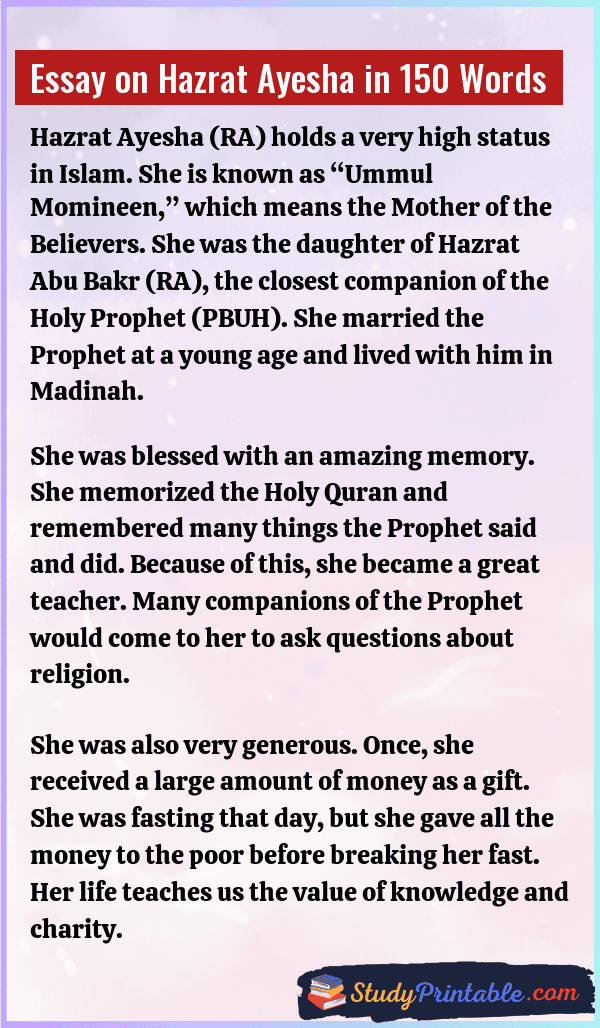
Hazrat Ayesha (RA) holds a very high status in Islam. She is known as “Ummul Momineen,” which means the Mother of the Believers. She was the daughter of Hazrat Abu Bakr (RA), the closest companion of the Holy Prophet (PBUH). She married the Prophet at a young age and lived with him in Madinah.
She was blessed with an amazing memory. She memorized the Holy Quran and remembered many things the Prophet said and did. Because of this, she became a great teacher. Many companions of the Prophet would come to her to ask questions about religion.
She was also very generous. Once, she received a large amount of money as a gift. She was fasting that day, but she gave all the money to the poor before breaking her fast. Her life teaches us the value of knowledge and charity.
Essay on Hazrat Ayesha in 200 Words
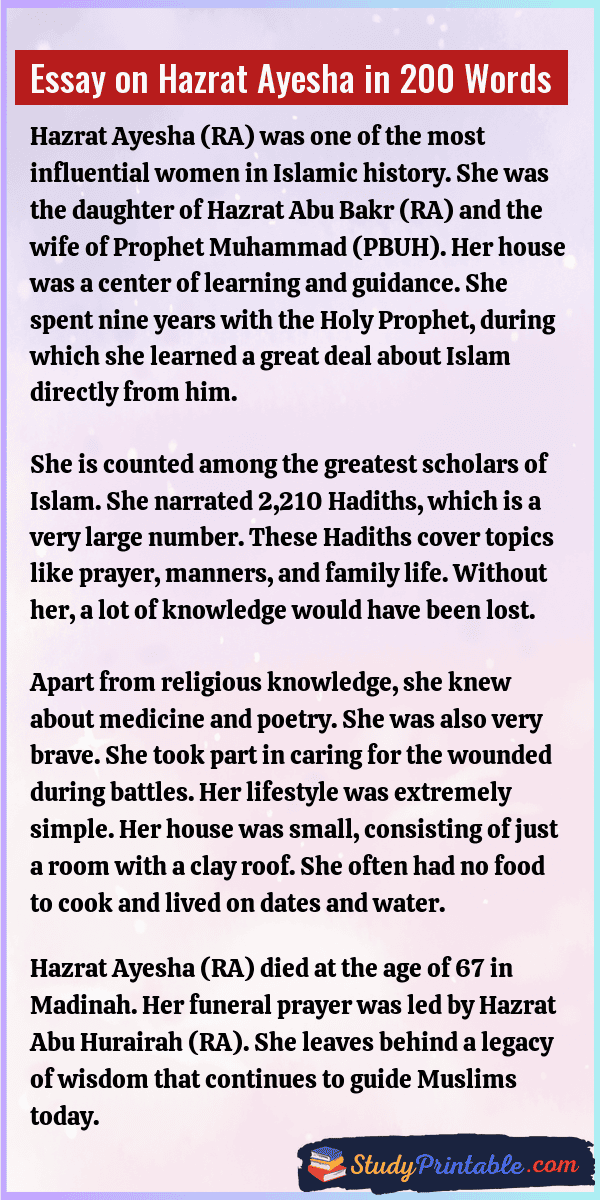
Hazrat Ayesha (RA) was one of the most influential women in Islamic history. She was the daughter of Hazrat Abu Bakr (RA) and the wife of Prophet Muhammad (PBUH). Her house was a center of learning and guidance. She spent nine years with the Holy Prophet, during which she learned a great deal about Islam directly from him.
She is counted among the greatest scholars of Islam. She narrated 2,210 Hadiths, which is a very large number. These Hadiths cover topics like prayer, manners, and family life. Without her, a lot of knowledge would have been lost.
Apart from religious knowledge, she knew about medicine and poetry. She was also very brave. She took part in caring for the wounded during battles. Her lifestyle was extremely simple. Her house was small, consisting of just a room with a clay roof. She often had no food to cook and lived on dates and water.
Hazrat Ayesha (RA) died at the age of 67 in Madinah. Her funeral prayer was led by Hazrat Abu Hurairah (RA). She leaves behind a legacy of wisdom that continues to guide Muslims today.
Essay on Hazrat Ayesha in 250 Words
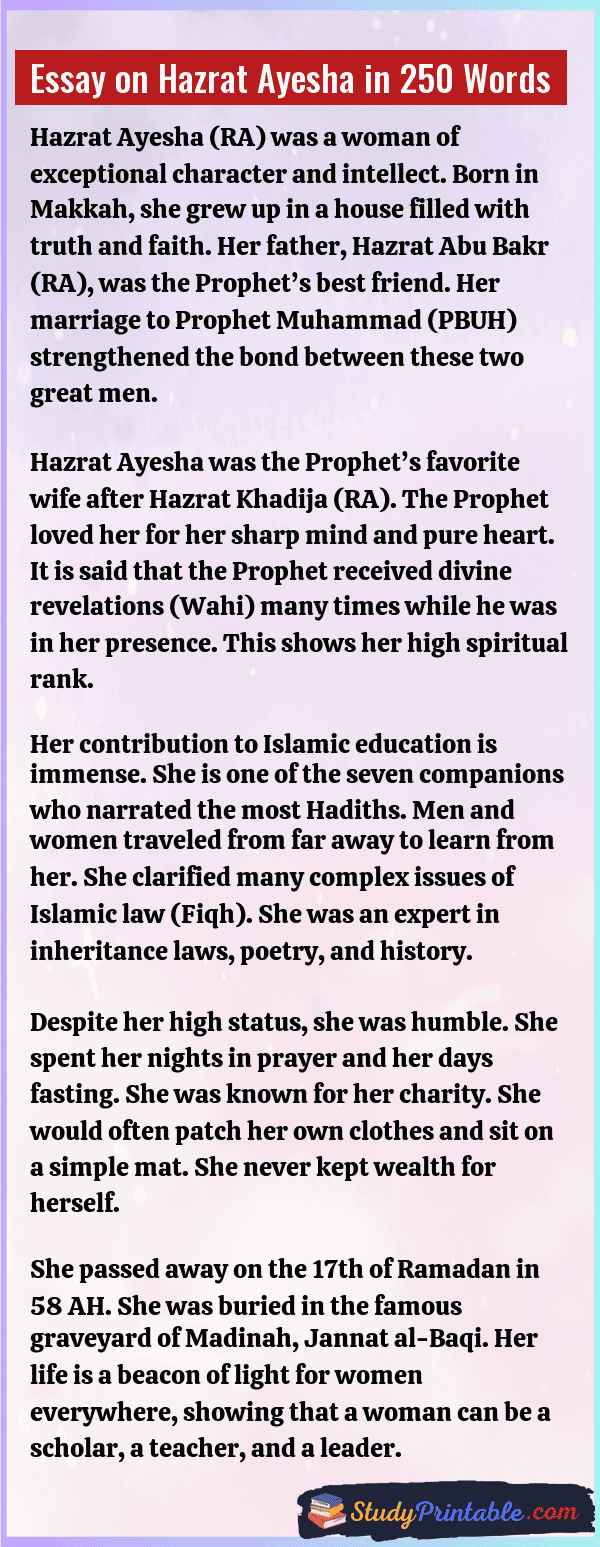
Hazrat Ayesha (RA) was a woman of exceptional character and intellect. Born in Makkah, she grew up in a house filled with truth and faith. Her father, Hazrat Abu Bakr (RA), was the Prophet’s best friend. Her marriage to Prophet Muhammad (PBUH) strengthened the bond between these two great men.
Hazrat Ayesha was the Prophet’s favorite wife after Hazrat Khadija (RA). The Prophet loved her for her sharp mind and pure heart. It is said that the Prophet received divine revelations (Wahi) many times while he was in her presence. This shows her high spiritual rank.
Her contribution to Islamic education is immense. She is one of the seven companions who narrated the most Hadiths. Men and women traveled from far away to learn from her. She clarified many complex issues of Islamic law (Fiqh). She was an expert in inheritance laws, poetry, and history.
Despite her high status, she was humble. She spent her nights in prayer and her days fasting. She was known for her charity. She would often patch her own clothes and sit on a simple mat. She never kept wealth for herself.
She passed away on the 17th of Ramadan in 58 AH. She was buried in the famous graveyard of Madinah, Jannat al-Baqi. Her life is a beacon of light for women everywhere, showing that a woman can be a scholar, a teacher, and a leader.
Essay on Hazrat Ayesha in 300 Words
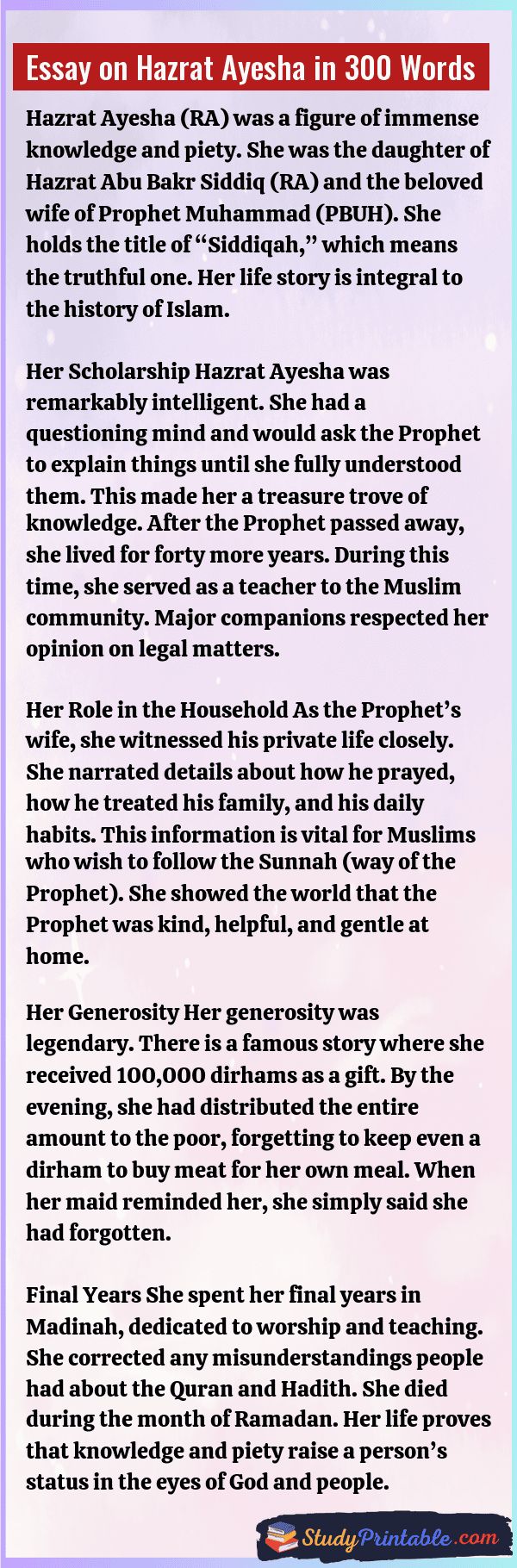
Hazrat Ayesha (RA) was a figure of immense knowledge and piety. She was the daughter of Hazrat Abu Bakr Siddiq (RA) and the beloved wife of Prophet Muhammad (PBUH). She holds the title of “Siddiqah,” which means the truthful one. Her life story is integral to the history of Islam.
Her Scholarship
Hazrat Ayesha was remarkably intelligent. She had a questioning mind and would ask the Prophet to explain things until she fully understood them. This made her a treasure trove of knowledge. After the Prophet passed away, she lived for forty more years. During this time, she served as a teacher to the Muslim community. Major companions respected her opinion on legal matters.
Her Role in the Household
As the Prophet’s wife, she witnessed his private life closely. She narrated details about how he prayed, how he treated his family, and his daily habits. This information is vital for Muslims who wish to follow the Sunnah (way of the Prophet). She showed the world that the Prophet was kind, helpful, and gentle at home.
Her Generosity
Her generosity was legendary. There is a famous story where she received 100,000 dirhams as a gift. By the evening, she had distributed the entire amount to the poor, forgetting to keep even a dirham to buy meat for her own meal. When her maid reminded her, she simply said she had forgotten.
Final Years
She spent her final years in Madinah, dedicated to worship and teaching. She corrected any misunderstandings people had about the Quran and Hadith. She died during the month of Ramadan. Her life proves that knowledge and piety raise a person’s status in the eyes of God and people.
Essay on Hazrat Ayesha in 500 Words
Hazrat Ayesha (RA) stands as one of the most distinguished figures in Islamic history. She was the daughter of Hazrat Abu Bakr (RA), the first Caliph, and the wife of the last Prophet, Muhammad (PBUH). She is universally respected as “Ummul Momineen,” the Mother of the Believers. Her life was a blend of deep spirituality, immense knowledge, and great political insight.
Early Life and Marriage
Hazrat Ayesha was born in Makkah. She grew up in a pure Islamic environment, as her father was the Prophet’s closest companion. She was married to the Prophet in Makkah, but she moved to his house in Madinah after the migration (Hijrah). Her arrival in the Prophet’s household brought joy. She was young, energetic, and very intelligent. The Prophet had a deep love for her. He once said that Ayesha was to him like “Tharid” (a special dish) is to other foods, meaning she was superior and beloved.
A Ocean of Knowledge
Hazrat Ayesha’s greatest contribution is in the field of knowledge. She had a photographic memory. She memorized the Quran and thousands of the Prophet’s sayings. She is one of the “Muksiroon,” the group of companions who narrated the highest number of Hadiths. She narrated 2,210 Hadiths.
But she was not just a narrator; she was a jurist (Faqih). She understood the deep meanings behind the laws. After the Prophet’s death, whenever the companions faced a difficult problem, they would come to her door for the solution. She also had knowledge of Arab history, poetry, and medicine, which she learned from listening to the delegations that visited Madinah.
Simplicity and Piety
Despite being the wife of the ruler of Madinah, she lived in poverty by choice. Her house was a small hut attached to the mosque. Often, months would pass without a fire being lit in her house for cooking; she and the Prophet would survive on dates and water. Yet, she was incredibly generous. She would give away whatever she received. She spent her time in fasting and praying (Tahajjud).
The Incident of Ifk
A significant event in her life was the incident of Ifk, where false accusations were made against her character by hypocrites. She suffered greatly during this time, but she remained patient and prayed to Allah. Eventually, Allah revealed verses in the Quran (Surah An-Nur) declaring her innocence and purity. This confirmed her high status forever.
Conclusion
Hazrat Ayesha (RA) passed away in 58 AH at the age of 67. She requested to be buried alongside the other wives of the Prophet in Jannat al-Baqi, rather than next to the Prophet, out of humility. Her life is a comprehensive guide for Muslims. She showed that women can be scholars, teachers, and guardians of the faith. She remains a role model of intelligence, courage, and faith.
Essay on Hazrat Ayesha in 1000 Words
Hazrat Ayesha bint Abu Bakr (RA) is a monumental figure in the history of Islam. As the beloved wife of Prophet Muhammad (PBUH) and the daughter of his most trusted companion, Hazrat Abu Bakr Siddiq (RA), she occupied a unique position in the early Muslim community. However, her fame rests not just on her relationships, but on her own formidable intellect, scholarship, and piety. She is revered as the “Mother of the Believers” (Ummul Momineen) and is considered one of the greatest teachers of Islam. Her life offers profound lessons in leadership, resilience, and the pursuit of knowledge.
Early Life and Upbringing
Hazrat Ayesha was born in Makkah around 613 or 614 CE. She was born into a Muslim family, as her father, Abu Bakr, was the first adult male to accept Islam. Consequently, she never knew a time of ignorance (Jahiliyyah) and was raised with the values of monotheism and virtue from her very first breath. She was a precocious child, known for her playful nature and sharp wit.
Her marriage to Prophet Muhammad (PBUH) was a divine command. The Prophet saw her in a dream where an angel presented her in a piece of silk, saying, “This is your wife.” The marriage cemented the bond between the Prophet and Abu Bakr. She moved to the Prophet’s house in Madinah after the Hijrah (migration). Despite the age gap, their marriage was filled with love, laughter, and mutual respect. The Prophet would often race with her and listen to her stories with patience.
Her Intellectual Legacy
Hazrat Ayesha is often described as a prodigy. Her house was essentially a school. Living next to the Prophet’s mosque, she heard his sermons and witnessed the revelation of the Quran firsthand. Her inquisitive nature meant she never left a doubt unresolved. She would question the Prophet until she fully grasped the logic and wisdom behind a teaching.
1. Narrator of Hadith: She is the second most prolific narrator of Hadith among women and men combined (after Abu Hurairah). She reported approximately 2,210 traditions. These Hadiths are crucial because they cover the private life of the Prophet—how he slept, ate, treated his wives, and performed ablution. Without her, this aspect of the Sunnah would have remained unknown.
2. Jurist and Scholar: Hazrat Ayesha was not merely a recorder; she was an interpreter. She was a Mujtahid, someone capable of deriving laws from the Quran and Sunnah. Great companions like Umar (RA) and Uthman (RA) would consult her on complex legal issues. She often corrected the views of other companions if they contradicted the Quran or her own observation of the Prophet. Her corrections were later compiled in a book titled “Al-Ijabah.”
3. Orator and Poet: She was known for her eloquence. When she spoke, her Arabic was flawless and powerful. She was also well-versed in the history of the Arabs (genealogy) and poetry, knowledge she inherited from her father.
Her Character and Piety
Hazrat Ayesha’s life was a testament to asceticism (Zuhd). The Prophet’s household was often without food. Ayesha (RA) narrated that they would go for a whole month seeing the crescent moon three times without a fire being lit in their house for cooking. They survived on “Al-Aswadan” (the two black things): dates and water. Yet, she never complained.
Her generosity was boundless. Once, Muawiyah (RA) sent her a gift of 100,000 dirhams. She started distributing it to the poor and needy immediately. By sunset, she had nothing left. Her maid said, “O Mother of the Believers, could you not have bought a dirham’s worth of meat for us to break our fast?” Ayesha replied, “If you had reminded me, I would have done so.” This incident highlights her selflessness; she focused so much on others that she forgot her own hunger.
She was also deeply devoted to worship. She performed Hajj (pilgrimage) regularly and spent long hours in night prayers. She was very particular about the hijab and modesty, setting a standard for Muslim women.
The Divine Vindication
One of the most testing times in her life was the incident of *Ifk* (The Slander). During a return from an expedition, she was accidentally left behind and was brought back to Madinah by a companion named Safwan bin Muattal. Hypocrites spread false rumors about her character. This caused immense pain to her, her family, and the Prophet. She became ill with grief. However, she refused to ask the Prophet for forgiveness for a sin she did not commit, stating she would only complain of her grief to Allah.
Her faith was rewarded when Allah revealed verses in *Surah An-Nur* confirming her innocence. These verses are recited in the Quran to this day, serving as an eternal testimony to her purity and the severe punishment for those who slander chaste women.
Political Role
After the death of the Prophet, Hazrat Ayesha continued to play a pivotal role. During the caliphate of Hazrat Uthman (RA) and Hazrat Ali (RA), the Muslim Ummah faced internal strife. Hazrat Ayesha led a group during the Battle of the Camel, seeking justice for the assassination of Uthman (RA). While the battle ended in tragedy and she later regretted her involvement in the war, her intent was reform and justice. She retired from politics afterward, dedicating her life entirely to teaching.
Death and Legacy
Hazrat Ayesha lived through the caliphates of the four Rightly Guided Caliphs and into the Umayyad period. She passed away on the 17th of Ramadan, 58 AH (678 CE), at the age of 67. As per her wish, she was buried at night in Jannat al-Baqi in Madinah, alongside the other Mothers of the Believers.
Her legacy is unparalleled. She is the teacher of teachers. A quarter of Islamic Sharia law is said to be based on her narrations. She proved that in Islam, a woman’s intellect is equal to a man’s, and her voice is essential in the preservation of faith. She remains a symbol of truth, wisdom, and dignity for millions around the world.
FAQ
Who was Hazrat Ayesha?
Hazrat Ayesha (RA) was the wife of Prophet Muhammad (PBUH) and the daughter of Hazrat Abu Bakr (RA). She is known as the “Mother of the Believers.”
Why is she famous in Islam?
She is famous because she was a great scholar. She remembered thousands of sayings (Hadiths) of the Prophet and taught them to others. She helped spread the knowledge of Islam.
What is her title?
Her most famous title is “Ummul Momineen,” which means Mother of the Believers. She is also called “Siddiqah,” which means the truthful woman.
Where is she buried?
She is buried in the Jannat al-Baqi graveyard in the city of Madinah, Saudi Arabia.


