
Independence Day is a day of great pride and glory for every nation. It marks the day when a country became free from foreign rule. For India, this historic day is August 15. It reminds us of the long struggle and the sacrifices made by our great heroes. On this day, we celebrate our freedom and promise to protect our country. It is a day to remember the past and look forward to a bright future. The following essays are written for students from Class 1 to Class 12.
Essay on Independence Day in 100 Words
Independence Day is celebrated on August 15 every year in India. On this day in 1947, India became free from British rule. It is a national holiday. We remember our freedom fighters like Mahatma Gandhi, Bhagat Singh, and Netaji Subhash Chandra Bose.
The Prime Minister hoists the national flag at the Red Fort in Delhi. Everyone sings the national anthem, “Jana Gana Mana.” Schools and colleges also have flag hoisting ceremonies. Children sing patriotic songs and perform dances. We distribute sweets to celebrate. It is a day of joy and pride for all Indians. We love our country very much.
Essay on Independence Day in 150 Words
Independence Day is the most important day in Indian history. It is celebrated on the 15th of August. Before 1947, India was ruled by the British for almost 200 years. Our leaders fought hard to get freedom. Many people gave their lives for the nation.
On this day, the Prime Minister raises the tricolor flag at the Red Fort. He gives a speech to the nation. He talks about the progress of the country. The armed forces perform a parade to show their strength. In schools, students organize cultural programs. They dress up as freedom fighters and sing songs like “Vande Mataram.”
This day teaches us the value of freedom. It reminds us that we are one nation, despite different religions and languages. We must work hard to make our country the best in the world. Jai Hind!
Essay on Independence Day in 200 Words
Independence Day is a red-letter day for India. It marks the end of British slavery and the beginning of a free India. We celebrate it on August 15 with great enthusiasm. The struggle for freedom was long and painful. Great leaders like Mahatma Gandhi, Jawaharlal Nehru, and Sardar Patel led the movement. Brave heroes like Bhagat Singh and Chandrashekhar Azad sacrificed their lives.
The main celebration takes place in New Delhi. The Prime Minister unfurls the National Flag at the Red Fort. The national anthem echoes in the air. A 21-gun salute is given to honor the flag. The Prime Minister addresses the citizens, highlighting the achievements of the government and future plans.
People fly kites on this day as a symbol of freedom. The sky becomes full of colorful kites. Streets are decorated with saffron, white, and green lights. Television channels show patriotic movies. It is a day to forget our differences and stand united.
Independence Day is not just a holiday. It is a reminder of our duties. We must respect our freedom and follow the laws. We must protect the unity and integrity of our motherland.
Essay on Independence Day in 250 Words
Independence Day is a celebration of liberty and democracy. On August 15, 1947, India awoke to a new dawn of freedom. The British Empire, which ruled us for two centuries, finally left. This victory was the result of a non-violent struggle led by Mahatma Gandhi and the sacrifices of countless revolutionaries.
The celebrations start early in the morning. Every government building and school hoists the Tricolor. The atmosphere is filled with patriotism. At the Red Fort, the Prime Minister pays tribute to the martyrs at Rajghat before hoisting the flag. The speech that follows inspires millions. It focuses on the development of the nation.
Schools play a big role in the celebrations. Principals hoist the flag, and students sing the national anthem. Competitions for speeches, essays, and drawing are held. Sweets are distributed to everyone. In offices, people wear traditional clothes and decorate their desks.
This day also honors the Indian Army, Navy, and Air Force. They protect our freedom at the borders. We remember their courage and dedication.
However, independence comes with responsibility. While we are free from foreign rule, we still fight against poverty, corruption, and illiteracy. Independence Day is a time to pledge to fight these internal enemies. It is a day to renew our promise to serve the nation. A free country needs disciplined citizens to progress. Let us all work together to build a strong and prosperous India.
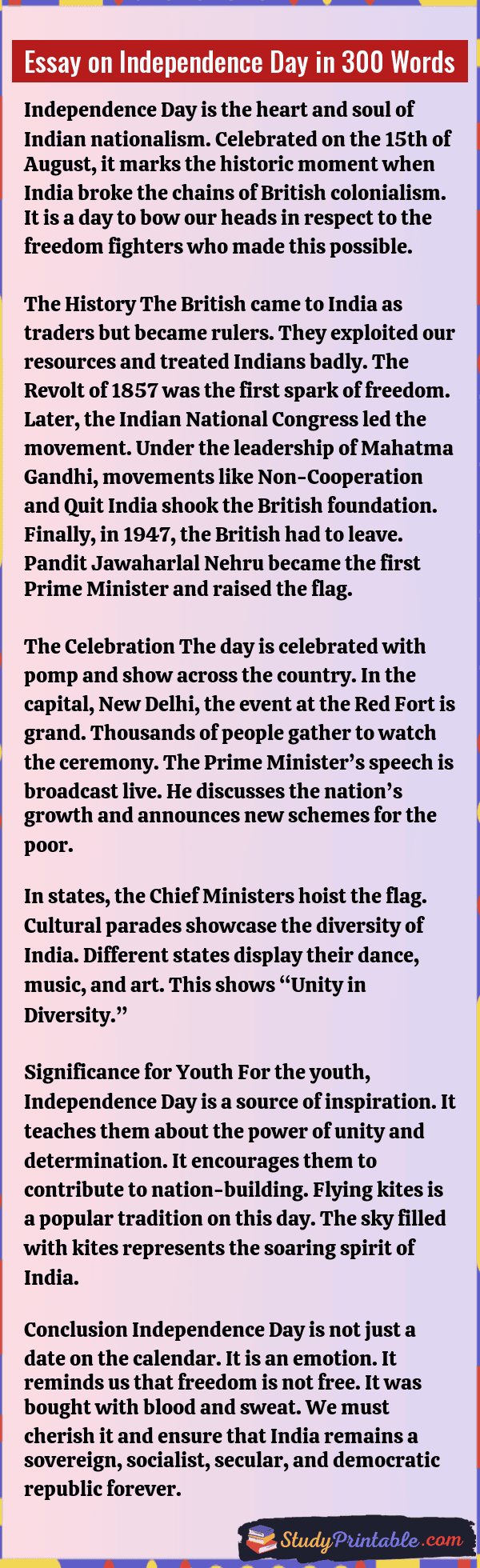
Essay on Independence Day in 300 Words
Independence Day is the heart and soul of Indian nationalism. Celebrated on the 15th of August, it marks the historic moment when India broke the chains of British colonialism. It is a day to bow our heads in respect to the freedom fighters who made this possible.
The History
The British came to India as traders but became rulers. They exploited our resources and treated Indians badly. The Revolt of 1857 was the first spark of freedom. Later, the Indian National Congress led the movement. Under the leadership of Mahatma Gandhi, movements like Non-Cooperation and Quit India shook the British foundation. Finally, in 1947, the British had to leave. Pandit Jawaharlal Nehru became the first Prime Minister and raised the flag.
The Celebration
The day is celebrated with pomp and show across the country. In the capital, New Delhi, the event at the Red Fort is grand. Thousands of people gather to watch the ceremony. The Prime Minister’s speech is broadcast live. He discusses the nation’s growth and announces new schemes for the poor.
In states, the Chief Ministers hoist the flag. Cultural parades showcase the diversity of India. Different states display their dance, music, and art. This shows “Unity in Diversity.”
Significance for Youth
For the youth, Independence Day is a source of inspiration. It teaches them about the power of unity and determination. It encourages them to contribute to nation-building. Flying kites is a popular tradition on this day. The sky filled with kites represents the soaring spirit of India.
Conclusion
Independence Day is not just a date on the calendar. It is an emotion. It reminds us that freedom is not free. It was bought with blood and sweat. We must cherish it and ensure that India remains a sovereign, socialist, secular, and democratic republic forever.
Essay on Independence Day in 500 Words
Independence Day is a golden day in the history of India. It is celebrated every year on August 15. This day marks the end of 200 years of British rule and the birth of a free nation. It is a day of national pride, joy, and remembrance. On this day, we remember the struggles of our forefathers and celebrate the spirit of freedom.
The Struggle for Freedom
The story of India’s freedom is a long and difficult one. The British East India Company entered India for trade but slowly took over the entire country. They imposed heavy taxes and destroyed local industries. The Indians were treated as second-class citizens in their own land.
The fight for freedom began with the Revolt of 1857, also known as the First War of Independence. Brave leaders like Rani Lakshmibai and Mangal Pandey fought courageously. Later, the freedom movement became organized. Mahatma Gandhi introduced the weapons of Truth (Satya) and Non-violence (Ahimsa). He led mass movements like the Dandi March and the Quit India Movement.
On the other hand, revolutionaries like Bhagat Singh, Rajguru, Sukhdev, and Subhash Chandra Bose believed in aggressive action. They sacrificed their youth and lives for the motherland. Finally, the British could no longer control India. On August 15, 1947, they left, and India became independent.
Celebrations Across the Nation
Independence Day is a national festival. It is a public holiday. The main event is held at the Red Fort in Delhi. The Prime Minister of India hoists the National Flag. The band plays the National Anthem, “Jana Gana Mana.” A 21-gun salute is given to honor the Tricolor. Flower petals are showered from helicopters.
The Prime Minister then addresses the nation. He speaks about the achievements of the past year and the goals for the future. He also remembers the martyrs who died for the country.
In every school, college, and office, the flag is hoisted. Children sing patriotic songs like “Sare Jahan Se Acha.” They perform plays depicting the life of freedom fighters. Sweets, especially laddoos, are distributed to everyone. The streets are decorated with flags and lights.
The Spirit of Unity
Independence Day unites the whole country. People of all religions—Hindus, Muslims, Sikhs, and Christians—celebrate it together. It reminds us that we are Indians first. The diversity of our culture is shown through folk dances and songs performed on this day. It strengthens the bond of brotherhood among citizens.
Our Responsibility
Freedom is a precious gift. But it comes with duties. Today, India faces new challenges like pollution, corruption, poverty, and terrorism. Independence Day is a time to think about these problems. We must pledge to keep our country clean and green. We must be honest and hardworking. True independence will be achieved only when every Indian is educated, healthy, and happy.
Conclusion
Independence Day is a day to salute the heroes of the past and build the heroes of the future. It fills our hearts with patriotism. As we watch the flag fly high, we feel proud to be part of this great nation. Jai Hind!
Essay on Independence Day in 1000 Words
Independence Day is the most significant day in the annals of Indian history. Celebrated annually on August 15, it commemorates the day in 1947 when India liberated itself from the clutches of the British Empire. This day is not merely a holiday; it is a celebration of the indomitable human spirit, a tribute to the sacrifices of millions, and a reaffirmation of our commitment to democratic values. It is the day when the soul of a nation, long suppressed, found utterance.
The Dark Era of Colonialism
To understand the joy of independence, one must understand the pain of slavery. The British ruled India for nearly two centuries. They came as traders in the 1600s but used “Divide and Rule” policies to conquer the land. Under British rule, India’s wealth was drained. The local industries, especially textiles, were destroyed to favor British goods. Famines were common, and millions died of starvation. The Jallianwala Bagh massacre in 1919, where General Dyer ordered troops to fire on unarmed civilians, showed the brutality of foreign rule. Indians had no voice in their own government and lived in constant fear.
The Saga of Struggle
The journey to August 15, 1947, was paved with blood and sweat. It was a mass movement that involved every section of society—farmers, students, women, and workers.
The Violent and Non-Violent Streams: The freedom struggle had two main streams. One was led by Mahatma Gandhi, who preached Ahimsa (Non-violence) and Satyagraha (Truth-force). He believed that moral force was stronger than physical force. His movements, such as Non-Cooperation, Civil Disobedience, and Quit India, mobilized millions. He taught Indians to be fearless.
The other stream was led by revolutionaries. Icons like Bhagat Singh, Chandrashekhar Azad, and Ram Prasad Bismil believed that the British would only understand the language of force. Netaji Subhash Chandra Bose formed the Indian National Army (INA) to fight the British militarily. Both streams played a vital role in weakening the British hold on India.
The Dawn of Freedom
Finally, the British realized they could no longer rule India. The toll of World War II and the relentless pressure from Indian nationalists forced them to leave. At the stroke of midnight on August 14, 1947, India awoke to life and freedom. Pandit Jawaharlal Nehru, the first Prime Minister, delivered his famous “Tryst with Destiny” speech. He said, “At the stroke of the midnight hour, when the world sleeps, India will awake to life and freedom.”
However, the joy was mixed with the sorrow of Partition. The country was divided into India and Pakistan. This led to communal riots and the displacement of millions. Despite this tragedy, the birth of a free India was a monumental event in world history.
Celebrations at the Red Fort
The tradition established in 1947 continues to this day. The main function is held at the Red Fort in Delhi.
The Ceremony: In the morning, the Prime Minister is received by the Defence Minister and the chiefs of the Army, Navy, and Air Force. He inspects the Guard of Honour. He then proceeds to the ramparts of the fort to hoist the National Flag. As the Tricolor unfurls, the National Anthem is played, and a 21-gun salute is fired. This moment fills every Indian heart with goosebumps.
The Address: The Prime Minister then addresses the nation. This speech is very significant. It is a report card of the government’s work and a roadmap for the future. He highlights the country’s achievements in science, economy, and defense. He also speaks about challenges like terrorism and poverty. The speech ends with the chanting of “Jai Hind” (Victory to India).
Celebrations Across India
The spirit of Independence Day is felt in every corner of the country.
Schools and Colleges: Educational institutions are the hubs of celebration. Students arrive in crisp uniforms. The Principal hoists the flag. Cultural programs are held where students sing patriotic songs and perform skits about freedom fighters. Sweets are distributed, which is the favorite part for many children.
Kite Flying: In North India, especially in Delhi, kite flying is a tradition. The sky is dotted with kites of all shapes and sizes. It symbolizes the free spirit of the nation soaring high. Rooftops are packed with families cheering and celebrating.
Illumination: At night, government buildings like the Parliament House, Rashtrapati Bhavan, and state assemblies are lit up with the colors of the flag—Saffron, White, and Green. It is a breathtaking sight.
Significance of the Day
Independence Day is a reminder of our national identity. India is a land of immense diversity. We have hundreds of languages, different religions, and varied customs. Yet, on this day, we all stand under one flag and sing one anthem. It reinforces the idea of “Unity in Diversity.”
It is also a day of gratitude. We enjoy the fruits of democracy today because our ancestors sacrificed their today for our tomorrow. We have the right to speak, to vote, and to live freely. We must never take these rights for granted.
Challenges and the Way Forward
While we celebrate our freedom, we must also introspect. Are we truly free? We are free from British rule, but are we free from hunger, illiteracy, and corruption?
India has made great strides. We are a nuclear power, a space power, and a growing economy. But millions still live in poverty. Caste discrimination and gender inequality still exist. Independence Day is a call to action. It urges the youth to take charge. The true celebration of independence is to build a nation where every citizen has dignity and opportunity.
Conclusion
Independence Day is a festival of freedom. It is a day to rejoice in our sovereignty. But it is also a day to renew our vows to the motherland. As we look back at the glory of 1947, we must also look forward to India at 100 in 2047. The dream of a developed, peaceful, and prosperous India lies in our hands. Let us work together to make the Tricolor fly higher and higher. Jai Hind, Jai Bharat.
FAQ
When is Independence Day celebrated in India?
Independence Day is celebrated on August 15 every year. This is the day India became free from British rule in 1947.
Who hoists the flag at the Red Fort?
The Prime Minister of India hoists the national flag at the Red Fort in New Delhi. He also gives a speech to the nation from there.
What is the difference between Independence Day and Republic Day?
Independence Day (August 15) marks freedom from British rule. Republic Day (January 26) marks the day our Constitution came into force and India became a republic.
Why do people fly kites on Independence Day?
People fly kites to symbolize freedom. A kite flying high in the sky represents a free nation and a free spirit. It is a tradition of joy and celebration.


