
Knowing right from wrong is a big skill. It helps us be good people. It makes the world a safe place. When we do right, we feel happy. When we do wrong, we feel sad. It guides our choices every day. It builds trust with friends. Everyone needs to learn this early. These essays are written for students in classes 1 to 12.
Essay on Right and Wrong in 100 Words
Right and wrong are two paths. The right path is good. It means helping others. It means telling the truth. The wrong path is bad. It hurts people. It includes telling lies. Or taking things that are not yours. Parents teach us this first. Teachers help us too.
We have a feeling inside. It is called a conscience. It tells us what to do. If we feel guilt, it is wrong. If we feel peace, it is right. Choosing right makes us strong. It makes our parents proud. We should always try to do the good thing.
Essay on Right and Wrong in 150 Words
Life is full of choices. We pick between good and bad. Right actions follow the rules. They are fair to everyone. Wrong actions break the rules. They are selfish. For example, sharing a toy is right. Stealing a toy is wrong. Helping a friend is right. Hitting a friend is wrong.
We learn these rules at home. We learn them at school too. Sometimes it is hard to choose. We might want to be naughty. But we must stop and think. We must think about others. How would they feel?
If an action causes pain, do not do it. If it brings joy, do it. Being honest is always right. Cheating is always wrong. A good person listens to their heart. They try to be kind. This makes the world a nice place to live. Everyone likes a person who does right.
Essay on Right and Wrong in 200 Words
Right and wrong are like a compass. They show us where to go. The right way leads to peace. The wrong way leads to trouble. We face this test every day. Should I do homework? Or should I tell a lie?
Doing homework is right. Lying is wrong. Doing the right thing builds trust. People believe an honest person. They do not trust a liar. Trust is like a glass. Once broken, it is hard to fix. So, we must be careful.
Sometimes, doing right is hard. It might make us lose a game. But winning by cheating is fake. Real winning is being fair. Our conscience is a little voice. It whispers in our ear. It says “stop” when we do bad.
We must listen to it. If we ignore it, it goes quiet. That is dangerous. Society has laws too. Laws tell us what is wrong. Stealing is a crime. Speeding is unsafe. These laws keep us safe. But morals are deeper. They are about being good inside. A hero is someone who chooses right, even when no one is looking. This is true character.
Essay on Right and Wrong in 250 Words
Understanding right and wrong is vital. It is the base of a good life. It is not just about rules. It is about feelings too. Empathy is a big word. It means feeling what others feel. If you hurt someone, they cry. You should feel sad too. This stops you from doing wrong.
Right actions act like seeds. We plant them and good things grow. Kindness grows into friendship. Honesty grows into respect. Wrong actions are like weeds. They ruin the garden. Anger grows into fights. Lies grow into fear. We want a garden of flowers, not weeds.
Who decides what is right? Parents guide us first. They say “share” and “say sorry.” Religion also teaches us. Most faiths say the same thing. Do not kill. Do not steal. Love your neighbor. These are universal truths.
But sometimes, it is tricky. What if two good things clash? This is a dilemma. We have to think hard. We have to pick the best outcome. We must ask, “What brings the most good?”
We make mistakes sometimes. We do the wrong thing. That is okay if we learn. We must say sorry. We must fix the mess. This brings us back to the right path. We grow up by learning. We become better humans. The goal is to be kind. To be fair. To be true. This makes a happy life. It makes a happy world.
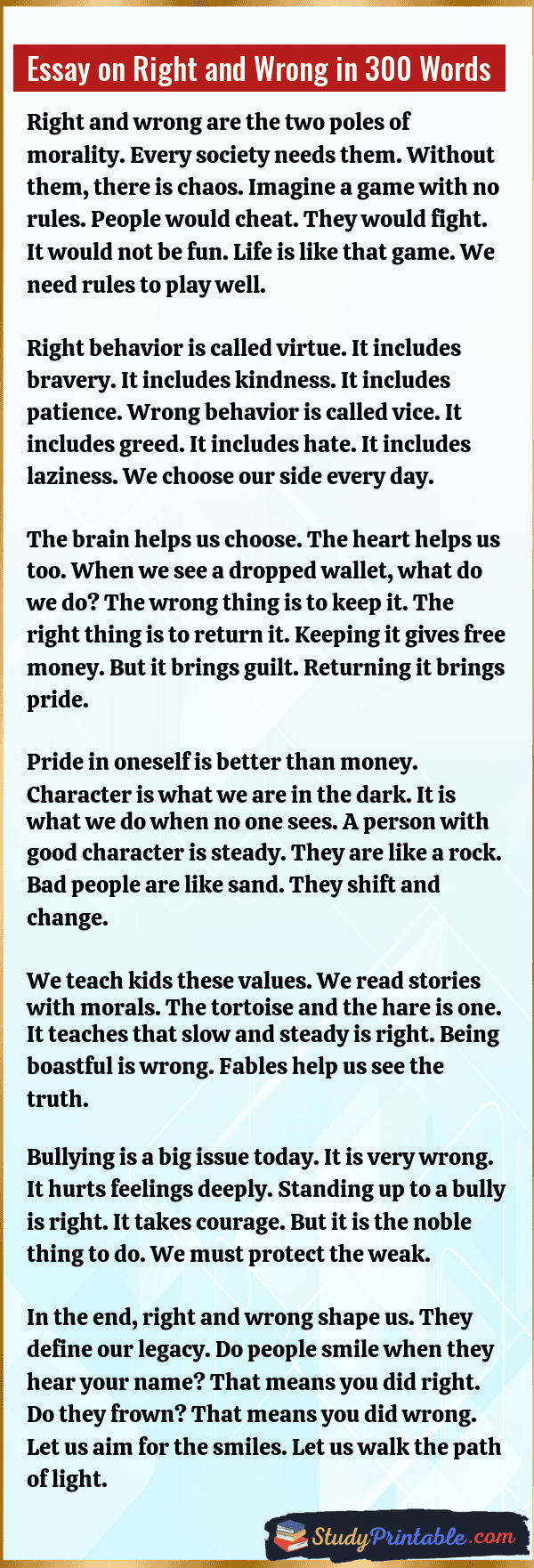
Essay on Right and Wrong in 300 Words
Right and wrong are the two poles of morality. Every society needs them. Without them, there is chaos. Imagine a game with no rules. People would cheat. They would fight. It would not be fun. Life is like that game. We need rules to play well.
Right behavior is called virtue. It includes bravery. It includes kindness. It includes patience. Wrong behavior is called vice. It includes greed. It includes hate. It includes laziness. We choose our side every day.
The brain helps us choose. The heart helps us too. When we see a dropped wallet, what do we do? The wrong thing is to keep it. The right thing is to return it. Keeping it gives free money. But it brings guilt. Returning it brings pride.
Pride in oneself is better than money. Character is what we are in the dark. It is what we do when no one sees. A person with good character is steady. They are like a rock. Bad people are like sand. They shift and change.
We teach kids these values. We read stories with morals. The tortoise and the hare is one. It teaches that slow and steady is right. Being boastful is wrong. Fables help us see the truth.
Bullying is a big issue today. It is very wrong. It hurts feelings deeply. Standing up to a bully is right. It takes courage. But it is the noble thing to do. We must protect the weak.
In the end, right and wrong shape us. They define our legacy. Do people smile when they hear your name? That means you did right. Do they frown? That means you did wrong. Let us aim for the smiles. Let us walk the path of light.
Essay on Right and Wrong in 500 Words
Introduction
Right and wrong are simple words. But they have deep meaning. They are the tools for living. They help us get along. A world without them would be scary. No one would be safe. Everyone would only care for themselves. So, we learn to distinguish them. We learn to be moral beings.
The Inner Voice
Inside every person is a voice. It is the conscience. It acts like a judge. When we help a granny, it cheers. It says, “Good job.” We feel warm and happy. When we pull a cat’s tail, it scolds. It says, “That is bad.” We feel a heavy knot in the tummy. This knot is guilt. Guilt is good. It tells us to stop. It tells us to say sorry. It is our internal alarm. We must keep the battery fresh. We do this by listening to it.
Learning from Others
We are not born knowing everything. We watch and learn. Parents are the first teachers. They scold us for biting. They hug us for sharing. This sets the pattern. Schools teach us too. They have rules. No running in halls. No talking in class. These rules teach order. They teach respect for others.
Books and movies help too. Heroes do the right thing. Villains do the wrong thing. The hero wins in the end. This teaches us that good prevails. It makes us want to be heroes.
Impact on Society
Society rests on right and wrong. Laws are based on them. Stealing is wrong, so it is a crime. Hitting is wrong, so it is a crime. If everyone stole, shops would close. If everyone hit, hospitals would be full. We follow rules to live together.
Trust is the glue of society. If I promise to pay you, I must do it. That is the right thing. If I do not, you will not trust me again. Business stops. Friendship stops. Honesty keeps the wheels turning.
The Golden Rule
There is a simple rule. It is called the Golden Rule. It says, “Treat others as you want to be treated.” This is the best test. Before you act, think. Would I like this done to me? If the answer is no, then it is wrong. If the answer is yes, it is right. It is a magic key. It solves most problems.
Mistakes and Forgiveness
No one is perfect. We all do wrong sometimes. We tell a white lie. We get angry. This is human. The key is what happens next. Do we hide it? Or do we fix it? Admitting a mistake is the right thing. It is brave. Saying sorry heals the hurt. Forgiving others is also right. Holding a grudge is wrong. It hurts us more than them.
Conclusion
Choosing right is a daily task. It is not always easy. But it is always worth it. It brings peace of mind. It brings good friends. It makes the world a bright place.
Essay on Right and Wrong in 1000 Words
Introduction
The concepts of right and wrong are ancient. They are as old as humans. They are the invisible lines we draw. On one side is good behavior. On the other side is bad behavior. Staying on the good side is a duty. It is a duty to ourselves. It is a duty to our neighbors. Without these concepts, we are just wild animals. With them, we are civilized people. We build cities and families. We create art and laws. Understanding this difference is the most important lesson in life.
What is Right?
Doing right means acting with love. It means acting with fairness. It is about adding value to the world. When we help a blind man cross the road, it is right. We do not get money for it. We do not get a prize. But we feel good. That feeling is the reward.
Right actions are built on values. Honesty is a value. It means speaking the truth. If you break a vase, you admit it. You do not blame the cat. Responsibility is a value. It means doing your chores. It means finishing your homework. Kindness is a value. It means using nice words. It means sharing your lunch.
What is Wrong?
Doing wrong comes from selfishness. It puts “me” before “we.” It ignores the pain of others. Stealing is a classic wrong. It takes what is not ours. It makes the victim sad and angry. Lying is another wrong. It hides the truth. It creates a false world.
Cheating is also wrong. If you peek at a test paper, you cheat. You might get a good grade. But you did not learn. You cheated yourself. Bullying is a very bad wrong. It uses power to hurt. It leaves deep scars. Wrong actions break connections. They build walls between people.
The Role of Conscience
How do we know the difference? We have a built-in sensor. It is the conscience. It is not a body part like a hand. It is a part of the mind. It is developed over time.
When a baby pulls hair, they do not know it is wrong. They learn when the parent says “No.” Slowly, the voice goes inside. By age five, a child knows. They look around before taking a cookie. They know they might get caught.
Later, we do right even if no one looks. That is a mature conscience. It is the police officer in the head. It keeps us on the straight path.
Ethics and Culture
Different places have different rules. In some places, burping is polite. In others, it is rude. These are manners. They are small rights and wrongs. But the big ones are the same everywhere.
Murder is wrong in every land. Theft is wrong in every tribe. These are universal ethics. They protect life and property.
Religion plays a big role here. Every faith has a code. Christians follow the Ten Commandments. Buddhists follow the Eightfold Path. They all say similar things. They say we must control our bad side. We must feed our good side. They give us a map for a moral life.
The Grey Areas
Sometimes, it is not black and white. It is grey. Imagine a starving man. He steals a loaf of bread. Is it wrong? Yes, stealing is wrong. But letting his family die is also wrong. This is a moral dilemma.
We have to weigh the options. We have to look at the intent. Did he want to hurt the baker? No. He wanted to save a life. This makes it complex. Courts look at this too. They look at why a crime was done.
But for kids, it is usually clear. Hitting a brother is wrong. There is no good reason. Taking a candy is wrong. We must master the simple rules first.
Consequences
Every action has a reaction. This is true in physics. It is true in morals. Right actions bring good results. If you study, you learn. If you are kind, you get friends. These are positive consequences.
Wrong actions bring bad results. If you lie, you get caught. You get punished. You lose privileges. Even if you don’t get caught, you lose peace. You worry about the secret.
Karma is a word for this. It means what goes around comes around. If you put good into the world, good comes back. If you put bad, bad comes back. It is a circle.
Peer Pressure
Friends can test us. They might say, “Let’s skip class.” They might say, “Let’s break this window.” This is peer pressure. It is hard to say no. We want to fit in. We do not want to be teased.
But a real friend does not ask you to do wrong. Saying no takes strength. It shows leadership. Often, others want to say no too. They are just waiting for one person to be brave. Being that brave person is doing right.
The Ripple Effect
One right action can change a lot. It is like a ripple in a pond. You smile at a sad boy. He feels better. He goes home and helps his mom. She feels happy. She cooks a great meal. The dad comes home to a happy house.
It all started with one smile. We never know how far our good deeds go. They travel far. The same is true for bad deeds. One mean word can ruin a day for many people. We have the power to create ripples. We should choose happy ones.
Conclusion
Life is a long journey. We walk it one step at a time. Each step is a choice. Right or wrong? Good or bad? We build our life with these bricks. A house built on right actions is strong. Storms cannot knock it down. A house built on wrong actions is weak. It will fall.
We must teach this to every child. We must model it as adults. We must celebrate good deeds. We must correct bad deeds with love. Understanding right and wrong is the key. It unlocks a meaningful life. It makes us human in the best sense.
FAQ
What is a conscience?
A conscience is a feeling inside you. It tells you if something is good or bad. It is like a little voice in your head.
Why should we do the right thing?
Doing the right thing builds trust. It makes us feel proud and happy. It also makes the world a better place for everyone.
Is lying ever okay?
Lying is usually wrong because it breaks trust. Sometimes people tell small lies to be polite, but being honest is almost always better.
How do I know if something is wrong?
Ask yourself if it hurts someone. Ask if you would like it done to you. If the answer is yes, it is likely wrong.


