
The Amazon Jungle is the largest rainforest in the world. It is a vast green land full of tall trees and amazing animals. It is often called the “Lungs of the Earth” because it makes a lot of the oxygen we breathe. A huge river flows through it, giving life to everything around. Many plants used for medicine are found here. Protecting this jungle is vital for the health of our planet. The following essays are written for students from Class 1 to Class 12.
Essay on Amazon Jungle in 100 Words
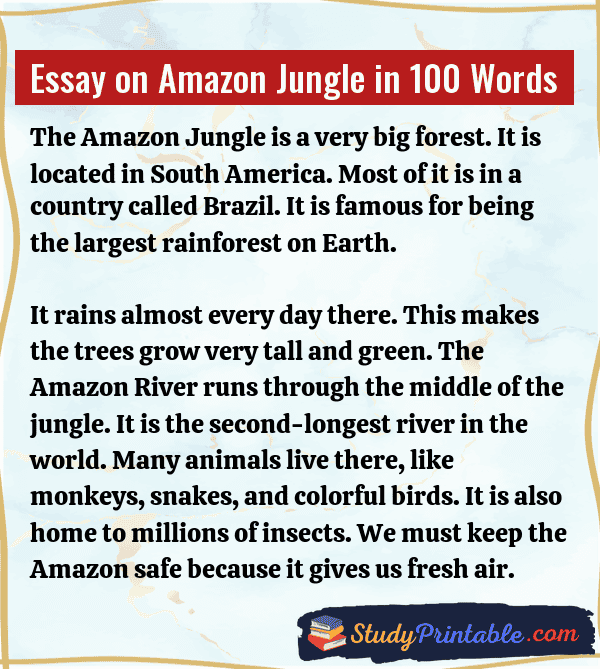
The Amazon Jungle is a very big forest. It is located in South America. Most of it is in a country called Brazil. It is famous for being the largest rainforest on Earth.
It rains almost every day there. This makes the trees grow very tall and green. The Amazon River runs through the middle of the jungle. It is the second-longest river in the world. Many animals live there, like monkeys, snakes, and colorful birds. It is also home to millions of insects. We must keep the Amazon safe because it gives us fresh air.
Essay on Amazon Jungle in 150 Words
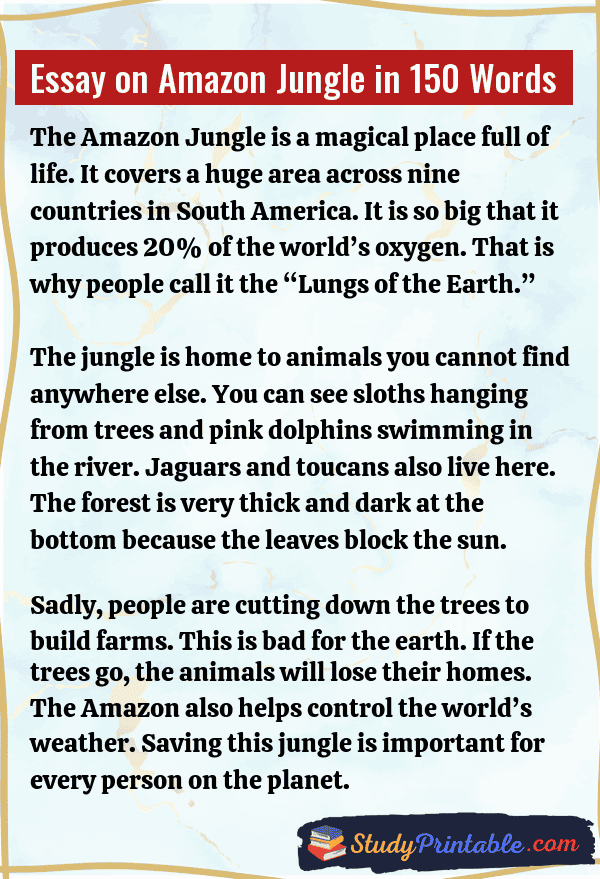
The Amazon Jungle is a magical place full of life. It covers a huge area across nine countries in South America. It is so big that it produces 20% of the world’s oxygen. That is why people call it the “Lungs of the Earth.”
The jungle is home to animals you cannot find anywhere else. You can see sloths hanging from trees and pink dolphins swimming in the river. Jaguars and toucans also live here. The forest is very thick and dark at the bottom because the leaves block the sun.
Sadly, people are cutting down the trees to build farms. This is bad for the earth. If the trees go, the animals will lose their homes. The Amazon also helps control the world’s weather. Saving this jungle is important for every person on the planet.
Essay on Amazon Jungle in 200 Words
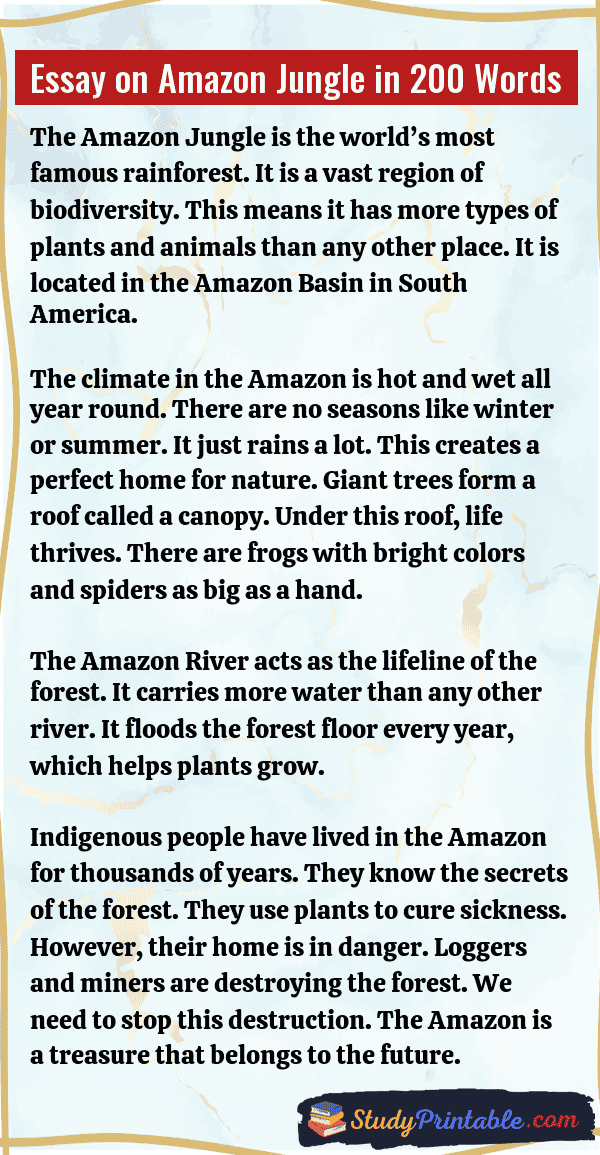
The Amazon Jungle is the world’s most famous rainforest. It is a vast region of biodiversity. This means it has more types of plants and animals than any other place. It is located in the Amazon Basin in South America.
The climate in the Amazon is hot and wet all year round. There are no seasons like winter or summer. It just rains a lot. This creates a perfect home for nature. Giant trees form a roof called a canopy. Under this roof, life thrives. There are frogs with bright colors and spiders as big as a hand.
The Amazon River acts as the lifeline of the forest. It carries more water than any other river. It floods the forest floor every year, which helps plants grow.
Indigenous people have lived in the Amazon for thousands of years. They know the secrets of the forest. They use plants to cure sickness. However, their home is in danger. Loggers and miners are destroying the forest. We need to stop this destruction. The Amazon is a treasure that belongs to the future.
Essay on Amazon Jungle in 250 Words
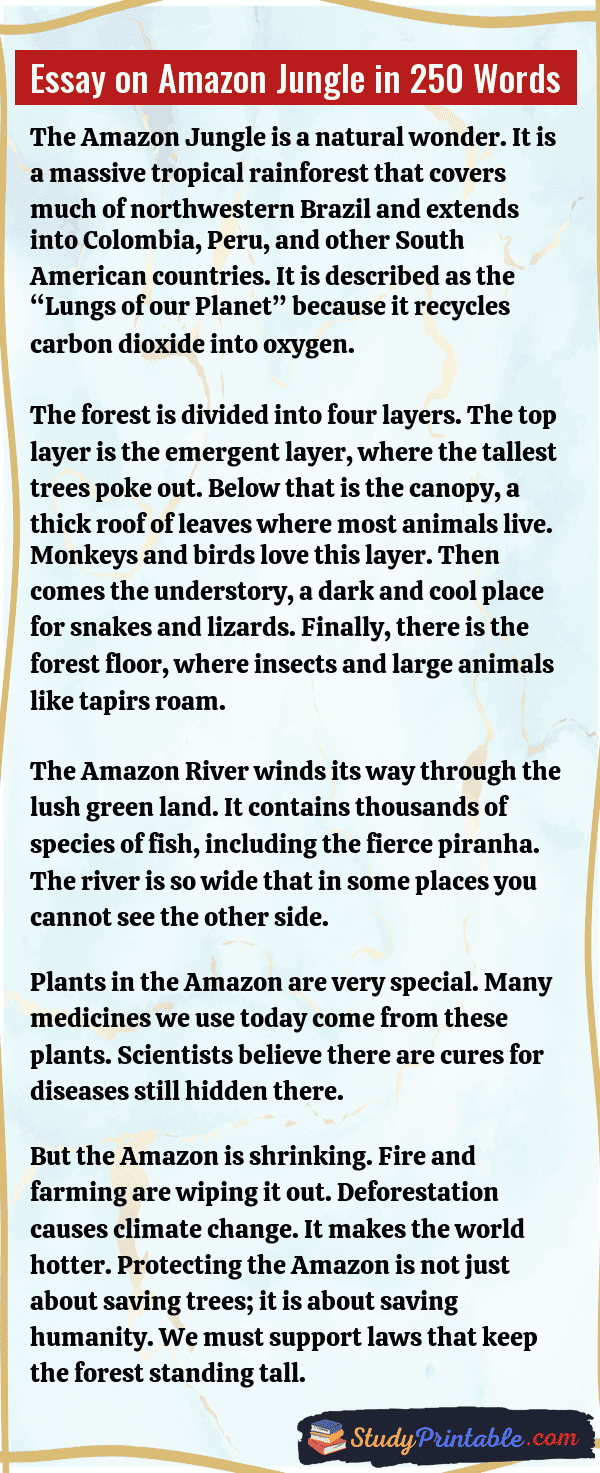
The Amazon Jungle is a natural wonder. It is a massive tropical rainforest that covers much of northwestern Brazil and extends into Colombia, Peru, and other South American countries. It is described as the “Lungs of our Planet” because it recycles carbon dioxide into oxygen.
The forest is divided into four layers. The top layer is the emergent layer, where the tallest trees poke out. Below that is the canopy, a thick roof of leaves where most animals live. Monkeys and birds love this layer. Then comes the understory, a dark and cool place for snakes and lizards. Finally, there is the forest floor, where insects and large animals like tapirs roam.
The Amazon River winds its way through the lush green land. It contains thousands of species of fish, including the fierce piranha. The river is so wide that in some places you cannot see the other side.
Plants in the Amazon are very special. Many medicines we use today come from these plants. Scientists believe there are cures for diseases still hidden there.
But the Amazon is shrinking. Fire and farming are wiping it out. Deforestation causes climate change. It makes the world hotter. Protecting the Amazon is not just about saving trees; it is about saving humanity. We must support laws that keep the forest standing tall.
Essay on Amazon Jungle in 300 Words
The Amazon Jungle is the crown jewel of the natural world. It is the largest and most species-rich tract of tropical rainforest in the world. It represents over half of the planet’s remaining rainforests. Without the Amazon, the Earth would be a very different place.
A Home for Wildlife
The biodiversity here is stunning. One in ten known species in the world lives in the Amazon. It is home to the jaguar, the largest cat in the Americas. It has the loudest animal, the Howler Monkey. The river has the Electric Eel and the giant Anaconda snake. Every trip to the Amazon reveals a new creature.
The River Sea
The Amazon River is often called the “River Sea” because of its vast size. It contains more water than the next seven largest rivers combined. It flows from the Andes Mountains in Peru all the way to the Atlantic Ocean in Brazil.
Threats to the Jungle
Today, the Amazon faces a crisis. Humans are clearing the land for cattle ranching and soy farming. Gold mining is poisoning the rivers. In 2019, huge fires burned large parts of the forest. This destruction releases huge amounts of carbon into the air. This speeds up global warming.
Indigenous Tribes
There are about 400 distinct indigenous tribes in the Amazon. Some have never had contact with the outside world. They live in harmony with nature. They take only what they need. Their knowledge of the forest is priceless.
Conclusion
The Amazon is a global responsibility. It regulates the rain cycle for the whole continent. If it dies, the world will suffer. We must act to conserve this green paradise.
Essay on Amazon Jungle in 500 Words
The Amazon Jungle, also known as Amazonia, is a moist broadleaf tropical rainforest in the Amazon biome that covers most of the Amazon basin of South America. This basin encompasses 7 million square kilometers, of which 5.5 million square kilometers are covered by the rainforest. It is a place of immense beauty and danger, filled with the wonders of the natural world.
Geography and Climate
The majority of the forest is contained within Brazil, with 60% of the rainforest, followed by Peru with 13%, and minor amounts in Colombia, Venezuela, Ecuador, Bolivia, Guyana, Suriname, and French Guiana. The climate is tropical, meaning it is hot and humid. It rains frequently, which keeps the forest lush and green. The average temperature is around 27 degrees Celsius all year round.
The Layers of Life
The jungle is structured like a building with different floors.
1. Forest Floor: This is the ground level. It is very dark because less than 2% of sunlight reaches here. Leaves rot quickly here, feeding the soil. Animals like anteaters and armadillos live here.
2. Understory: This lies above the floor. It is a tangle of shrubs and young trees. It is home to jaguars and boa constrictors who wait for prey.
3. Canopy: This is the roof of the forest formed by tree branches. It acts as an umbrella. Most of the Amazon’s animals, such as toucans, sloths, and monkeys, live here because there is plenty of food.
4. Emergent Layer: These are the giant trees that poke out above the canopy. Eagles and bats rest here.
The Amazon River
The lifeblood of the jungle is the Amazon River. It originates in the Andes Mountains. It has over 1,100 tributaries. During the wet season, the river rises and floods the forest floor. This allows fish to swim among the tree trunks. The pink river dolphin, a rare and smart animal, is found here.
Environmental Importance
The Amazon is critical for the global climate. Trees absorb carbon dioxide, a gas that traps heat. By holding this carbon, the Amazon cools the planet. It also produces vast amounts of water vapor, which creates “flying rivers” (clouds) that bring rain to other parts of the world.
Deforestation and Conservation
Unfortunately, the Amazon is disappearing. Loggers cut down valuable trees for wood. Farmers burn the forest to make space for cows. This is called “slash and burn.” Scientists warn that if we lose too much forest, it could turn into a dry savannah. This would be a disaster for climate change. Many organizations are working to save the Amazon. They are planting new trees and protecting the lands of indigenous people. We must support these efforts.
Essay on Amazon Jungle in 1000 Words
The Amazon Jungle is the world’s greatest natural resource. It is a vast expanse of greenery that spans across nine nations in South America. It is the largest rainforest on Earth, often described as the “Lungs of the Planet” because of its vital role in maintaining the Earth’s atmosphere. It is a place of mystery, home to uncontacted tribes and undiscovered species. It is a living, breathing giant that affects the weather patterns of the entire globe.
Geography and Scale
The scale of the Amazon is hard to comprehend. It covers about 40% of the South American continent. While Brazil holds the largest share, the jungle also extends into Peru, Colombia, Venezuela, Ecuador, Bolivia, Guyana, Suriname, and French Guiana. The Amazon Basin, the area drained by the Amazon River and its tributaries, is almost the size of the United States.
The heart of this ecosystem is the Amazon River. By volume, it is the largest river in the world. It discharges more water into the ocean than the next seven largest rivers combined. At its widest point during the wet season, the river can be 40 kilometers wide. It is so large that ocean-going ships can travel deep inland.
Biodiversity: A Treasure Trove
The Amazon is the most biologically diverse place on Earth. It is estimated that the region is home to about 390 billion individual trees divided into 16,000 species.
Animals: The fauna is incredibly varied. The canopy is noisy with the calls of macaws and parrots. The forest floor is prowled by the jaguar and the cougar. The rivers are teeming with piranhas, electric eels, and the giant arapaima fish. The insect population is massive, with millions of species, including beautiful butterflies and dangerous ants.
Plants: The flora is equally impressive. The Victoria Amazonica is a giant water lily with leaves so big a small child can sit on them. There are countless medicinal plants. Drugs for fighting cancer, malaria, and heart disease have been derived from Amazonian plants. Scientists believe less than 1% of these flowering plants have been studied for their medicinal potential.
The Indigenous People
Humans have lived in the Amazon for at least 11,000 years. Today, there are about 30 million people living in the Amazon basin. Among them are roughly 400 diverse indigenous tribes. These people have a deep spiritual connection to the forest. They view the land not as a resource to be exploited, but as a parent that provides for them.
Some of these tribes are “uncontacted,” meaning they live in voluntary isolation deep in the forest. They have no contact with modern civilization. They are the guardians of the forest. However, they face threats from illegal miners and loggers who invade their territory and bring diseases to which they have no immunity.
The Climate Engine
The Amazon acts as a giant air conditioner for the Earth. Through a process called transpiration, the trees release water vapor into the air. A single large tree can release 1,000 liters of water a day. This moisture forms thick clouds that travel across the continent, bringing rain to farms and cities far away.
Furthermore, the forest is a massive carbon sink. It stores between 90 and 140 billion metric tons of carbon. When trees are cut or burned, this carbon is released as CO2, accelerating global warming. Preserving the Amazon is one of the most effective ways to fight climate change.
Threats to the Amazon
Despite its importance, the Amazon is under siege.
Deforestation: This is the biggest threat. Since 1970, about 20% of the rainforest has been lost. The land is cleared primarily for cattle ranching. Brazil is the world’s largest exporter of beef, and the forest pays the price.
Agriculture: Soy plantations are another major driver. Farmers clear vast areas to grow soy, much of which is used to feed animals in Europe and China.
Mining and Logging: Illegal gold mining pollutes the rivers with mercury. Illegal logging targets valuable trees like mahogany. Roads built for these industries open up the forest to further destruction.
Fire: In recent years, the number of fires has spiked. Farmers often set fire to the forest to clear land for planting. In the dry season, these fires can rage out of control, destroying millions of acres.
The Tipping Point
Scientists warn of a “tipping point.” This is a point of no return. If deforestation reaches 20-25%, the forest will no longer be able to generate enough rain to sustain itself. It will start to dry out and turn into a savannah. This would lead to a massive loss of biodiversity and a catastrophic release of carbon. We are dangerously close to this point.
Global Efforts and Future
Saving the Amazon requires a global effort. International pressure creates laws to protect the forest. Consumer choices matter too. Avoiding products linked to deforestation helps reduce demand. Sustainable development is key. We need to find ways for the local people to earn a living without destroying the trees. Ecotourism and sustainable harvesting of nuts and fruits are good examples.
The Amazon is a heritage for all humanity. It is a library of life that we have barely begun to read. Burning it down is like burning a library before we have read the books.
Conclusion
The Amazon Jungle is a wonder of nature that sustains life on Earth. Its survival is linked to our survival. It is a battle between short-term greed and long-term survival. The roar of the jaguar and the flow of the Amazon River are calls to action. We must protect this green heart of our world before it stops beating.
FAQ
Where is the Amazon Jungle located?
The Amazon Jungle is in South America. Most of it is in Brazil, but it also spreads into Peru, Colombia, and other nearby countries.
Why is it called the “Lungs of the Earth”?
It is called the “Lungs of the Earth” because the trees there make a huge amount of oxygen. They take in the bad gas (carbon dioxide) and give us fresh air to breathe.
What dangerous animals live there?
There are many dangerous animals. The jaguar is a strong big cat. The anaconda is a giant snake. In the water, there are piranhas with sharp teeth and electric eels that can shock you.
Why is the jungle burning?
The jungle burns mostly because of humans. Farmers and loggers start fires on purpose to clear the land. They want to make space for cows and farms. Sometimes, dry weather makes the fires spread fast.


