
The world is full of different kinds of plants. From tiny green moss on a rock to giant banyan trees, the variety is endless. This is called diversity in plants. Some plants grow in water, while others grow in dry deserts. Some give us sweet fruits, while others have sharp thorns. This mix of shapes, sizes, and colors makes nature beautiful and keeps life on Earth going. The following essays are written for students from Class 1 to Class 12.
Essay on Diversity in Plants in 100 Words
Diversity in plants means having many different types of plants. If you look at a garden, you see tall trees and short grass. You see flowers of all colors like red, yellow, and blue.
Some plants live on land, like the mango tree. Some live in water, like the lotus. There are plants that need lots of rain, and others, like the cactus, that can live in hot deserts with no water. Some plants live for only a few months, while others live for hundreds of years. This variety helps animals and humans survive.
Essay on Diversity in Plants in 150 Words
Diversity in plants refers to the amazing variety of plant life on Earth. There are thousands of species found everywhere. We can group them based on their size. Small plants with soft stems are herbs, like mint. Bigger plants are shrubs, like the rose. The biggest ones with hard trunks are trees, like the oak.
Plants also differ in where they live. This is called their habitat. Aquatic plants float on water. Desert plants have thick skins to save water. Plants in snowy mountains are shaped like cones to shed snow.
Another big difference is flowers. Flowering plants produce seeds inside fruits. Non-flowering plants, like ferns, use spores to grow. This diversity is very important. Different plants provide different kinds of food and medicine. Without this variety, the world would be a boring and difficult place to live.
Essay on Diversity in Plants in 200 Words
Our planet is home to a vast diversity of plants. This diversity is seen in their structure, lifespan, and habitat. Some plants are microscopic, like algae floating in a pond. Others are massive, like the Redwood trees in California that touch the sky.
We can see diversity in how they reproduce. Most plants we see are Angiosperms. They have flowers and fruits. Examples include apple trees and sunflowers. But there are also Gymnosperms. These plants do not have flowers. They have cones instead, like the pine tree.
Adaptation is another part of diversity. A cactus turns its leaves into spines to stop animals from eating it and to save water. A climber plant has weak stems but uses hooks to climb up tall trees to get sunlight.
Plants also vary in their lifespan. Annuals like rice live for one season. Perennials like the neem tree live for many years. This rich variety keeps the soil healthy and the air clean. It supports all the animals and insects in the food chain. We must protect all types of plants, not just the useful ones.
Essay on Diversity in Plants in 250 Words
Diversity in plants is nature’s way of ensuring survival. It is the wide range of plant species found in different environments. Scientists have identified over 300,000 types of plants, but many more are yet to be discovered.
One way to look at diversity is through the root system. Some plants, like carrots, have a taproot. This is one main root going deep. Others, like grass, have fibrous roots. These are many small roots spreading out. This helps different plants grow in different soils.
Leaves also show great diversity. Banana leaves are huge, while neem leaves are tiny. Pine needles are sharp, while rubber plant leaves are thick and waxy. These shapes help the plant survive in its specific home.
The role of plants varies too. Leguminous plants, like peas, help fix nitrogen in the soil. This makes the soil rich for other plants. Medicinal plants like Tulsi and Aloe Vera heal our bodies.
Sadly, human activities are reducing this diversity. Cutting down forests destroys rare plants. When we lose a plant species, we might lose a cure for a disease. We also lose the insects that depend on that plant. Conservation of plant diversity is crucial. We can do this by creating botanical gardens and seed banks. Protecting biodiversity is protecting our own future.
Essay on Diversity in Plants in 300 Words
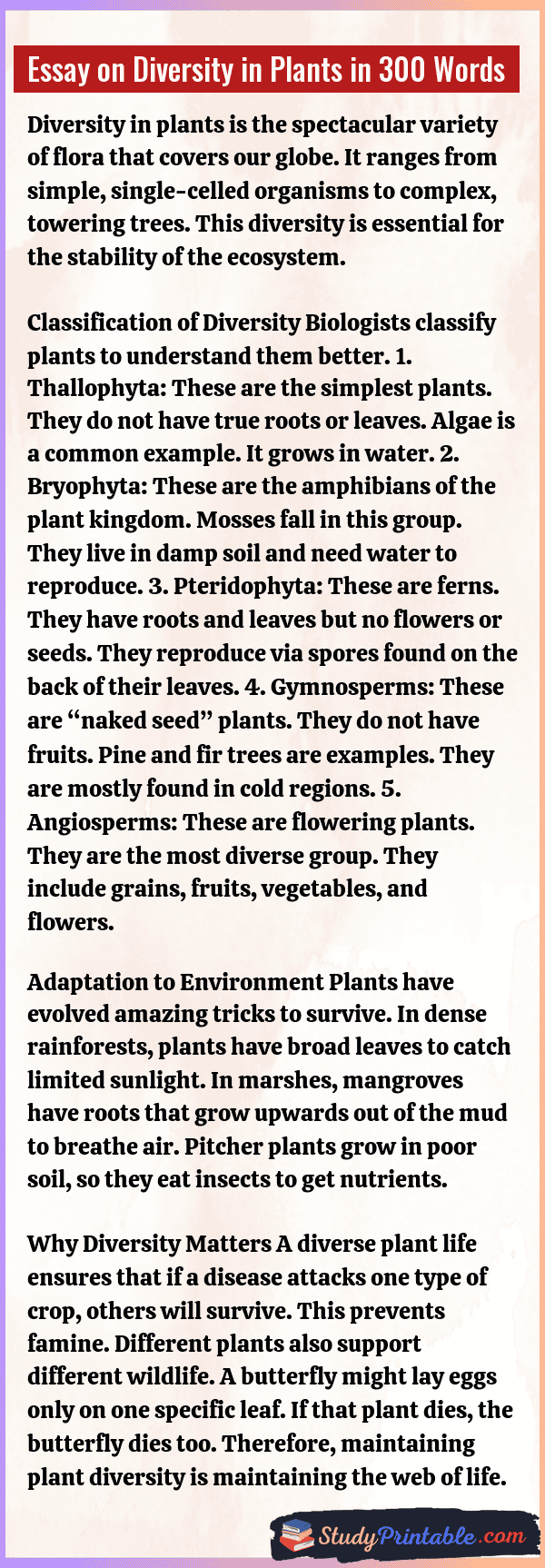
Diversity in plants is the spectacular variety of flora that covers our globe. It ranges from simple, single-celled organisms to complex, towering trees. This diversity is essential for the stability of the ecosystem.
Classification of Diversity
Biologists classify plants to understand them better.
1. Thallophyta: These are the simplest plants. They do not have true roots or leaves. Algae is a common example. It grows in water.
2. Bryophyta: These are the amphibians of the plant kingdom. Mosses fall in this group. They live in damp soil and need water to reproduce.
3. Pteridophyta: These are ferns. They have roots and leaves but no flowers or seeds. They reproduce via spores found on the back of their leaves.
4. Gymnosperms: These are “naked seed” plants. They do not have fruits. Pine and fir trees are examples. They are mostly found in cold regions.
5. Angiosperms: These are flowering plants. They are the most diverse group. They include grains, fruits, vegetables, and flowers.
Adaptation to Environment
Plants have evolved amazing tricks to survive. In dense rainforests, plants have broad leaves to catch limited sunlight. In marshes, mangroves have roots that grow upwards out of the mud to breathe air. Pitcher plants grow in poor soil, so they eat insects to get nutrients.
Why Diversity Matters
A diverse plant life ensures that if a disease attacks one type of crop, others will survive. This prevents famine. Different plants also support different wildlife. A butterfly might lay eggs only on one specific leaf. If that plant dies, the butterfly dies too. Therefore, maintaining plant diversity is maintaining the web of life.
Essay on Diversity in Plants in 500 Words
Diversity in plants, also known as plant biodiversity, is the richness of plant life on Earth. It is the result of millions of years of evolution. Plants were the first living things to colonize land, and they have adapted to almost every corner of the planet. From the freezing tundra to the scorching desert, plants have found a way to thrive.
The Spectrum of Plant Life
The plant kingdom is incredibly varied. At the bottom of the scale, we have non-vascular plants. These are plants like mosses and liverworts. They lack the tubes to carry water, so they stay small and hug the damp ground.
Higher up, we have vascular plants. These have special tissues called xylem and phloem to transport water and food. This allows them to grow tall. Ferns were the first plants to develop this system, but they still rely on water for reproduction.
The most advanced are the seed-bearing plants. Seeds are a major evolutionary step. They protect the baby plant and provide it with food. This group is divided into Gymnosperms and Angiosperms. Angiosperms, or flowering plants, are the dominant plants today. They use beautiful flowers and sweet nectar to attract insects for pollination. This partnership with insects is a key reason for their massive diversity.
Diversity in Habitat
Xerophytes: These are plants adapted to dry conditions. Cacti store water in their stems. Their leaves are reduced to spines to prevent water loss.
Hydrophytes: These are water plants. The lotus has a waxy coating on its leaves so water doesn’t rot them. Hydrilla grows completely underwater.
Mesophytes: These land plants live in moderate climates. Most of our crops like wheat and maize belong here.
Epiphytes: These are plants like orchids that grow on other trees. They do not harm the tree; they just use it for support to reach the sunlight.
Economic and Ecological Importance
Plant diversity is the foundation of human agriculture. We eat thousands of different plants. Different varieties of rice and wheat have been bred to resist pests and droughts. Wild relatives of these crops are a treasure trove of genes that can help improve our food in the future.
Medicinally, diversity is vital. The rosy periwinkle gives us drugs for cancer. The bark of the cinchona tree cures malaria. Indigenous tribes use thousands of plants that modern science is just beginning to study.
Ecologically, diverse forests are more resilient. They can recover from fires and storms faster than forests with only one type of tree. They regulate the climate and water cycle more efficiently.
Conclusion
However, this diversity is under threat. Monoculture, where farmers grow only one crop over huge areas, kills diversity. Climate change is moving faster than plants can adapt. Saving plant diversity is not just about saving pretty flowers; it is about saving the systems that keep us alive. We must value and protect the green variety of our blue planet.
Essay on Diversity in Plants in 1000 Words
The Earth is a green planet, teeming with an incredible variety of vegetation. This variety is what we call diversity in plants. It encompasses the genetic variation within species, the variety of species in a region, and the variety of ecosystems. Plants are the primary producers of the world. They capture the energy of the sun and turn it into food. Without plants, there would be no animals and no humans. The diversity of plants is what makes life on Earth resilient, beautiful, and sustainable.
Evolutionary History of Diversity
Plant diversity is a story of evolution. It began billions of years ago with simple algae in the ocean. These aquatic plants produced the oxygen that created our atmosphere. Over time, plants moved onto land. The first land plants were small and simple, like mosses. They had to stay near water to survive.
Then came the ferns, which developed vascular tissues to pump water. This allowed them to grow taller. Later, plants developed seeds, which allowed them to reproduce without water. The Gymnosperms, like pines and cycads, dominated the earth during the time of the dinosaurs. Finally, around 140 million years ago, flowering plants (Angiosperms) appeared. They evolved rapidly, creating the colorful and diverse world we see today.
Classification of Plant Diversity
To make sense of this vast variety, scientists classify plants into major groups.
1. Algae: These are simple, plant-like organisms. They can be single-celled or multicellular like seaweed. They live in water and are the base of the aquatic food web.
2. Bryophytes: These include mosses and liverworts. They are the “amphibians” of the plant world. They live on land but need water for fertilization. They play a key role in preventing soil erosion.
3. Pteridophytes: These are the ferns and horsetails. They are seedless vascular plants. They reproduce using spores. You often see them in damp, shady forests.
4. Gymnosperms: These are the naked seed plants. Their seeds are not enclosed in a fruit. Examples include conifers like pine, spruce, and fir. They are adapted to cold and dry climates. They give us timber and paper.
5. Angiosperms: These are the flowering plants. Their seeds are enclosed within a fruit. They are the most successful group, with over 250,000 species. They range from tiny duckweeds to massive eucalyptus trees. They provide most of our food, clothing, and medicine.
Diversity in Adaptations
Plants have evolved fascinating features to survive in different habitats.
Desert Adaptations: In the desert, water is scarce. Plants like the cactus store water in fleshy stems. They have no leaves to reduce water loss. Some desert plants have roots that go 50 feet deep to find water.
Rainforest Adaptations: In the rainforest, the competition is for light. Lianas are woody vines that climb up tall trees to reach the sun. Some plants have “drip tips” on their leaves so rain runs off quickly, preventing mold.
Aquatic Adaptations: Plants like the water lily have floating leaves with air sacs. This keeps them on the surface to catch sunlight. Their roots are small because they can absorb water directly through their leaves.
Insectivorous Plants: In soil that lacks nitrogen, some plants turn into hunters. The Venus Flytrap and Pitcher Plant trap and digest insects to get the nutrients they need.
Importance of Plant Diversity
Food Security: Humans rely on a small number of crops for most of our calories—rice, wheat, corn, and potatoes. However, there are thousands of edible plants. Maintaining diversity in wild crops is essential. If a new pest destroys all the wheat, we can use genes from wild wheat to breed a resistant variety. This is why seed banks are so important.
Medicine: About 25% of all prescription medicines come from plants. The biodiversity of the rainforest is often called the world’s pharmacy. We have explored only a fraction of these plants. Losing diversity means losing potential cures for diseases like cancer or AIDS.
Ecosystem Services: Diverse plant communities provide clean water, oxygen, and fertile soil. They control floods and stabilize the climate. A mangrove forest protects the coast from tsunamis much better than a concrete wall.
Threats to Plant Diversity
Unfortunately, we are in the midst of a biodiversity crisis.
Habitat Loss: This is the biggest threat. We are clearing forests for agriculture, cities, and roads. When the home is gone, the plants disappear.
Invasive Species: Humans move plants around the world. Sometimes, a foreign plant (like the water hyacinth) grows too fast and kills the local plants.
Climate Change: The earth is heating up. Plants that live on cool mountain tops have nowhere to go. Changing rain patterns are causing droughts that kill forests.
Pollution: Acid rain and soil pollution harm sensitive plant species.
Conclusion
Diversity in plants is a precious heritage. It is the result of eons of natural selection. It keeps the planet functioning and healthy. We have a moral duty to protect it. Conservation efforts like National Parks and Biosphere Reserves are vital. But we also need sustainable living habits. We need to stop destroying nature in the name of development. Every species, no matter how small or simple, has a right to exist and a role to play in the grand symphony of life.
FAQ
What is the biggest group of plants?
The biggest group is Angiosperms, or flowering plants. There are more than 250,000 types of flowering plants. They include roses, mango trees, grass, and wheat.
Why do desert plants have thorns?
Desert plants like cacti have thorns instead of leaves. This helps them save water because leaves lose water in the heat. Thorns also protect the plant from animals that want to eat it.
What are aquatic plants?
Aquatic plants are plants that live in water. Some float on top like the lotus, and some grow underwater like hydrilla. They are adapted to live in wet places.
Why is it important to save different types of plants?
It is important because different plants help us in different ways. Some give food, some give medicine, and some clean the air. If we lose them, we might lose things we need to survive.


